
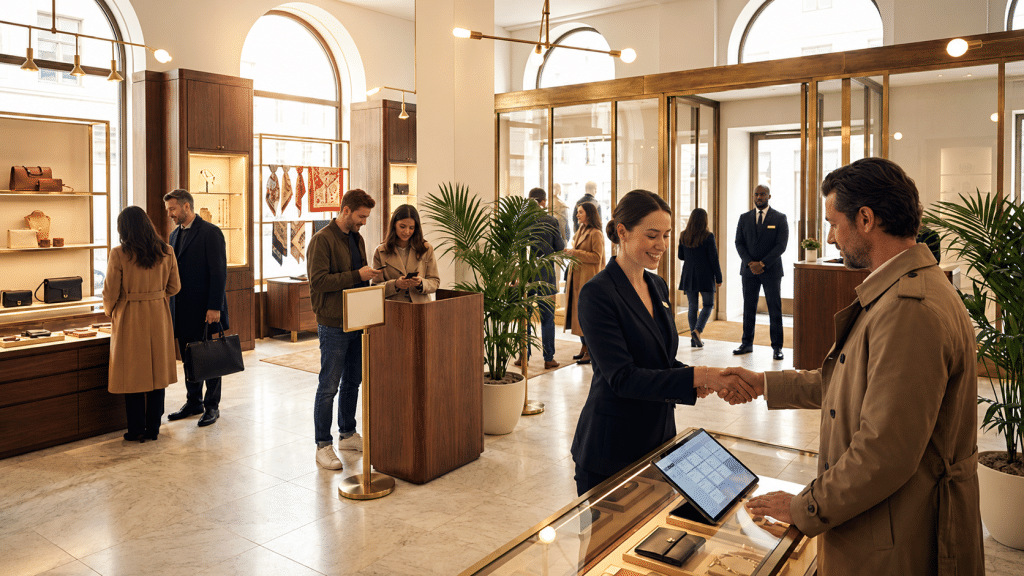

Peak periods define the commercial year for luxury retail, yet most boutiques enter them with the same floor capacity they run in a quiet week. When holiday crowds, collection launches, and private sale evenings converge, the boutique that cannot structure its flow loses sales it already paid to attract and erodes the calm that justifies its prices. This guide breaks down why peak traffic threatens the luxury experience, what drives the spikes, and the operational levers that keep the floor composed when demand surges.
Why Does Peak Traffic Threaten the Luxury In-Store Experience?
Luxury depends on a controlled, unhurried experience, and peak traffic attacks that control directly. A crowded floor forces client advisors to split their attention, shortens every interaction, and turns a considered purchase into a rushed transaction. The result is measurable revenue loss layered on top of a quieter cost: a diluted brand impression that the client carries home.
Managing that surge starts well before the client reaches the door, which is where structured booking earns its place. Maisons that treat luxury retail appointment scheduling as an operational layer, using platforms like Booxi, convert anticipated demand into planned visits instead of unmanaged crowds. That shift lets a boutique hold its service standard even on its busiest afternoon, because every advisor knows who is coming and why.
What Happens When a Boutique Exceeds Its Service Capacity?
A boutique exceeds its service capacity the moment client demand outpaces the advisors available to deliver the expected level of attention. When that happens, waiting replaces welcome, and waiting is where luxury retail leaks revenue. Research from Facit.ai found that 73% of customers walk away after waiting more than 5 minutes, so a saturated floor quietly converts qualified traffic into lost sales. Because the loss shows up as an empty exit rather than a failed transaction, most teams never see the number they are giving away.
How Do Visible Queues Affect Brand Perception?
Visible queues signal a loss of control, and in luxury that signal is expensive. A line at the entrance tells a passing client that the maison cannot manage its own floor, which contradicts the promise of exclusivity the brand sells. Most shoppers avoid a store with a visible queue altogether, and many will choose a competitor rather than stand and wait. For a boutique, the queue is not a neutral operational detail. It is a storefront message that sends prospective clients elsewhere.
What Drives Traffic Spikes in Luxury Boutiques?
Traffic spikes in luxury boutiques come from a predictable mix of calendar events and unstructured walk-in demand. Naming the drivers is the first step, because a spike you can anticipate is a spike you can staff and schedule against. The two categories below behave differently and call for different responses.
Which Moments Generate the Highest Footfall?
The highest footfall clusters around a handful of known moments: the December gift season, seasonal sales, collection launches, and private VIC events. These periods concentrate a disproportionate share of annual revenue into a few weeks, which raises the stakes on every interaction. Because the dates are known months ahead, the boutique that plans capacity around them turns a predictable surge into a revenue opportunity rather than a scramble.
How Does Unstructured Walk-In Traffic Compound the Problem?
Unstructured walk-in traffic compounds a peak because it arrives without warning and without context. When advisors cannot see who is in the boutique or what each visitor needs, the floor defaults to first-come service that ignores client value. High-intent buyers wait beside casual browsers, and the team spends its scarcest peak-hour minutes reacting instead of selling. Structuring that flow is what separates a boutique that absorbs a rush from one that is overwhelmed by it.
How Can Appointments Absorb Peak Demand?
Appointments absorb peak demand by converting an unpredictable crowd into a scheduled sequence of visits. Instead of everyone arriving at once, demand spreads across the day into slots the boutique can actually serve. This is the single most effective lever for protecting both revenue and experience when traffic surges.
Why Do Booked Visits Convert Better Than Walk-Ins?
Booked visits convert better than walk-ins because intent and preparation are built into them. A client who reserves time has already decided to buy, and the advisor can prepare the selection before the client arrives. Booxi’s Voice of Appointment report puts conversion on booked visits at 70%, against under 20% for average walk-in traffic, and records a 30% higher average basket after an appointment. During a peak, steering even a portion of demand into appointments raises the return on every hour of floor time.
How Do Appointments Make Staffing Predictable at Peak?
Appointments make staffing predictable because a booked calendar is a demand forecast. When advisors can see the day’s reservations in advance, managers schedule the right people for the right services instead of paying for availability and hoping. That visibility also protects prepared slots from no-shows; Booxi reports a no-show rate under 4% with reminders in place, well below the common 10% to 20% industry range. Predictable demand is what lets a boutique staff a peak with precision rather than guesswork.
How Can Queue Management Keep the Floor Calm During a Rush?
Queue management keeps the floor calm by organizing the walk-in traffic that appointments do not capture. Not every client will book, so the boutique still needs a way to absorb spontaneous visits without letting a line form at the door. A structured queue turns waiting from a visible failure into an invisible, managed step.
What Is an Invisible Queue and Why Does It Matter in Luxury?
An invisible queue is a system that holds a client’s place without making them stand in a physical line. The client checks in, then browses, steps into the café, or waits in comfort until an advisor is free. For luxury, this matters because it removes the most damaging visual cue of overcrowding while preserving the client’s time. The boutique stays serene on the surface even when demand behind the scenes is at its highest.
How Does Self Check-In Reduce Wait-Time Friction?
Self check-in reduces friction by letting clients join the queue on their own terms, often through a QR code, the moment they arrive. That removes awkward gatekeeping at the entrance and gives the client a realistic wait estimate up front. Because the system tracks who is waiting and for what, advisors can prioritize by service type and client value instead of by whoever pushes forward. The friction of waiting drops, and the sense of order rises.
How Should Boutiques Protect VIC Experiences During Peak Hours?
Boutiques protect VIC experiences during peak hours by recognizing and routing their highest-value clients before the crowd absorbs them. A peak is exactly when a VIC is most likely to be treated as an anonymous visitor, and that failure carries the steepest cost. Deliberate prioritization keeps the most important relationships intact when the floor is under the most pressure.
Why Do High-Value Clients Need Priority Routing?
High-value clients need priority routing because their spend and loyalty justify a level of attention a crowded floor cannot deliver by default. When a top client walks in unrecognized during a rush, the advisor has no brief, no history, and no time, so the interaction defaults to generic service. Priority routing flags the client on arrival and connects them to the right advisor, turning a chaotic moment into a moment of recognition. That recognition is what protects lifetime value when it is most at risk.
Building Peak Readiness Before the Rush Hits
Peak readiness is built in the weeks before the surge, not improvised during it. The boutiques that stay composed at peak are the ones that mapped their demand, structured their booking and queue flows, and briefed their teams ahead of time. Preparation converts a known spike from a threat into the most productive stretch of the year.
What Role Does Demand Anticipation Play in Staffing and Space Planning?
Demand anticipation is the foundation of both staffing and space planning because it replaces reaction with a plan. When a boutique knows which days and hours will peak, it can align advisor schedules, reserve consultation space, and open appointment slots to shape the flow. Booking data makes that anticipation concrete, since reservations reveal demand patterns before they reach the floor. The boutique that plans against real signals enters its peak ready, not exposed.
Key Takeaways for Managing Peak Traffic in Luxury Retail
Managing peak traffic in luxury boutiques comes down to structuring demand before it structures you. Appointments spread the surge and lift conversion, queue management keeps the floor visibly calm, and VIC routing protects the relationships that matter most. Each lever depends on anticipation, so the real work happens before the crowd arrives. Handled well, a peak stops being a risk to the experience and becomes the clearest proof of a boutique’s command of its floor.
Frequently Asked Questions About Peak Traffic in Luxury Boutiques
How Do Luxury Boutiques Handle Crowds During the Holidays?
Luxury boutiques handle holiday crowds by planning capacity around known peak dates and steering demand into appointments and managed queues. Booking spreads visits across the day, while an invisible queue absorbs walk-ins without a visible line. Teams are briefed and staffed against the forecast, so the boutique serves more clients without sacrificing its service standard.
Do Appointments Really Reduce Walk-Outs at Peak Times?
Yes. Appointments reduce walk-outs because they replace uncertain waiting with a reserved time, giving clients a reason to stay and a moment they can count on. A booked client arrives expected and prepared for, which shortens the path to a sale. During peaks, every visit converted from an anxious wait into a scheduled appointment is a walk-out avoided.
How Can a Boutique Reduce Wait Times Without Losing Exclusivity?
A boutique reduces wait times without losing exclusivity by making the wait invisible rather than by rushing service. Self check-in and a virtual queue let clients hold their place while they browse or relax, so the floor never looks crowded. Pairing that with appointments for high-intent and VIC clients keeps the experience unhurried, which is the exact feeling exclusivity depends on.
