
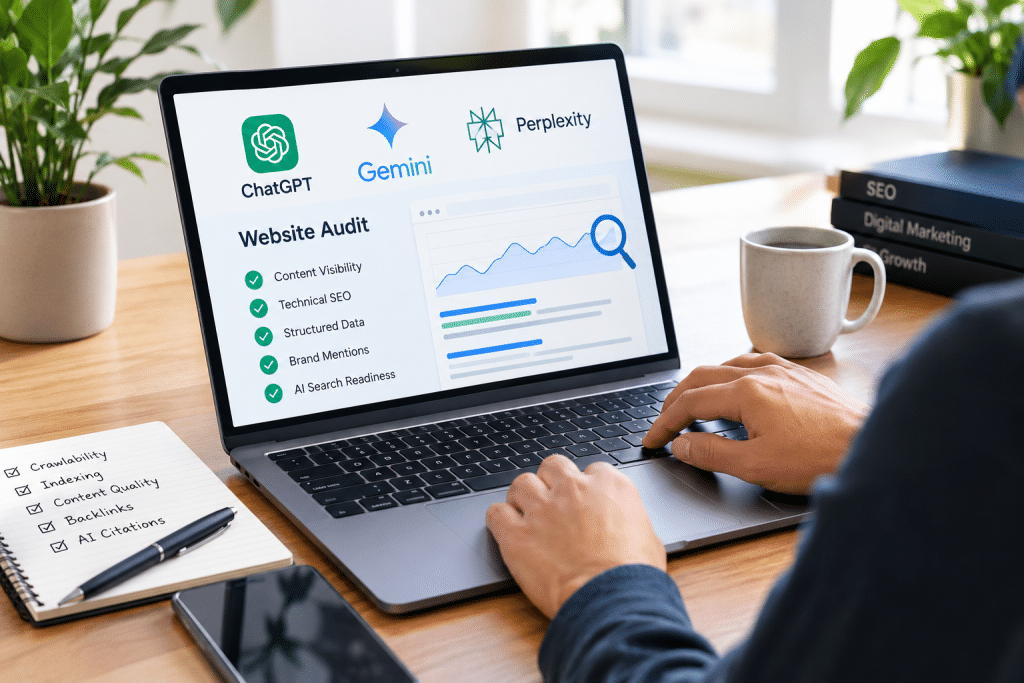

Your website may attract Google traffic but still miss out when a buyer asks ChatGPT to recommend an ecommerce agency. That’s the blind spot an AI search visibility audit helps uncover. It shows whether AI platforms mention your business, which pages support those mentions, and where competitors are getting attention you are missing.
The answer isn’t to publish ten more blogs and hope for the best. Start by checking what AI platforms can find, what they understand about your business, and whether your content gives customers a convincing reason to choose you.
5 Ways to Check Your AI Search Visibility
1. Ask AI Platforms the Questions Your Customers Ask
Open ChatGPT, Gemini, and Perplexity and test real buyer queries, not just your company name.
Try these:
- Which ecommerce development agencies help small businesses grow?
- How do I choose a reliable Shopify development partner?
- Which agencies offer ecommerce SEO and AI search optimization?
Keep a record of brand mentions, cited URLs, competitor recommendations, and factual errors. Run the same prompts again later. AI answers can vary, so one appearance is not proof of lasting visibility.
2. Make Sure Your Website Is Accessible
Even excellent content has limited value if important pages cannot be discovered or accessed.
Check your robots.txt file, XML sitemap, internal links, redirects, and indexability. Review important landing pages to confirm their main content loads correctly and remains readable without complicated interactions.
For ChatGPT search, OpenAI documents OAI-SearchBot as a crawler used to surface websites in search results. Its role differs from GPTBot, which is used for potential model training. Consult the official crawler documentation before changing access rules.
Check each platform’s requirements separately. One configuration does not automatically suit every AI search engine.
3. Find the Questions Your Content Leaves Unanswered
Read your service pages from a buyer’s perspective. Can someone understand what you offer, what the process involves, and whether your service fits their needs?
Consider a Shopify development page. If it mentions attractive storefronts but says nothing about integrations, migration, customization, or ongoing support, buyers still have important questions.
Use an AI search optimization audit checklist to review content accuracy, missing answers, outdated information, and unsupported claims. Add details that help readers make informed decisions rather than padding pages with keywords.
4. Check Whether Your Brand Information Holds Up
AI platforms may encounter information about your business beyond your own website. Review relevant business directories, professional profiles, partner websites, industry publications, and customer reviews.
Correct inconsistent company details. Replace outdated service descriptions. Where you have genuine expertise, publish useful examples or original insights that others can reference.
Google’s guidance on AI search features reinforces established SEO fundamentals and helpful, original content. No specific GEO tactic guarantees an AI recommendation.
5. Look at What Competitors Explain Better
Test the same buyer questions for your business and three competitors. Compare their cited pages, supporting evidence, service explanations, and coverage of common concerns.
Perhaps a competitor explains how ecommerce migrations work, while your website only lists development services. That is a clear content gap.
Fix the gaps that affect buying decisions first.
Your AI Search Audit Checklist
| Area | What to examine |
| AI mentions | Brand appearances across three platforms |
| Citations | Referenced pages and external sources |
| Technical SEO | Crawl access, indexability, and internal links |
| Content | Accurate facts and direct answers |
| Trust | Consistent business details and credible mentions |
| Competitors | Missing topics and stronger competing pages |
| Results | Referral traffic, enquiries, and conversions |
Begin with manual prompt testing, Google Search Console, website analytics, and a technical SEO crawler. Specialist tools for AI visibility can help monitor brand mentions and citations at scale. Before choosing one, check its platform coverage, data collection frequency, and reporting methodology.
From Better Visibility to Better Leads
An audit is useful only when you act on its findings. Resolve access issues first, improve high-value pages next, and then fill the content gaps that matter to customers. Retest your original queries and track qualified enquiries alongside referral traffic.
Webiators provides Organic Search Engine Optimization Services to strengthen organic search performance, Answer Engine Optimization for question-focused discovery, and Generative Engine Optimization Services to support visibility across AI-driven search experiences. Its Ecommerce Marketing Services can help connect these efforts with customer acquisition and conversion goals.
Agencies managing client campaigns may also explore white label SEO services and white label GEO optimization. If you’re assessing a white label SEO agency or deciding how to choose a white label SEO partner, ask how it verifies citations, measures progress, and reports meaningful business outcomes. Be cautious of anyone promising guaranteed AI rankings.
Start with ten buyer-intent queries. Record what appears, identify three weaknesses, and address them before your next review.
FAQs
1. How do I check whether ChatGPT mentions my website?
Test relevant buyer queries and record brand mentions and cited URLs. Verify sources directly and repeat the prompts periodically.
2. How can I improve my brand visibility in Gemini?
Maintain accessible, accurate pages that answer customer questions. Strengthen technical SEO and earn relevant, credible brand mentions. Results cannot be guaranteed.
3. How do I monitor website citations in Perplexity?
Run consistent queries, record cited domains and URLs, and review analytics for identifiable referral visits. Specialist monitoring tools may help with reporting.
4. What should an AI search visibility audit include?
Review brand mentions, citations, technical accessibility, content quality, trust signals, competitor coverage, content gaps, and business results.
5. How can I identify content gaps affecting AI search visibility?
Compare your website with customer questions and competitor pages cited in AI answers. Look for missing explanations, outdated facts, weak comparisons, and unanswered buying questions.
