
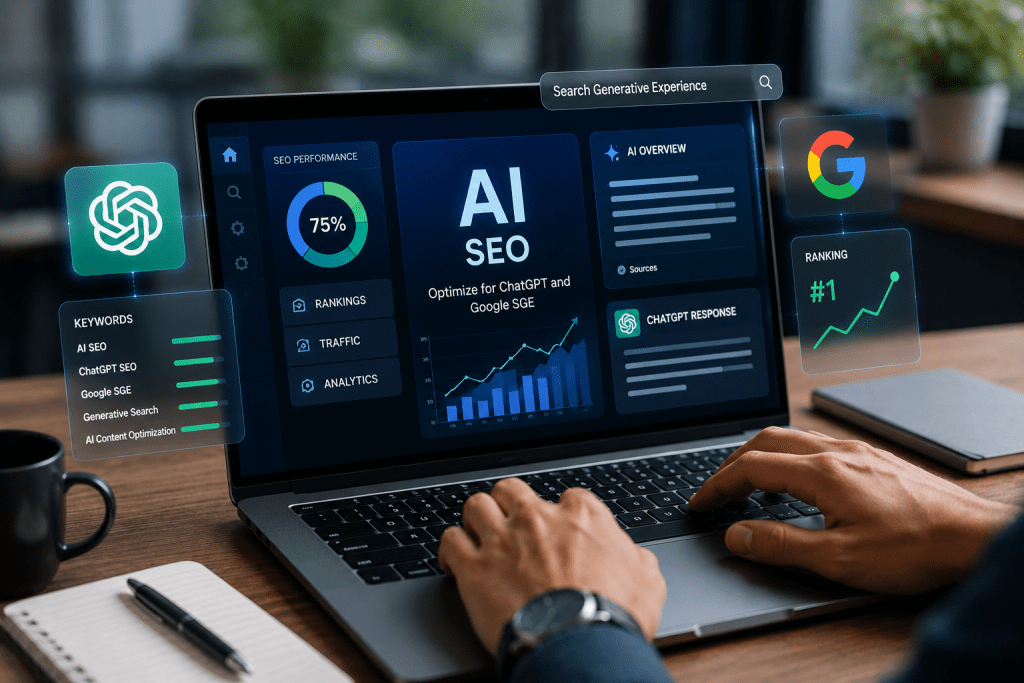

Search behavior has shifted in a very real way.
People are asking full questions and expecting direct answers instead of scanning multiple links. Tools like ChatGPT and Google SGE (Search Generative Experience) often provide summarized responses, which means fewer users click through unless your content stands out or gets referenced.
If your website is not structured for this shift, you are not just losing traffic. You are missing visibility during decision-making moments.
This is where AI SEO becomes important.
What Is AI SEO and Why It Matters

AI SEO is the process of optimizing your content so it is easy for AI systems to understand, interpret, and reference when generating answers.
It does not replace traditional SEO. It builds on it.
Here is the practical difference:
- Traditional SEO helps your pages rank in search results
- AI SEO improves the chances of your content being used in AI-generated answers
Important clarification:
AI tools like ChatGPT do not always pull directly from your website in real time. However, they rely on structured, high-quality, and widely trusted content patterns. Google SGE, on the other hand, may reference live web content.
So your goal is simple:
Make your content clear, useful, and credible enough to be selected.
How AI Search Systems Use Content

AI systems do not rank pages the same way search engines do. They analyze multiple sources and generate responses based on relevance and clarity.
They prefer content that is:
- Direct and easy to understand
- Well-structured and scannable
- Factually accurate
- Focused on answering specific questions
If your content is vague or overly complex, it becomes less usable.
How to Optimize for ChatGPT Search
1. Answer Real Questions Clearly
Focus on how users actually search.
Instead of writing broad statements, frame your content around specific questions.
Example:
Weak:
“Ecommerce websites are essential for business growth.”
Stronger:
“What is the best ecommerce platform for a small business with a limited budget?”
Then provide a clear, direct answer before expanding.
2. Keep Structure Clean and Logical
Clarity beats creativity in search.
Use:
- Short paragraphs
- Bullet points
- Numbered steps
- Clear subheadings
Example:
Ways to improve ecommerce conversions:
- Simplify checkout steps
- Reduce page load time
- Add trust signals like reviews
- Write clear product descriptions
This format improves readability and makes content easier to process.
3. Build Topical Consistency
Publishing unrelated content weakens authority.
Instead, stay focused on core areas such as:
- Ecommerce website development
- Conversion optimization
- Payment systems
- Digital marketing strategies
A structured content approach, often supported by SEO Services for Ecommerce, helps build long-term visibility and trust.
4. Add Practical and Verifiable Insights
Avoid generic advice.
Instead of:
“Improve website speed for better performance”
Use:
“Compressing images, reducing unused scripts, and using faster hosting can significantly reduce load time, which helps lower bounce rates.”
Keep it realistic and grounded in actual practices.
Google SGE SEO: What Works Today
Google SGE generates AI-based summaries within search results. It pulls insights from multiple sources to answer queries quickly.
1. Focus on User Intent
Keywords alone are not enough.
Understand what the user wants to achieve.
Example:
- Search: ecommerce marketing services
- Intent: increase sales or traffic
Your content should directly address those outcomes.
2. Keep Content Updated and Accurate
Outdated information reduces trust.
Regularly review:
- Tools and platforms
- Industry practices
- Statistics and examples
Accuracy plays a key role in credibility.
3. Make Content Easy to Extract
Structure matters.
Use:
- Clear headings
- Direct answers early in sections
- Logical flow between ideas
Avoid long, cluttered paragraphs. If it is hard to scan, it is harder to use.
A Practical AI SEO Strategy
Focus on Problem-Solving Content
Users search to solve problems.
Create content that answers:
- Why ecommerce sales are low
- How to improve conversion rates
- Which platform fits specific business needs
Clarity and relevance matter more than volume.
Strengthen Core Service Pages
Your blog should support your business goals.
Key pages like:
should:
- Answer common client questions
- Clearly explain your services
- Include real use cases or outcomes
- Guide users toward contacting you
Traffic without direction rarely converts.
Write Naturally and Clearly
AI search aligns with how people communicate.
Use simple language:
- Clear
- Direct
- Human
Avoid overcomplicated terms unless necessary.
Common Mistakes to Avoid
- Writing long, unfocused content
- Ignoring user intent
- Publishing without a content strategy
- Using unclear or technical language unnecessarily
- Over-optimizing for keywords
If your content is difficult to understand, it is less likely to perform well.
Conclusion
AI SEO is not about shortcuts. It is about clarity, usefulness, and consistency.
Websites that provide structured, relevant, and practical content are more likely to gain visibility across both traditional and AI-driven search.
If your goal is to attract the right audience and convert them into customers, your approach must combine strong content, solid SEO fundamentals, and a well-optimized website.
That is where a team like Webiators can support you, helping you build a strategy that aligns with how modern search actually works.
FAQs
1. What is AI SEO?
Ans. AI SEO is the process of making your content easier for AI systems to understand and use when generating answers.
2. How do I optimize for ChatGPT search?
Ans. Focus on clear answers, structured formatting, and useful content based on real user queries.
3. What is Google SGE SEO?
Ans. It refers to optimizing content so it can be included in Google’s AI-generated search summaries.
4. Does AI SEO replace traditional SEO?
Ans. No. It complements it. Both are necessary for visibility.
5. Why is AI SEO important for ecommerce businesses?
Ans. It increases the chances of your content being referenced during AI-driven recommendations, which can influence user decisions.
