
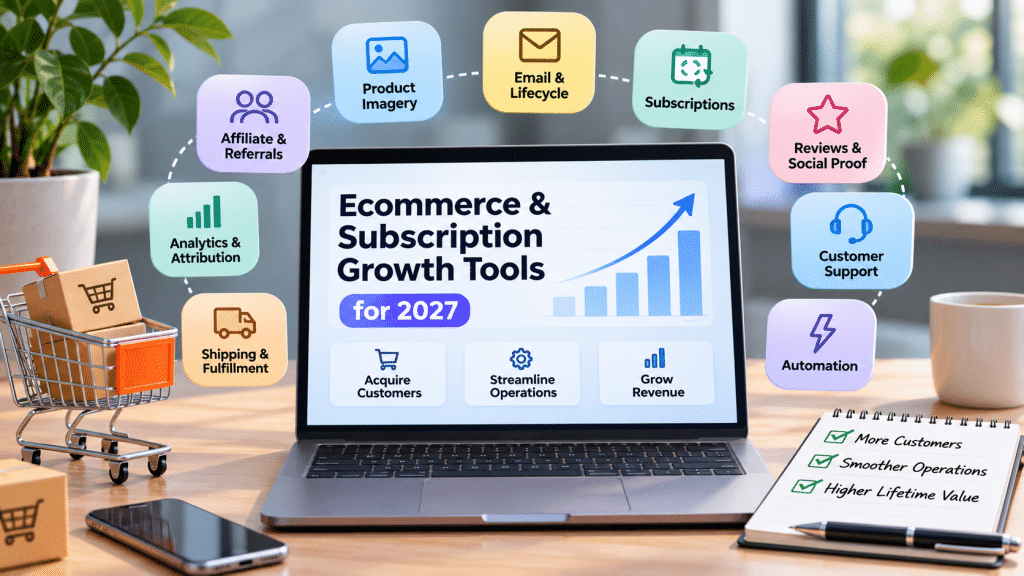

Most ecommerce businesses already have plenty of software. The harder question is whether each product still solves a problem that matters.
Growth tends to expose weak points gradually. Affiliate commissions become tedious to reconcile. Product photography spends too long waiting for approval. Support agents lose time hunting for order details. Marketing teams get conflicting attribution numbers.
A useful stack grows around those constraints. These ten tools cover different parts of ecommerce and subscription growth, with each earning its place for a different reason.
1. Rewardful for partner-led acquisition
Affiliate programs get more complicated once recurring revenue is involved. The first conversion is only part of the relationship because customers can later upgrade, downgrade, cancel, or receive a refund.
For Stripe-based subscription businesses, Rewardful connects those billing events with affiliate and referral tracking. Commissions can reflect changes in the customer relationship instead of being treated as a one-time calculation.
That makes the platform especially relevant once affiliates, customers, or creators become a real acquisition channel rather than a small experiment run from a spreadsheet.
2. PicDrop for getting product imagery approved
A product shoot can finish on Tuesday and still leave the store waiting for usable images on Friday.
The delay usually appears after the files arrive. One person chooses favorites, someone else comments on retouching, marketing wants a different crop, and the final version gets buried among email attachments and chat messages.
With PicDrop, selections, comments, approvals, and delivery stay connected to the actual images. For ecommerce teams producing photography regularly, that gives the creative handoff a clearer place to happen instead of spreading decisions across several channels.
3. Klaviyo once customers stop behaving alike
A small store can get a long way with a welcome sequence, abandoned-cart reminders, and occasional promotional emails.
Eventually, the audience stops being one audience. Repeat buyers behave differently from first-time customers. Some people respond to discounts while others buy at full price. Others haven’t returned for months.
Klaviyo becomes more valuable at that stage because customer behavior can shape segmentation and lifecycle messaging. The payoff comes from having enough data to create genuinely different experiences, not simply from adding another email platform.
4. Recharge gives subscription changes somewhere to live
Recurring products create ongoing account work that doesn’t exist in a standard one-time purchase.
Customers want to move a delivery, swap an item, pause the subscription, or cancel it. If every adjustment goes through support, a successful subscription model can generate a surprising amount of avoidable admin.
Recharge gives those recurring relationships their own operating layer. For brands built around replenishment or repeat delivery, customer-controlled subscription management reduces the pressure to handle every routine change manually.
5. Judge.me turns fulfilled orders into useful proof
Ecommerce product pages have an obvious limitation. Everything on them was chosen by the seller.
Customer reviews add evidence from people who actually bought the product. Judge.me collects written feedback as well as customer photos and videos, which can then appear on storefront pages where shoppers are making decisions.
That becomes particularly useful for products where appearance, fit, or scale is difficult to judge from polished brand photography alone. The value also grows with order volume because a larger customer base produces more material worth showing.
6. Gorgias shortens the distance between a ticket and the answer
A support request such as “Where is my order?” shouldn’t require an agent to reconstruct the customer’s history across several tabs.
Once ticket volume rises, those small lookups become expensive in aggregate.
Gorgias combines customer conversations with ecommerce context so agents can work with relevant store and order information close to the ticket itself. Well-designed AI applications can take this further by analyzing customer and order data to suggest responses, resolve routine questions, and reduce the workload on support teams. The benefit is less about adding another support channel and more about reducing the repeated searching that happens before an agent can deal with the actual question.
7. Rebuy focuses on shoppers who are already there
A store can spend heavily bringing qualified visitors to the site and still leave revenue on the table after they arrive.
For Shopify brands with products that naturally go together, Rebuy adds personalized recommendations, upsells, cross-sells, and other merchandising experiences around the purchase journey.
The catalog matters here. A store with a broad range of complementary products has much more room to improve discovery and basket size than one selling a handful of unrelated items. The opportunity comes from what customers could reasonably buy next, not simply from displaying more recommendations.
8. Triple Whale becomes relevant when attribution starts affecting budget
At low advertising spend, disagreement between platforms may be irritating without being especially costly.
That changes when a business is deciding where to move a significant marketing budget. Meta, Google, and other channels can each present a different account of what drove a purchase.
Triple Whale gives ecommerce teams another view of attribution and customer journeys across marketing activity. The reason to add that layer is practical. Once reporting differences start changing spending decisions, measurement becomes an operating problem rather than a dashboard preference.
9. ShipStation deals with the work growth creates after checkout
Marketing teams naturally focus on getting more orders. Operations teams then have to process them.
More volume means more labels, carrier choices, tracking updates, and opportunities for fulfillment errors. A merchant selling across several channels can reach the point where shipping administration absorbs time that used to go elsewhere.
ShipStation centralizes that side of the operation. It matters most when fulfillment has become the constraint and another hundred orders create more operational pressure than the existing process can comfortably absorb.
10. Zapier is for gaps between otherwise useful systems
Sometimes neither platform needs replacing. The problem is the manual step sitting between them.
An order arrives and someone creates a task. A customer update needs to reach another system. A repetitive internal notification still depends on somebody remembering to send it.
Zapier handles that kind of connection between applications through automated workflows. Its best use is a process that is already clear and repetitive. Automating an unstable workflow usually preserves the confusion instead of fixing it.
Buy the next tool for a reason you can measure
A growing software stack becomes harder to evaluate when every product is justified with the same vague promise of saving time or supporting growth.
A better buying rule is to name the bottleneck first. If product-photo approvals are delaying campaigns, measure approval time. If affiliate administration is becoming manual, track how much work reconciliation creates. If fulfillment is the issue, look at where orders are getting stuck.
That also gives the team a way to revisit the decision later. Six months after a tool is introduced, there should be some evidence that the problem it was purchased to solve has changed.
If nobody can explain what job a platform still owns, the next software decision may be a cancellation rather than another addition.
