


A study by Statista shows that global ecommerce sales are expected to cross $8 trillion by 2027. That sounds exciting until you realize something uncomfortable.
Most online stores still struggle to convert visitors into buyers.
It’s rarely about design or pricing. More often, it comes down to one thing.
They’re targeting the wrong keywords.
If your traffic isn’t converting, your keyword strategy is probably attracting curiosity instead of purchase intent. Let’s fix that.
Why Keyword Research for Ecommerce Is Different
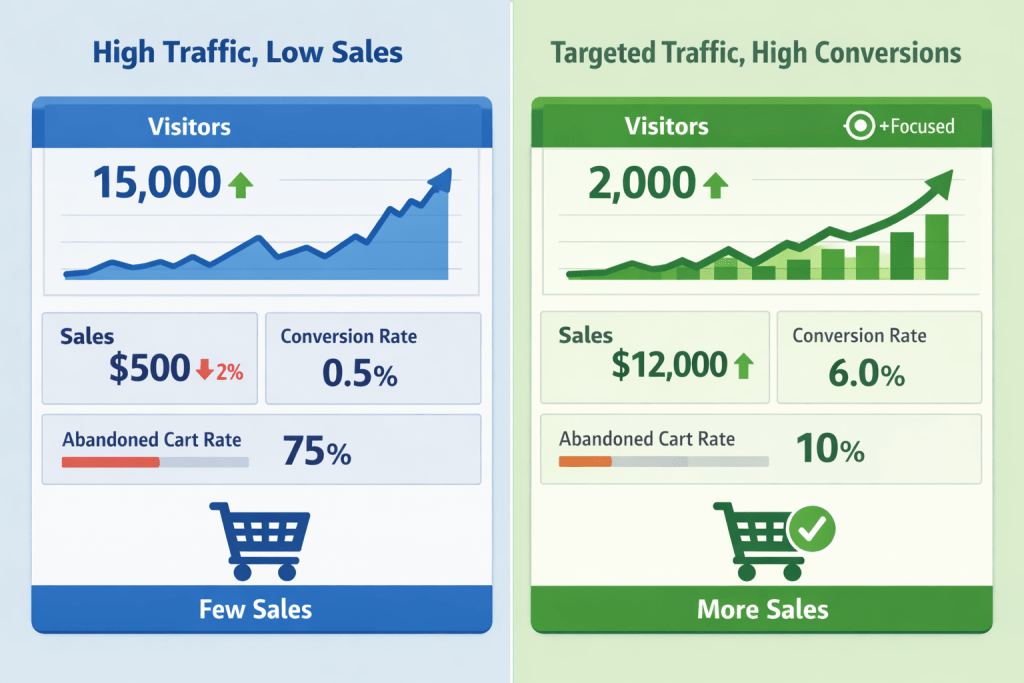
Keyword research ecommerce is not the same as blog SEO.
According to Google, search intent plays a critical role in rankings and user satisfaction. That means your keywords must match what the user actually wants to do.
For ecommerce, that usually means:
- Comparing products
- Looking for deals
- Ready to buy
A keyword like “what are running shoes” brings traffic.
A keyword like “buy running shoes online” brings revenue.
That difference shapes your entire strategy.
Step 1: Start With What You Sell, Not Tools

Before jumping into tools, map your products clearly.
Think like your customer:
- What would they type when they need your product?
- Are they searching by problem, feature, or brand?
For example, if you sell skincare:
- “organic face cream for dry skin”
- “buy chemical free moisturizer”
This forms your base keyword list.
Many businesses skip this and rely entirely on tools, which often leads to irrelevant keyword targeting.
Step 2: Understand Search Intent Like a Buyer
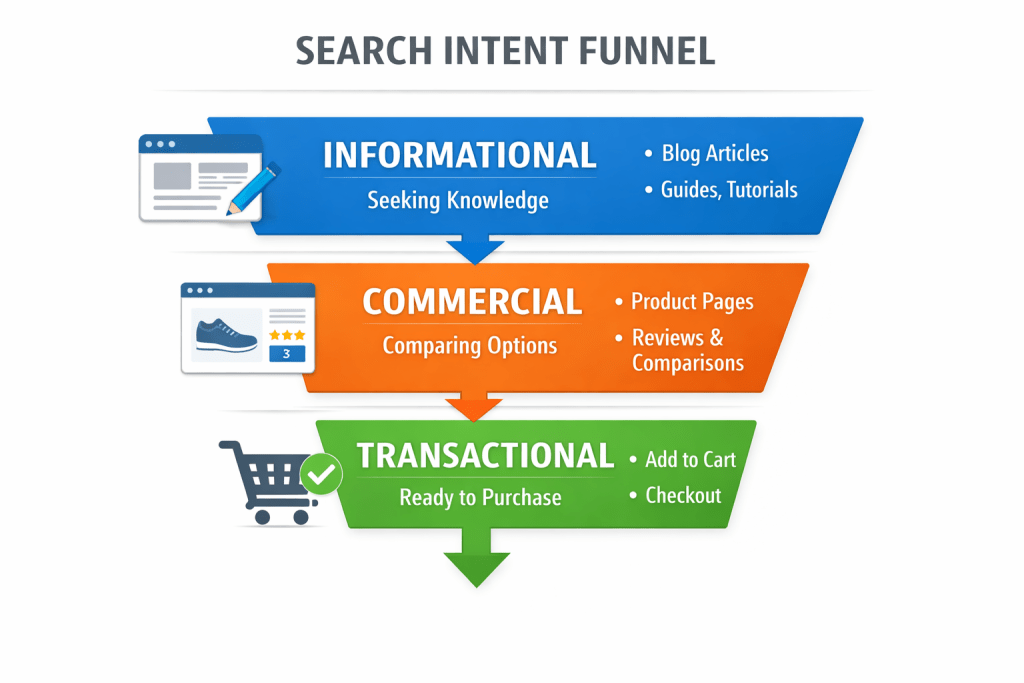
Research from Think with Google highlights that users move through different intent stages before making a purchase.
You need to map your keywords accordingly:
| Intent Type | Example | Page Type |
| Informational | how to choose a laptop | Blog |
| Commercial | best laptops under 1000 | Category |
| Transactional | buy laptop online | Product |
If your site only ranks for informational queries, you’ll see traffic without conversions.
Balancing all three is key, but ecommerce success depends heavily on commercial and transactional keywords.
Also Read – On-Page SEO Checklist for Ecommerce Websites (2026)
Step 3: Use Keyword Tools With a Strategy

Tools are helpful, but only when used with the right filters.
Popular options include:
- Google Keyword Planner
- Ahrefs
- SEMrush
According to Ahrefs, long-tail keywords account for a large portion of search queries and often have lower competition.
Focus on:
- Relevance to your product
- Buyer intent
- Manageable keyword difficulty
A smaller, high-intent keyword often delivers better ROI than a broad, high-volume one.
Step 4: Analyze Competitors That Already Rank

Search your main product keywords and study top-ranking pages.
Look for:
- Keyword patterns in titles
- Content structure
- Product descriptions
This gives you insight into what Google already trusts.
It’s not about copying competitors. It’s about identifying gaps you can improve.
Step 5: Build Keyword Clusters Instead of Single Keywords
Modern SEO is shifting from single keywords to topic clusters.
A report by HubSpot explains that clustering improves content relevance and internal linking.
Example:
Main keyword: running shoes
Cluster keywords:
- buy running shoes online
- running shoes for men
- lightweight running shoes
These can all support one category page.
To implement this effectively, many businesses rely on structured Ecommerce development services that align site architecture with SEO strategy.
Step 6: Optimize the Pages That Actually Convert
Keyword placement matters as much as keyword selection.
Here’s where to focus:
Product Pages
- Use primary keywords in titles
- Add natural variations in descriptions
- Include strong buying language
Category Pages
- Short, keyword-rich introduction
- Organized product listings
- Internal linking
Blog Content
- Answer informational queries
- Guide users toward products
This is where Search Engine Optimization Services and eCommerce SEO services can significantly improve both rankings and conversions.
Step 7: Long-Tail Keywords Drive Real Sales
Data from Backlinko shows that long-tail keywords tend to have higher conversion rates because they reflect specific intent.
Examples:
- best gaming laptop under 800
- organic skincare for sensitive skin
These users already know what they want.
Instead of chasing broad keywords, focus on capturing these high-intent searches.
Step 8: Track Performance and Refine
Keyword research is not a one-time task.
According to Google Analytics, tracking user behavior helps identify which keywords lead to conversions.
Review regularly:
- Which keywords bring sales
- Which pages underperform
- Where users drop off
Then refine your strategy.
Consistency beats one-time effort in SEO.
Also Read – SEO for Ecommerce Product Pages: How to Improve Visibility and Drive Organic Sales
Common Mistakes That Limit Ecommerce Growth
Here are some patterns seen across struggling ecommerce sites:
- Targeting high-volume but low-intent keywords
- Ignoring product and category page optimization
- Lack of internal linking
- No clear conversion path
Bridging this gap often requires a mix of SEO and Ecommerce Marketing services that focus on both traffic and revenue.
Final Thoughts
Keyword research for ecommerce is not about finding popular terms. It’s about understanding how real people search when they’re ready to buy.
When your keywords align with intent, everything improves:
- Traffic becomes qualified
- Conversion rates increase
- Marketing spend becomes more efficient
If your current strategy is bringing visitors but not customers, it’s time to rethink how your keywords are working for you.
Done right, keyword research doesn’t just improve rankings. It builds a predictable path to sales.
FAQs
1. How to do keyword research for ecommerce websites effectively?
Ans. Start with product-based keywords, analyze search intent, validate with tools, and group keywords into clusters for better ranking and conversions.
2. What is keyword research ecommerce?
Ans. It is the process of identifying search terms that potential customers use to find products online, with a focus on intent and conversion.
3. Why are long-tail keywords important for ecommerce?
Ans. They target specific user intent and often lead to higher conversion rates compared to broad keywords.
4. Which tools are best for keyword research for ecommerce?
Ans. Google Keyword Planner, Ahrefs, and SEMrush are commonly used for identifying keyword opportunities and competition levels.
5. How often should ecommerce keyword research be updated?
Ans. Ideally every month or quarter, depending on competition and market changes.
