

If you’re searching for how to increase ecommerce sales in 2026, the most effective strategy is to combine AI-powered personalization, ecommerce conversion optimization, and seamless customer experiences.
Online shoppers today expect fast, relevant, and highly personalized interactions. They want product recommendations that match their interests, search results that understand their intent, and support that is available instantly. Businesses that use artificial intelligence to improve these experiences are often able to increase conversion rates, improve customer retention, and generate higher average order values.
However, AI is not a magic solution. Success comes from implementing the right technologies on a well-optimized ecommerce platform. When AI is paired with a high-converting ecommerce website, data-driven marketing, and a customer-focused strategy, it becomes a powerful growth engine.
In this guide, we’ll explore practical ways ecommerce brands can use AI to increase ecommerce sales, improve customer experiences, and stay competitive in 2026.
Why AI Matters More Than Ever in Ecommerce
The ecommerce landscape has become more competitive than ever. Consumers have endless options, shorter attention spans, and higher expectations.
Artificial intelligence helps businesses meet these expectations by analyzing customer behavior at scale and delivering relevant experiences in real time.
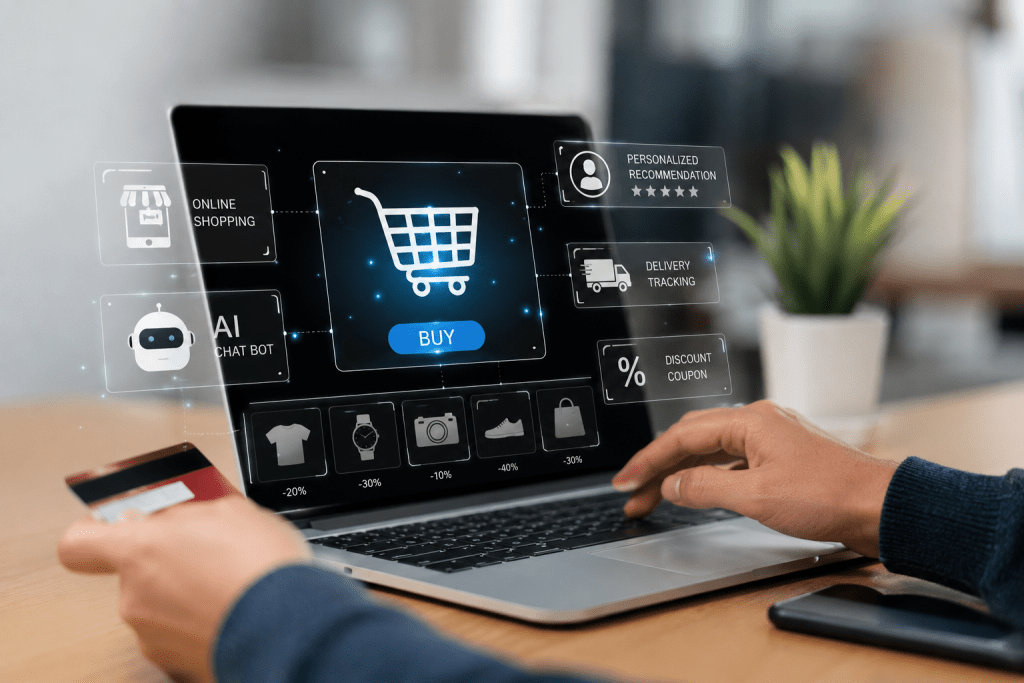
Instead of showing the same content to every visitor, AI can tailor:
- Product recommendations
- Search results
- Promotional offers
- Email campaigns
- Customer support interactions
- Shopping journeys
This level of personalization helps businesses create stronger customer relationships while improving conversion opportunities.
The Shift from Traditional Ecommerce to Intelligent Commerce
| Traditional Ecommerce | AI-Powered Ecommerce |
| Same experience for every visitor | Personalized experience for each visitor |
| Manual customer segmentation | Real-time behavioral segmentation |
| Static product recommendations | Dynamic AI recommendations |
| Reactive marketing campaigns | Predictive marketing automation |
| Basic search functionality | Intelligent semantic search |
| Limited customer insights | Deep predictive analytics |
The businesses gaining market share in 2026 are not necessarily the largest brands. They are often the companies that use data and AI effectively to create better shopping experiences.
How Can AI Increase Ecommerce Sales?
AI increases ecommerce sales by helping businesses personalize customer experiences, improve product discovery, automate engagement, reduce friction in the buying process, and make smarter marketing decisions.
Key Ways AI Drives Revenue Growth
1. Personalized Product Recommendations
Personalized recommendations remain one of the most effective applications of AI in ecommerce.
Rather than displaying generic bestsellers, AI analyzes browsing behavior, purchase history, and customer preferences to suggest products that are more relevant to individual shoppers.
For example:
A customer viewing hiking boots may also be shown moisture-wicking socks, backpacks, and outdoor accessories that complement their purchase.
This approach helps increase:
- Average order value
- Cross-sell opportunities
- Customer engagement
- Purchase frequency
2. AI-Powered Search Improves Product Discovery
One of the biggest conversion killers is poor search functionality.
Traditional search relies heavily on exact keyword matching. AI-powered search understands context, intent, and natural language.
For example:
A shopper searching for “comfortable shoes for standing all day” may be shown products designed for healthcare workers, retail employees, or warehouse staff—even if the product title doesn’t contain those exact words.
When customers find products faster, they are more likely to convert.
3. Intelligent Customer Support
Modern AI assistants and chatbots can answer common questions instantly.
They help customers:
- Compare products
- Check availability
- Understand shipping policies
- Track orders
- Receive personalized recommendations
This reduces support delays and helps customers make purchasing decisions with greater confidence.
4. Predictive Marketing Automation
AI can identify patterns that humans often miss.
Using customer data, businesses can predict:
- Which customers are likely to purchase again
- Which shoppers are at risk of churning
- Which products may trend in upcoming seasons
- Which campaigns are likely to perform best
This allows marketing teams to allocate budgets more effectively and improve return on investment.
What Is Ecommerce Conversion Optimization?

Ecommerce conversion optimization (CRO) is the process of improving an online store to increase the percentage of visitors who complete desired actions, such as making a purchase.
Conversion optimization focuses on removing friction and making it easier for customers to complete their journey.
Common Conversion Optimization Goals
- Increase online sales
- Reduce cart abandonment
- Improve checkout completion rates
- Increase average order value
- Generate more qualified leads
- Improve customer retention
Simple Example
Imagine your store receives 50,000 monthly visitors.
If your conversion rate is 2%, you generate 1,000 orders.
If AI-powered optimization improves your conversion rate to 2.5%, you generate 1,250 orders from the same traffic volume.
That represents a 25% increase in sales without spending additional money on acquiring traffic.
This is why conversion optimization is often one of the highest-return investments for ecommerce businesses.
Read Also:– How to Increase Ecommerce Conversion Rate
What Makes an Ecommerce Website High-Converting?
A high converting ecommerce website is designed to help customers find what they need quickly and complete purchases with minimal friction.
The best-performing ecommerce stores typically share several characteristics.
Fast Website Performance
Site speed remains a critical factor for both user experience and search visibility.
Slow-loading pages can increase bounce rates and reduce conversions, especially on mobile devices.
Mobile-First Design
Mobile commerce continues to represent a significant share of online purchases.
Your website should provide a seamless experience across smartphones, tablets, and desktops.
Clear Product Information
Customers need enough information to make confident purchasing decisions.
Effective product pages include:
- Detailed descriptions
- High-quality images
- Product specifications
- Customer reviews
- Frequently asked questions
Personalized Shopping Experiences
AI helps tailor product recommendations, content, and offers based on user behavior.
This creates a more relevant shopping experience and often leads to higher engagement.
Simplified Checkout
The fewer obstacles customers face, the more likely they are to complete a purchase.
Best practices include:
- Guest checkout options
- Multiple payment methods
- Transparent shipping costs
- Auto-fill capabilities
- Minimal form fields
Strong Trust Signals
Customers are more likely to buy from stores they trust.
- Trust-building elements include:
- Verified customer reviews
- Secure payment badges
- Clear return policies
- Visible contact information
- Transparent shipping details
Whether you’re looking to improve personalization, boost conversions, or build a high-converting ecommerce website, partnering with experienced ecommerce specialists can accelerate results. At Webiators, our Shopify Development Services, Magento Development Services, Ecommerce development services, and Ecommerce Marketing services help businesses implement modern AI-powered shopping experiences that drive sustainable growth.
FAQs
1. Is AI only beneficial for large ecommerce businesses?
Ans. No. Small and mid-sized ecommerce businesses can also benefit from AI. Many ecommerce platforms now offer affordable AI-powered features that help improve personalization, marketing performance, and customer support without requiring large budgets.
2. What is ecommerce conversion optimization, and why is it important?
Ans. Ecommerce conversion optimization (CRO) is the process of improving your online store to increase the percentage of visitors who complete a purchase. Even small improvements in conversion rates can significantly increase revenue without requiring additional traffic, making CRO one of the most cost-effective growth strategies for ecommerce businesses.
3. How does AI personalization improve online sales?
Ans. AI personalization analyzes customer behavior, browsing history, and purchasing patterns to deliver relevant product recommendations, offers, and content. When shoppers see products that match their interests and needs, they are more likely to make a purchase.
4. Which AI tools help ecommerce stores grow faster?
Ans. Popular AI tools for ecommerce include recommendation engines, AI-powered search solutions, chatbots, marketing automation platforms, predictive analytics tools, and customer segmentation software. The right combination depends on your store’s size, goals, and customer base.
5. Should ecommerce businesses invest in AI in 2026?
Ans. Yes. AI is becoming a core part of modern ecommerce growth strategies. Businesses that use AI to enhance customer experiences, automate repetitive tasks, and make data-driven decisions are better positioned to improve conversions, increase customer retention, and stay competitive in an increasingly crowded online marketplace.
