
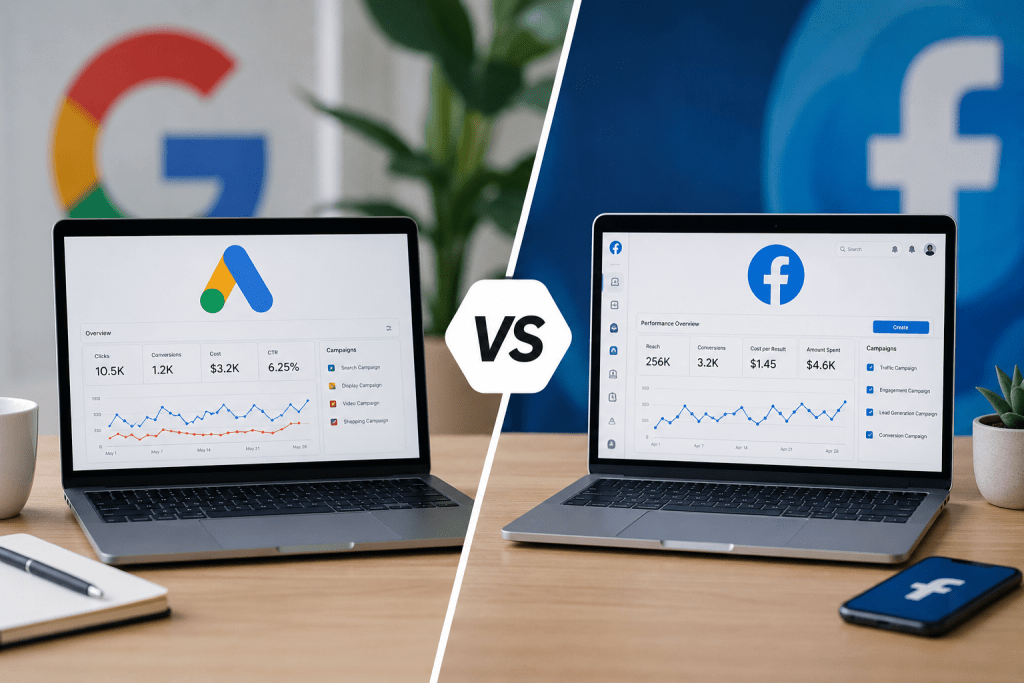

Every advertising dollar matters in 2026.
Customer acquisition costs have increased across many industries, competition continues to intensify, and businesses expect measurable returns from every campaign they launch. Whether you’re running an ecommerce store, a growing startup, or an established online business, choosing the right advertising platform can significantly impact your revenue.
That brings us to one of the most common questions in digital marketing: Google Ads vs Facebook Ads: which delivers better ROI in 2026?
The answer is not as simple as choosing one over the other. Both platforms can generate excellent results, but they work in very different ways. Understanding those differences is the key to making smarter advertising decisions.
Understanding the Core Difference
Before comparing performance, it’s important to understand what each platform is designed to do.
Google Ads Captures Existing Demand
Google Ads places your business in front of people actively searching for a product, service, or solution.
For example:
- Shopify development agency
- Ecommerce marketing company
- Running shoes for flat feet
- CRM software for small businesses
These users are already looking for something specific. In many cases, they are evaluating options and may be only one or two steps away from making a purchase decision.
This is why search advertising is often associated with high-quality traffic and strong conversion potential.
Google has historically reported that businesses earn an average of approximately $2 in revenue for every $1 spent on Google Ads. While actual results vary by industry and campaign quality, the statistic highlights the power of intent-driven advertising.
Facebook Ads Creates Demand
Facebook and Instagram advertising operates differently.
Users are scrolling through feeds, watching videos, interacting with content, and discovering new brands. They are not necessarily searching for a product at that moment.
Instead, Facebook Ads introduces products and services based on demographics, interests, online behavior, engagement history, and AI-powered audience signals.
This makes Facebook particularly effective for brand awareness, product discovery, and audience building.
Search Intent vs Discovery Intent
The biggest difference in the Facebook ads vs Google ads debate comes down to customer intent.
Search Intent
A user searches:
“Best Shopify agency for ecommerce store”
That person already recognizes a need and is actively exploring solutions.
Google Ads allows your business to appear exactly when that need exists.
Discovery Intent
Now consider someone scrolling Instagram.
They come across a video showcasing a unique fitness product, skincare item, or home accessory. A few minutes earlier, they had no intention of buying anything.
The ad created interest and introduced a potential purchase opportunity.
Neither approach is inherently better. They simply influence different stages of the customer journey.
Google Ads vs Facebook Ads: ROI Comparison in 2026
| Factor | Google Ads | Facebook Ads |
| User Intent | Very High | Moderate |
| Brand Awareness | Good | Excellent |
| Lead Quality | Often Higher | Varies by Industry |
| Product Discovery | Moderate | Excellent |
| Conversion Speed | Often Faster | Usually Longer |
| Remarketing | Strong | Strong |
| Targeting Method | Search Keywords | Interests, Behaviors, AI Signals |
| Best Use Case | Capturing Demand | Creating Demand |
The platform that generates the highest ROI depends largely on your business model, audience behavior, and marketing goals.
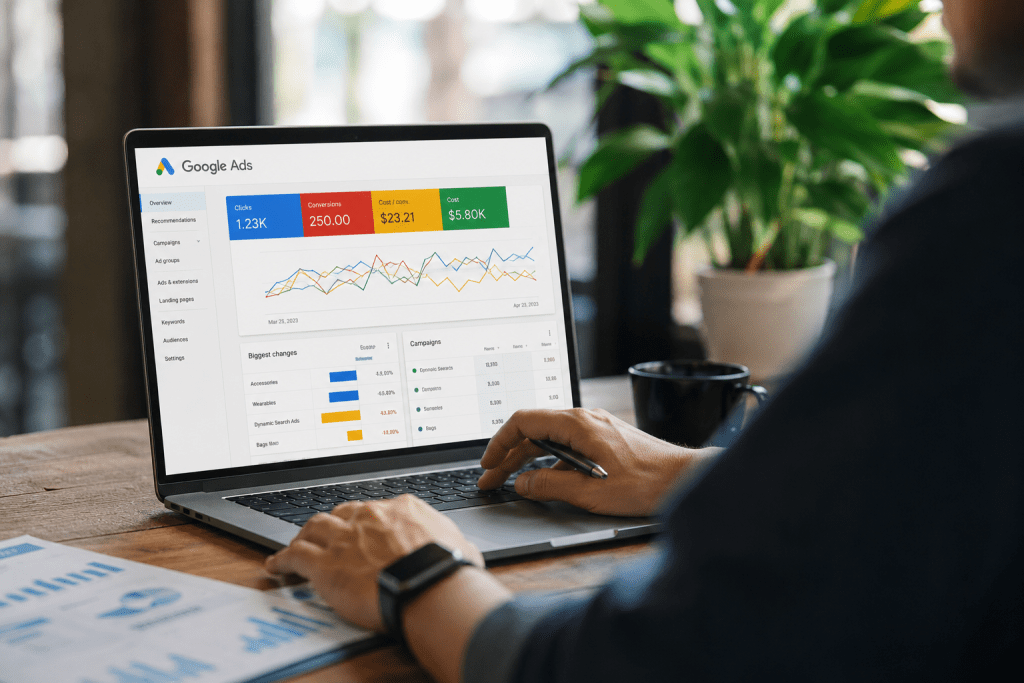
When Google Ads Typically Delivers Better ROI
Service-Based Businesses
Google Ads often performs exceptionally well for businesses selling expertise or specialized services.
Examples include:
- Web development agencies
- Ecommerce consultants
- Financial services
- Legal firms
- SaaS companies
Since users are actively searching for solutions, traffic tends to be highly qualified.
Local Businesses
Local search remains one of the strongest drivers of conversions.
Searches such as:
- Web design company near me
- Marketing agency in Austin
- Ecommerce consultant in Chicago
often indicate immediate intent, making Google Ads particularly valuable for local lead generation.
B2B Lead Generation
Businesses selling high-value services frequently see stronger PPC ROI through Google Ads because buyers conduct extensive research before making purchasing decisions.
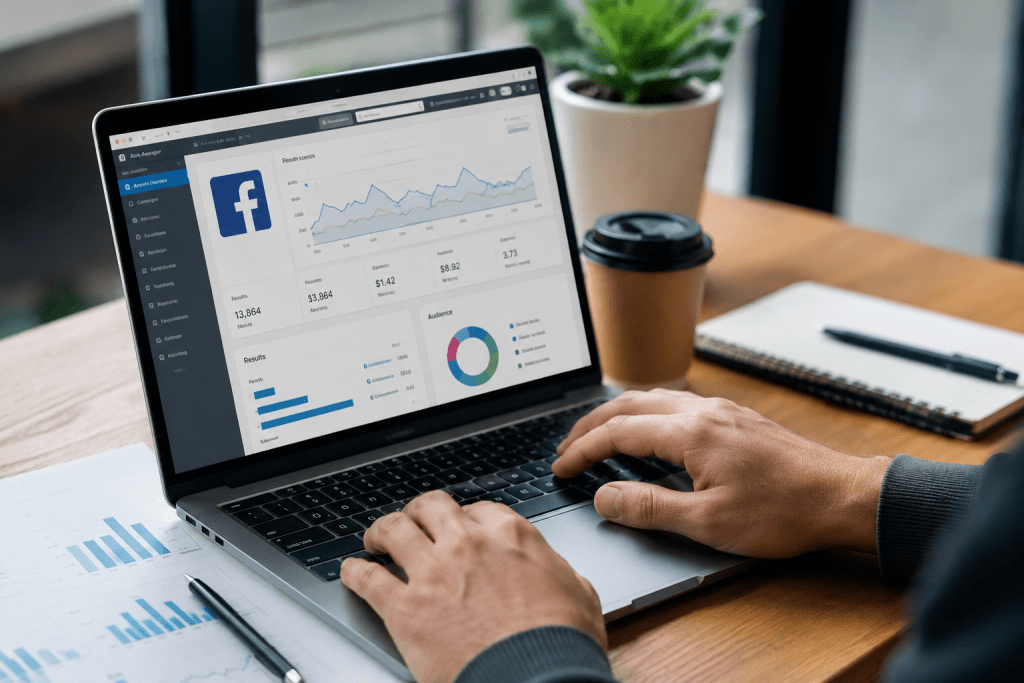
When Facebook Ads Often Delivers Better ROI
Ecommerce Brands
Facebook and Instagram continue to be powerful channels for ecommerce businesses.
Industries that often perform well include:
- Fashion
- Beauty
- Fitness
- Home décor
- Lifestyle products
Strong visuals and compelling storytelling can introduce products to customers before they begin actively searching.
New Product Launches
Customers cannot search for products they have never seen.
Facebook Ads helps businesses create awareness and generate interest for new products and emerging brands.
Audience Building
For businesses with longer sales cycles, Facebook excels at building audiences that can later be nurtured through email marketing, retargeting campaigns, and search advertising.
The Role of AI in Advertising Performance
Artificial intelligence is playing a larger role than ever in digital advertising.
Google’s Performance Max campaigns and Meta’s Advantage+ campaigns use machine learning to automate bidding, audience expansion, ad placements, and optimization decisions.
However, automation alone does not guarantee results.
Successful campaigns still depend on:
- Strong ad creative
- Clear value propositions
- Accurate conversion tracking
- Optimized landing pages
- Quality customer data
The most successful advertisers in 2026 combine automation with strategic oversight and continuous testing.
Why Many Ecommerce Brands Use Both Platforms
The highest-performing brands rarely rely on a single advertising channel.
Instead, they build a complete customer acquisition system.
A typical journey looks like this:
- A customer discovers a product through Facebook or Instagram.
- They visit the website but leave without purchasing.
- Later, they search Google for reviews or comparisons.
- A Google search ad brings them back.
- They complete the purchase.
Example: How the Platforms Work Together
Imagine an online store selling premium fitness accessories.
A potential customer discovers the product through an Instagram video ad. They browse the website but leave without buying. A few days later, they search Google for reviews and product comparisons. A Google search ad appears, leading them back to the site where they finally make a purchase.
Neither platform generated the sale on its own. The conversion happened because both platforms supported different stages of the buying journey.
Businesses that want to scale efficiently often combine professional ecommerce ppc management with strategic social advertising. Dedicated Facebook Ads Management Services can improve audience targeting and creative performance, while broader Ecommerce Marketing services help unify customer acquisition efforts across multiple channels.
Which Platform Should You Choose in 2026?
Choose Google Ads if:
- Customers actively search for your services
- You need qualified leads quickly
- You operate in B2B markets
- Your products solve specific problems
Choose Facebook Ads if:
- Your products are visually appealing
- Brand awareness is a priority
- You are launching new products
- You want to reach potential customers before competitors
Use both if:
- You run an ecommerce business
- Customer acquisition is a key growth goal
- You want sustainable long-term growth
- You want to maximize advertising efficiency across the customer journey
Read Also:- Facebook Meta Ads Management with Advanced AI Optimization
Final Verdict
The businesses seeing the strongest advertising results in 2026 are not choosing between Google Ads and Facebook Ads. They are using each platform for what it does best.
Google Ads captures people actively searching for solutions. Facebook Ads introduces products and brands to audiences who may not be looking yet.
When these channels work together, businesses create a customer acquisition system that generates awareness, captures demand, and drives sustainable growth.
That is where the strongest long-term ROI is found.
FAQs
1. Which platform has better ROI, Google Ads or Facebook Ads?
Ans. Neither platform is universally better. Google Ads often performs well for high-intent searches, while Facebook Ads excels at product discovery, audience building, and brand awareness.
2. Are Facebook Ads cheaper than Google Ads?
Ans. Facebook Ads frequently have lower average cost-per-click costs. However, lower costs do not automatically result in better ROI. Conversion quality and customer lifetime value matter more.
3. Is Google Ads better for lead generation?
Ans. For many service-based businesses and B2B companies, Google Ads can be highly effective because users are actively searching for solutions and services.
4. Should ecommerce businesses use both platforms?
Ans. Yes. Many successful ecommerce brands use Facebook and Instagram to build awareness while using Google Ads to capture high-intent searches and support remarketing efforts.
5. What is the best digital advertising strategy in 2026?
