
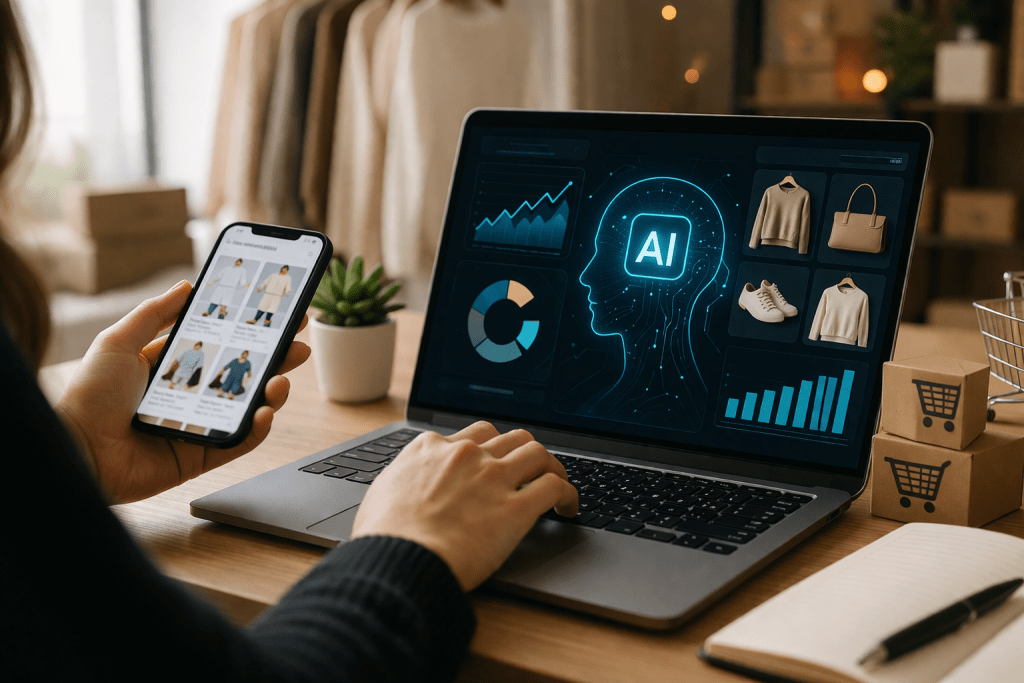

According to a 2024 report by McKinsey & Company, companies that effectively use AI in marketing and sales can increase revenue by 10–20% while reducing costs. At the same time, Salesforce reports that 84% of customers say the experience a company provides is as important as its products.
That shift explains why many e-commerce stores struggle today. It is not always about better products. It is about smarter experiences driven by AI.
If your store is not aligned with how AI evaluates content and behavior, growth becomes unpredictable.
Let’s break it down properly.
What AI E-commerce Optimization Really Means
Ai Optimization for Ecommerce refers to using machine learning, automation, and predictive analytics to improve how your store attracts, engages, and converts users.
It typically includes:
- Predictive product recommendations
- Automated content optimization
- Customer behavior analysis
- Dynamic pricing and personalization
According to IBM, AI systems can process large volumes of behavioral data far faster than manual analysis, helping businesses identify patterns that improve decision-making accuracy.
This is not about replacing human strategy. It is about improving precision.
How AI Improves E-Commerce Search Rankings

Search engines like Google rely heavily on AI systems such as RankBrain and neural matching to understand search intent.
Key Ranking Factors Influenced by AI
- Search Intent Matching
Google prioritizes content that satisfies intent, not just keyword presence.
- User Engagement Signals
Metrics like click-through rate, dwell time, and bounce rate influence rankings.
- Content Relevance and Depth
Comprehensive content performs better than thin pages.
- Personalized Results
Search results vary based on user behavior, location, and past activity
This means ranking today is less about stuffing keywords and more about solving specific problems better than competitors.
Also Read – Why Your WooCommerce Store Is Not Ranking (SEO Fixes)
Step-by-Step: How to Start AI E-commerce Optimization
1. Start with Data, Not Assumptions
Before using AI tools, analyze your existing performance.
Use:
- Google Analytics (user behavior insights)
- Google Search Console (search queries and CTR)
A study by Deloitte highlights that data-driven companies are 23 times more likely to acquire customers.
Without this foundation, optimization lacks direction.
2. Optimize Product Pages for AI Understanding
AI relies on structured and meaningful content.
Best practices:
- Unique product descriptions
- Schema markup (structured data)
- Customer reviews and ratings
- Product-specific FAQs
According to Baymard Institute, 70% of e-commerce users abandon purchases due to poor user experience, including unclear product information.
Clear, structured pages reduce friction and improve rankings.
Also Read – Why Your WooCommerce Store Is Not Ranking (SEO Fixes)
3. Use AI Tools for Smarter Content Creation
AI tools can assist with:
- Keyword research
- Content generation
- Meta optimization
- Trend prediction
However, Google’s guidelines clearly state that content must demonstrate experience, expertise, authoritativeness, and trustworthiness (E-E-A-T), regardless of how it is created.
Human oversight is essential.
If scaling feels complex, leveraging professional Digital Marketing Services ensures your strategy aligns with both AI and search engine expectations.
4. Focus on Search Intent, Not Just Keywords
Modern SEO revolves around intent classification:
- Informational
- Commercial
- Transactional
According to Ahrefs, long-tail keywords typically have lower competition and higher conversion rates.
Example shift:
- Generic: “running shoes”
- Intent-driven: “best running shoes for flat feet under $100”
This specificity aligns directly with AI-based ranking models.
5. Implement Personalization to Increase Conversions
Personalization is one of the most impactful AI applications in e-commerce.
- Product recommendations
- Dynamic content
- Behavioral targeting
A report by Epsilon found that 80% of consumers are more likely to purchase when brands offer personalized experiences.
This directly affects both engagement and revenue.
To implement effectively, many businesses rely on advanced Ecommerce Marketing services.
6. Optimize for Voice and Conversational Search
Voice search continues to grow, especially on mobile devices.
According to PwC, 71% of users prefer voice search for quick queries.
To adapt:
- Use natural language
- Add conversational FAQs
- Target question-based queries
This helps your content align with how AI interprets spoken searches.
7. Improve Site Speed and User Experience
Website performance directly impacts rankings and conversions.
Google recommends load times under 3 seconds
Mobile-first indexing is now standard
According to Google, 53% of mobile users abandon sites that take longer than 3 seconds to load.
A strong technical foundation, often built through professional Ecommerce development services, is essential for AI optimization to work effectively.
Also Read – On-Page SEO Checklist for Ecommerce Websites (2026)
Common Mistakes to Avoid
- Over-reliance on AI without strategy
- Publishing unedited AI-generated content
- Ignoring technical SEO
- Not tracking performance metrics
- Targeting broad keywords without intent focus
Each of these reduces the effectiveness of AI rather than enhancing it.
Conclusion
Ecommerce Ai Optimization is not a trend. It is the current standard for how online stores compete.
The businesses that win are not necessarily the biggest. They are the ones that understand user intent, personalize experiences, and continuously improve based on data.
Start with the basics. Build gradually. Stay consistent.
That is how AI becomes an advantage instead of confusion.
FAQs
1. What is AI e-commerce optimization?
Ans. It is the use of AI technologies to improve search rankings, user experience, and conversions through data-driven insights and automation.
2. How does AI improve e-commerce SEO?
Ans. AI helps search engines understand user intent, analyze behavior, and rank content based on relevance and engagement.
3. Is AI optimization suitable for small businesses?
Ans. Yes. Many tools are scalable and allow small businesses to compete effectively with larger brands.
4. How long does AI SEO take to show results?
Ans. Typically 3 to 6 months, depending on competition, strategy, and consistency.
5. Do I need experts for AI optimization?
Ans. Not always, but expert support can accelerate results and prevent costly mistakes.
