
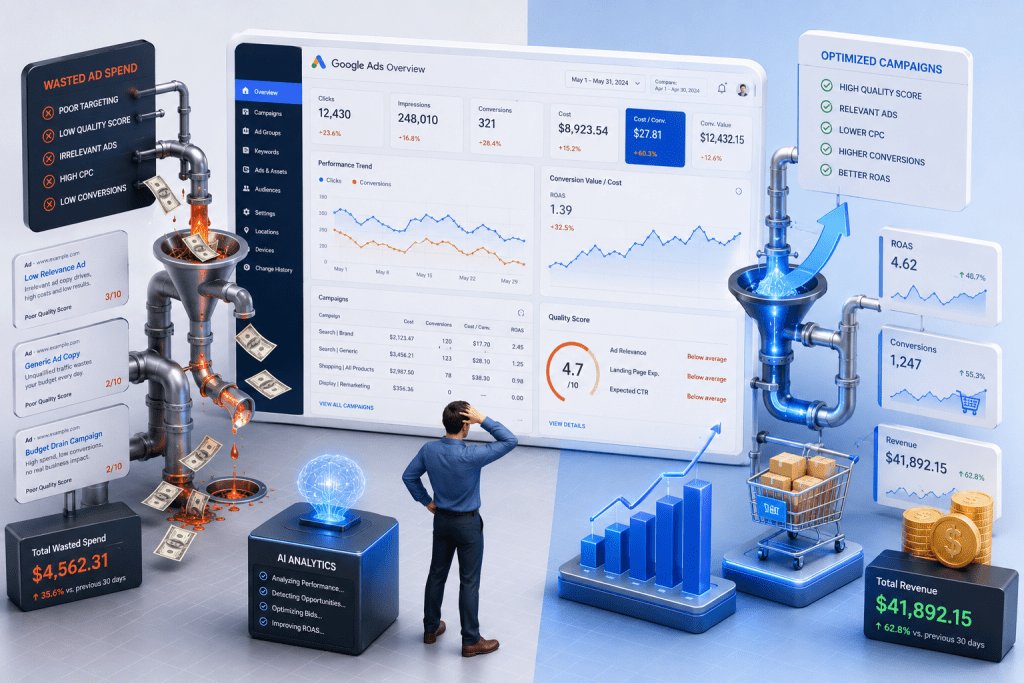

A surprising number sits behind almost every underperforming Google Ads account.
Businesses waste up to 76% of their advertising budget on ineffective campaigns, poor targeting, or weak conversion strategies, according to multiple PPC industry analyses. The painful part? Most advertisers don’t realize where the money disappeared. They simply notice fewer leads, shrinking profits, and a growing sense that Google Ads “doesn’t work anymore.”
From my experience working with ecommerce brands and growing businesses, Google Ads rarely fails on its own. The real issue is usually hidden inside campaign settings, landing pages, tracking errors, or bidding decisions that quietly eat away at profitability.
That’s why focusing only on clicks or impressions is risky. What really matters is Google Ads ROI. If every advertising dollar isn’t generating measurable business growth, something in your funnel deserves attention.
Throughout this guide, I’ll explain why Google Ads campaigns lose money, how to improve ROAS improvement, reduce unnecessary costs through smart CPC optimization, and build a system that turns paid traffic into profitable customers instead of expensive visitors.
What Is Google Ads ROI?
Google Ads ROI measures how much profit your advertising investment generates after accounting for costs.
Unlike vanity metrics such as clicks or impressions, ROI answers a simple business question:
“Did this campaign actually make money?”
A simplified formula looks like this:
ROI = (Revenue – Advertising Cost) ÷ Advertising Cost × 100
Here’s a quick example.
You spend $5,000 on Google Ads.
Your campaigns generate $18,000 in sales.
If your profit margin supports those numbers after product costs, shipping, software, and operating expenses, you’ve built a profitable campaign. If those additional costs consume most of the revenue, the campaign may look successful on paper while quietly losing money.
That distinction explains why experienced marketers rarely celebrate revenue alone.
ROI vs. ROAS: Why Many Businesses Confuse the Two
One of the biggest mistakes I see is treating Return on Ad Spend (ROAS) and ROI as if they mean the same thing.
They don’t.
| ROAS | ROI |
| Measures revenue generated from advertising | Measures actual business profit |
| Ignores operating expenses | Includes advertising and business costs |
| Useful for campaign performance | Useful for business decision making |
| Marketing metric | Financial metric |
Here’s a real-world example.
An online furniture retailer spends $10,000 on Google Ads and generates $40,000 in sales.
At first glance, a 4:1 ROAS looks excellent.
Now include manufacturing costs, shipping, payment processing fees, staff salaries, returns, and warehouse expenses.
Suddenly, the actual profit becomes much smaller than expected.
That’s why businesses focused only on ROAS often wonder why their bank account doesn’t reflect their advertising reports.
A healthy business tracks both metrics together. ROAS helps optimize campaigns, while Google Ads ROI determines whether your advertising is genuinely contributing to long-term growth.
Why Are Google Ads Not Profitable?
This is one of the most searched questions by business owners, and the answer is rarely as simple as “increase your budget.”
In most cases, unprofitable campaigns are caused by several small problems working together.
Common reasons include:
- Targeting keywords with high competition but low purchase intent.
- Weak ad conversion tracking, making optimization decisions inaccurate.
- Sending paid traffic to slow or confusing landing pages.
- Rising CPC without improvements in conversion rate.
- Poor audience segmentation.
- Using automated bidding before collecting enough conversion data.
- Ignoring customer lifetime value when measuring campaign success.
Think of Google Ads like filling a bucket with water.
Your budget is the water.
Every tracking error, irrelevant keyword, slow-loading page, or weak product offer creates another hole in that bucket.
Adding more budget rarely fixes the problem. Closing the leaks does.
That’s exactly where most businesses discover their fastest path to higher profitability.
7 Hidden Reasons Your Google Ads ROI Is Falling in 2026

If you’ve been asking, “My campaigns were profitable last year. What changed?” you’re not alone.
Google Ads has evolved rapidly. AI-powered bidding, changing search behavior, stricter privacy regulations, and rising competition have reshaped how campaigns perform. Winning today requires more than increasing your daily budget.
Here are the biggest reasons businesses lose money and, more importantly, how to fix them.
1. You’re Paying for Clicks Instead of Buying Intent
Not every click has the same value.
Someone searching “best running shoes” is browsing.
Someone searching “buy men’s running shoes size 10 today” is ready to purchase.
Many advertisers still spend heavily on broad, informational keywords because they generate plenty of traffic. Unfortunately, traffic doesn’t pay invoices.
Instead:
- Prioritize commercial and transactional keywords.
- Review your Search Terms Report weekly.
- Add negative keywords to filter irrelevant searches.
When you improve search intent targeting, your conversion rate often increases without spending another dollar.
2. Rising CPC Is Quietly Eating Your Budget
One of the most common questions I hear is:
How do you reduce CPC without losing visibility?
The answer isn’t lowering bids across the board.
Instead, improve the factors Google actually rewards.
Focus on:
- Better Quality Scores
- Highly relevant ad copy
- Strong keyword grouping
- Faster landing pages
- Higher click-through rates
This is where effective CPC optimization begins.
A campaign with a higher Quality Score often pays less per click than competitors bidding more aggressively.
Lower CPC isn’t about spending less.
It’s about becoming more relevant.
3. Your Landing Page Is Breaking the Customer Journey
Many advertisers obsess over ad performance while ignoring what happens after the click.
That’s where revenue is won or lost.
Consider this.
A shopper clicks your ad expecting running shoes.
Instead, they’re sent to a generic homepage with dozens of categories, multiple pop-ups, and a slow-loading menu.
Most visitors won’t search for the product.
They’ll leave.
A high-performing landing page should answer four questions within seconds:
- Am I in the right place?
- Can I trust this business?
- What should I do next?
- Is purchasing easy?
If conversions remain low despite strong traffic, improving your landing pages through professional CRO Services often delivers a faster return than increasing ad spend.
4. Your Conversion Tracking Isn’t Accurate
Many businesses believe their ROI is poor because they’re measuring incomplete data.
Without reliable ad conversion tracking, Google’s automated bidding cannot learn which users actually become customers.
Common tracking mistakes include:
- Missing purchase events
- Duplicate conversions
- Incorrect GA4 setup
- Ignoring phone call conversions
- Not importing offline sales from CRM systems
- Broken thank-you page tracking
Poor tracking creates poor optimization.
Accurate tracking creates smarter bidding decisions.
It’s that simple.
5. You’re Optimizing Campaigns Instead of Business Profit
This mistake is surprisingly common.
A campaign generating thousands of clicks can still lose money.
Instead of celebrating metrics like impressions or CTR, monitor numbers that affect your bottom line.
Pay close attention to:
- Cost per acquisition (CPA)
- Customer lifetime value (CLV)
- Average order value (AOV)
- Profit margin
- Repeat purchase rate
Successful advertisers think like business owners first and marketers second.
6. You’re Ignoring Audience Signals and First-Party Data
Privacy changes have made first-party data more valuable than ever. If you’re still targeting broad audiences without using customer insights, you’re likely paying for clicks that never convert.
Instead, build audience segments using:
- Previous purchasers
- Cart abandoners
- Email subscribers
- High-value customers
- Similar audiences based on first-party data
When Google receives stronger audience signals, its AI can optimize bidding more effectively. The result is often lower acquisition costs and better campaign performance.
7. You’re Optimizing Campaigns Too Infrequently
Google Ads isn’t a “set it and forget it” platform.
Auction dynamics, competitor bids, customer behavior, and search trends change every day. An account that performed well a month ago may already be wasting budget if no one is monitoring it.
Review your campaigns regularly by checking:
- Search Terms Report
- Budget allocation
- Impression Share
- Bid adjustments
- Ad performance
- Conversion trends
- Landing page metrics
Small optimizations performed consistently often outperform major account overhauls done once or twice a year.
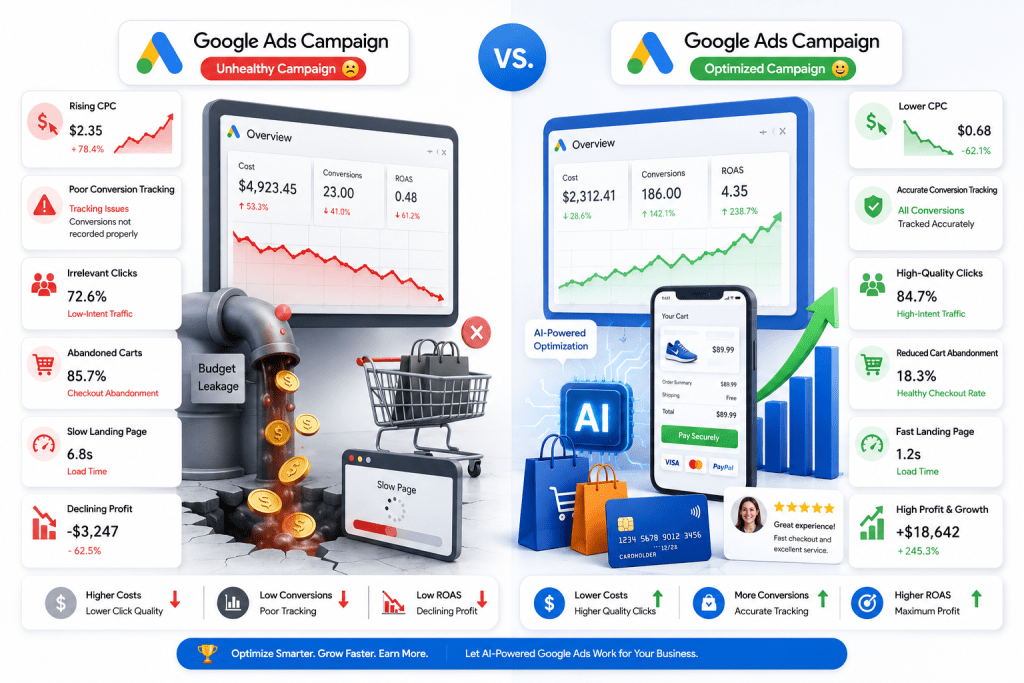
By now, you’ve probably noticed a pattern. Google Ads rarely fail because of a single mistake. It’s usually a combination of rising CPC, weak conversion tracking, poor landing pages, and inefficient campaign structure. The illustration below shows the difference between a campaign that burns budget and one that’s built for sustainable growth.
How to Improve ROAS Without Increasing Your Budget
One of the smartest ways to grow profit isn’t spending more.
It’s making every advertising dollar work harder.
Here are proven ways to achieve consistent ROAS improvement:
Refine Audience Segmentation
Separate campaigns based on customer intent.
Create different campaigns for:
- New visitors
- Returning customers
- High-value buyers
- Cart abandoners
- Brand searches
Each audience behaves differently.
Your bidding strategy should reflect that.
Continuously Test Ad Creatives
The highest-performing advertisers rarely keep the same ads running for months.
Test different:
- Headlines
- Descriptions
- Calls to action
- Promotions
- Product benefits
Even small improvements in click-through rate can significantly improve campaign profitability over time.
Optimize Your Ecommerce PPC Strategy
If you’re managing an online store, campaign structure matters as much as budget.
A strong Ecommerce PPC Strategy includes:
- Shopping campaigns grouped by product category
- Separate campaigns for best-selling products
- Seasonal budget adjustments
- Smart remarketing audiences
- Profit-based bidding rather than revenue-based bidding
Businesses using structured ecommerce campaigns usually scale more efficiently because budget flows toward products that generate the highest profit instead of simply the highest sales.
How to Reduce CPC Without Sacrificing Conversions
Reducing your cost per click doesn’t mean chasing the lowest bid. It means earning more value from every auction you enter.
I’ve seen businesses cut their average CPC by improving campaign quality instead of increasing budgets. Google rewards advertisers who create a better experience for users, and that works in your favor.
Here are practical ways to lower CPC while maintaining or even increasing conversions.
Improve Your Quality Score
Quality Score is Google’s way of measuring how relevant your ads are to searchers. A higher score can reduce your CPC and improve your ad position.
Focus on:
- Writing keyword-focused ad copy.
- Creating tightly themed ad groups.
- Matching landing page content with the search query.
- Improving page speed and mobile usability.
- Increasing click-through rate with compelling offers.
A small increase in Quality Score can have a noticeable impact on advertising costs over time.
Use Negative Keywords Aggressively
Many campaigns waste budget because ads appear for irrelevant searches.
For example, if you sell premium office furniture, you probably don’t want to pay for searches like:
- Free office desks
- DIY office table
- Used office chairs
Review your Search Terms Report every week and continue adding negative keywords. This simple habit prevents wasted clicks and improves campaign efficiency.
Bid Smarter, Not Higher
Automated bidding works best when it has reliable conversion data.
If your account has very few conversions, manual bidding or Maximize Clicks with limits may outperform aggressive automated strategies.
As conversion data grows, transition to Target CPA or Target ROAS based on actual business goals rather than assumptions.
The Metrics That Successful Advertisers Review Every Week
Many businesses check campaign performance once a month.
High-performing advertisers monitor their accounts weekly because small issues become expensive when left unnoticed.
Keep an eye on these metrics:
| Metric | Why It Matters |
| ROI | Measures overall business profitability. |
| ROAS | Shows revenue generated for every advertising dollar. |
| Conversion Rate | Indicates how effectively visitors become customers. |
| Cost Per Conversion | Reveals how much each acquisition costs. |
| Quality Score | Influences CPC and Ad Rank. |
| Search Impression Share | Identifies missed opportunities due to budget or ranking. |
| Average CPC | Tracks advertising cost trends over time. |
Looking at these metrics together provides a complete picture. A single number rarely tells the whole story.
When Should You Consider Professional PPC Optimization?
There comes a point when managing Google Ads internally starts costing more than it saves.
You might benefit from expert support if:
- Your campaigns generate traffic but not sales.
- CPC keeps increasing month after month.
- Conversion tracking isn’t configured correctly.
- You don’t have time to optimize campaigns regularly.
- You’re planning to scale into new markets or product categories.
- Your competitors consistently outrank you despite similar budgets.
Professional PPC Optimization Services focus on identifying hidden inefficiencies, refining bidding strategies, improving audience targeting, and maximizing long-term profitability rather than simply increasing clicks.
An experienced team also brings fresh insights that are difficult to gain when you’re working inside the same account every day.
Quick Google Ads ROI Improvement Checklist
Before increasing your advertising budget, ask yourself these questions:
☐ Are you tracking every meaningful conversion accurately?
☐ Are your landing pages designed to convert visitors into customers?
☐ Have you reviewed your Search Terms Report this week?
☐ Are negative keywords updated regularly?
☐ Is your bidding strategy aligned with your campaign goals?
☐ Do you measure profit, not just revenue?
☐ Are you optimizing campaigns based on customer lifetime value?
If you answered “No” to more than two questions, you’ve likely found several opportunities to improve your Google Ads ROI.
Read Also:- Google Ads vs Facebook Ads: Which Gives Better ROI in 2026?
Final Thoughts
Google Ads is still one of the most effective ways to reach high-intent customers in 2026. The businesses achieving the strongest results aren’t necessarily spending the most. They’re making smarter decisions with the budgets they already have.
Instead of chasing more clicks, focus on attracting qualified traffic, improving conversion tracking, optimizing landing pages, and measuring profitability rather than vanity metrics. Small improvements across your campaigns often compound into significant gains over time.
If your campaigns aren’t delivering the return you expect, don’t assume Google Ads has stopped working. More often than not, the opportunity lies in refining your strategy.
At Webiators, we help ecommerce businesses and growing brands transform underperforming Google Ads campaigns into scalable revenue channels through data-driven optimization, conversion-focused experiences, and continuous performance improvements. If you’re ready to stop wasting ad spend and start building profitable campaigns, our team is here to help.
FAQs
What is ROAS?
ROAS (Return on Ad Spend) measures the revenue generated for every dollar spent on advertising. Unlike ROI, it doesn’t account for business expenses such as product costs, shipping, or operational overhead.
Why does CPC increase?
CPC often rises because of increased competition, lower Quality Scores, broader keyword targeting, seasonal demand, or changes in Google’s ad auction. Improving ad relevance and landing page quality can help reduce CPC over time.
How do I track conversions in Google Ads?
Set up conversion actions in Google Ads, connect Google Analytics 4, enable Enhanced Conversions where applicable, and verify that purchases, leads, phone calls, and important customer actions are recorded accurately before optimizing campaigns.
Is Google Ads worth it for ecommerce businesses?
Yes, when campaigns are properly managed. Google Ads gives ecommerce businesses access to high-intent shoppers who are actively searching for products. Success depends on accurate tracking, strategic bidding, relevant keywords, and conversion-focused landing pages.
What is considered a good Google Ads ROI?
There’s no universal benchmark because every industry has different profit margins and customer acquisition costs. However, a successful campaign should consistently generate more profit than it costs to acquire customers while supporting your long-term business growth.
