
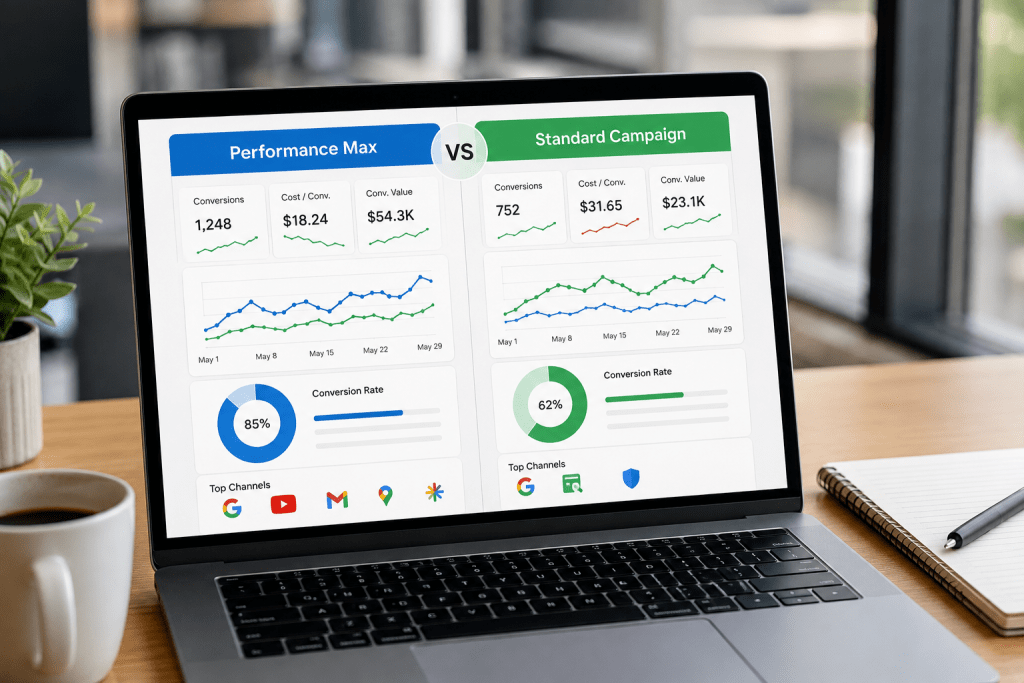

Every time Google introduces a major Ads update, one question lands in my inbox: “Should I switch everything to Performance Max?”
It’s a fair question. Google continues to invest heavily in AI-powered advertising, and Performance Max sits at the center of that vision. It promises to find more customers, automate bidding, and improve conversions across Google’s entire advertising ecosystem.
But after auditing Google Ads accounts for businesses at different growth stages, I’ve learned something important. Performance Max isn’t a shortcut to better results. It’s a powerful tool that performs exceptionally well when the account is ready for it and disappoints when the fundamentals are missing.
If you’re deciding between Performance Max and Standard Google Ads, don’t look for a universal winner. Look for the campaign that matches your objectives, data quality, and customer journey.
What Is Performance Max?
Performance Max, often called PMax campaigns, is a goal based Google Ads campaign that uses Google AI advertising to deliver ads across all eligible Google inventory, including Search, Shopping, Display, YouTube, Gmail, Discover, and Maps.
Instead of managing separate campaigns for each channel, advertisers provide:
- Creative assets
- Audience Signals
- Conversion goals
- Merchant Center feed (for ecommerce)
- Budget and bidding strategy
Google’s AI then uses Smart Bidding, Asset Groups, Search Themes, and real time auction signals to determine where each ad is most likely to generate a conversion.
This approach saves time, but it also means advertisers give Google far more control than they would with a traditional Search campaign.
Performance Max vs Standard Google Ads
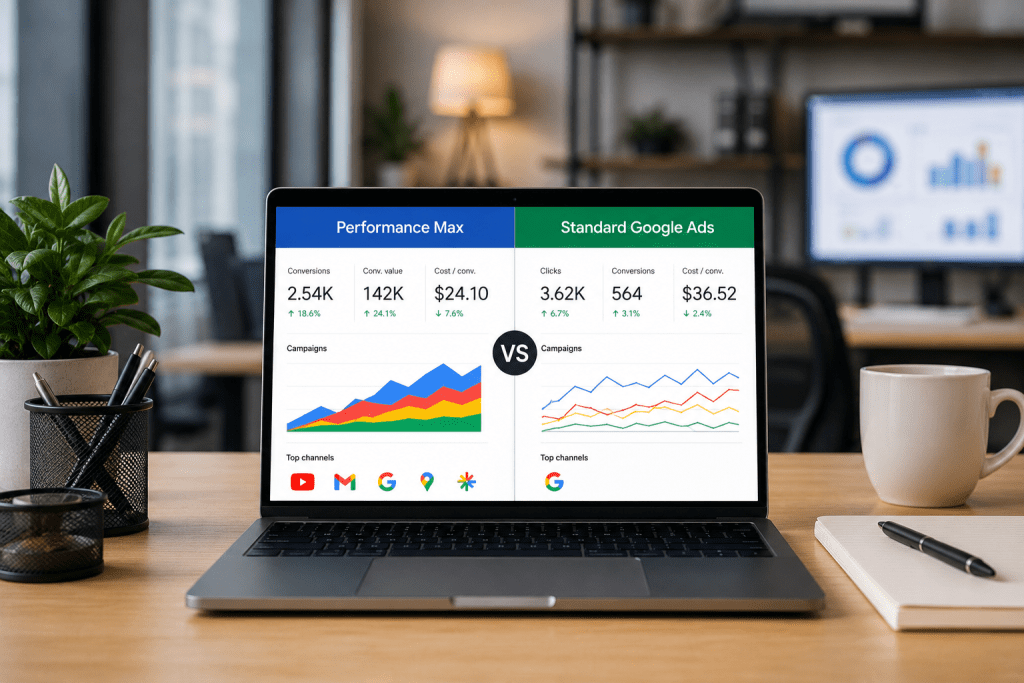
The biggest difference isn’t automation. It’s who makes the decisions.
| Feature | Performance Max | Standard Search Campaign |
| Reach | All Google channels | Google Search only |
| Bidding | Smart Bidding | Manual or automated |
| Keyword Control | Limited | Full control |
| Audience Targeting | AI driven | Keyword and audience based |
| Search Term Visibility | Limited | Detailed |
| Best Goal | Scale conversions | Capture high intent traffic |
If your business depends on precise keyword targeting, Search campaigns remain difficult to replace.
If your objective is maximizing conversions across multiple Google properties, Performance Max often has the advantage.
When Performance Max Is the Better Choice
From what I’ve seen, Performance Max performs best when businesses already have reliable data for Google’s AI to learn from.
It’s a strong option if you:
- Run an ecommerce store with an optimized Google Merchant Center feed.
- Track purchases or qualified leads accurately through Google Ads and Google Analytics 4.
- Generate consistent monthly conversions that improve machine learning.
- Want stronger ROAS optimization instead of managing multiple campaigns manually.
- Have high quality images, videos, headlines, and product descriptions for Asset Groups.
This is why many ecommerce brands combine Performance Max with a broader Ecommerce Marketing strategy. Instead of relying only on keyword searches, Google’s AI can identify new customers across several Google platforms and automatically adjust bids based on conversion probability.
One important point is often overlooked. Audience Signals don’t limit targeting. They simply give Google’s AI a better starting point. As the campaign collects more data, it expands beyond those initial audiences to find additional users who are likely to convert.
When Standard Search Campaigns Still Win
Despite Google’s push toward automation, Standard Search campaigns remain the better choice in several situations.
Choose Search campaigns if you need to:
- Target high intent keywords with complete control.
- Generate B2B or local service leads.
- Test new offers before enough conversion data exists.
- Review detailed search term reports.
- Maintain strict control over advertising compliance.
This also answers one of the biggest misconceptions about Google Ads.
Performance Max does not replace Search campaigns.
Google recommends using campaign types together based on business goals. In many successful accounts, Search captures customers actively looking for a solution, while Performance Max expands reach and discovers additional conversion opportunities.
Why Some Performance Max Campaigns Fail
Performance Max has a reputation for being a “set it and forget it” campaign. That’s one of the biggest reasons businesses struggle with it.
Google’s AI can optimize bids, placements, and creative combinations, but it cannot fix poor account fundamentals. If the data going into the campaign is inaccurate, the results usually reflect that.
The most common mistakes I find during Google Ads Management audits include:
- Tracking every website click instead of meaningful conversions.
- Using outdated or incomplete Merchant Center product data.
- Uploading too few creative assets, limiting Google’s ability to test Asset Groups.
- Making frequent changes before the campaign completes its learning phase.
- Measuring success by clicks instead of revenue, conversion value, or return on ad spend.
In most cases, the issue isn’t Performance Max itself. It’s the quality of the signals used to train Google’s AI.
5 Ways to Improve Performance Max Results
You don’t need a bigger advertising budget to improve results. You need better inputs.
1. Track the Right Conversions
Import purchase data or qualified leads instead of page views or button clicks. Better conversion data helps Smart Bidding make better decisions.
2. Strengthen Your Asset Groups
Add multiple headlines, descriptions, images, logos, and videos. More high-quality assets give Google’s AI greater flexibility to build relevant ads.
3. Keep Your Merchant Center Feed Healthy
For ecommerce businesses, accurate product titles, descriptions, pricing, and availability directly influence campaign performance.
4. Use Audience Signals Strategically
Start with existing customers, high value website visitors, or remarketing lists. While Audience Signals don’t restrict targeting, they help Google’s AI learn faster.
5. Review Insights, Not Just Reports
Instead of checking campaigns every day, look for trends in conversion value, ROAS, customer acquisition, and search themes. Long term optimization almost always outperforms reactive changes.
Businesses that combine experienced AI PPC specialists with ongoing testing often achieve more consistent growth because human strategy continues to guide Google’s automation.
Common Myths About Performance Max
Myth: Performance Max replaces Search campaigns.
Reality: Search campaigns remain essential when keyword intent, reporting transparency, and manual control are priorities. Performance Max is designed to complement them, not replace them.
Myth: Google’s AI does all the work.
Reality: AI optimizes campaigns using the signals you provide. Strong conversion tracking, quality creative assets, and accurate product data still determine success.
Myth: Increasing budget automatically improves performance.
Reality: Scaling a poorly optimized campaign usually increases wasted spend. Fix the campaign before increasing investment.
Which Campaign Should You Choose?
| If your goal is… | Recommended Campaign |
| Grow an ecommerce store | Performance Max |
| Capture high intent searches | Standard Search |
| Generate B2B leads | Standard Search |
| Maximize ROAS across channels | Performance Max |
| Maintain keyword control | Standard Search |
| Expand customer reach with AI | Performance Max |
For many businesses, the strongest strategy isn’t choosing one campaign over the other. It’s using both together to capture immediate demand while allowing Google’s AI to discover new opportunities.
Read Also:- Google Shopping Ads: Why Some Products Get Clicks While Others Never Sell
Conclusion
Performance Max isn’t replacing marketing strategy. It’s changing how strategy is executed.
If your business has reliable conversion tracking, quality creative assets, and a well managed Google Merchant Center feed, Performance Max can become one of your most profitable campaign types. If those foundations aren’t in place, Standard Search campaigns often provide better visibility and control while you strengthen your account.
At Webiators, we help businesses build data driven advertising strategies instead of relying on automation alone. Our PPC Services combine Performance Max, Search campaigns, and Conversion Optimization to create sustainable growth, stronger ROAS, and measurable business results.
FAQs
What is Performance Max?
Performance Max is a goal based Google Ads campaign that uses Google’s AI to show ads across Search, Shopping, Display, YouTube, Gmail, Discover, and Maps using a single campaign focused on conversion goals.
Can I control keywords in Performance Max?
Not like a Standard Search campaign. Performance Max uses Search Themes, Audience Signals, landing pages, and machine learning rather than traditional keyword targeting, so manual keyword control is limited.
Is Performance Max suitable for ecommerce?
Yes. It’s especially effective for ecommerce businesses with accurate conversion tracking, a well optimized Google Merchant Center feed, quality creative assets, and enough conversion data for Google’s AI to learn from.
What budget is recommended for Performance Max?
There’s no fixed budget. Start with an amount that allows the campaign to generate sufficient conversion data during the learning phase, then increase investment based on ROAS and business performance.
How do I measure Performance Max performance?
Focus on business outcomes rather than clicks alone. Track conversions, conversion value, ROAS, cost per acquisition, customer acquisition, and revenue growth using Google Ads and Google Analytics 4 to understand whether the campaign is delivering profitable results.
