
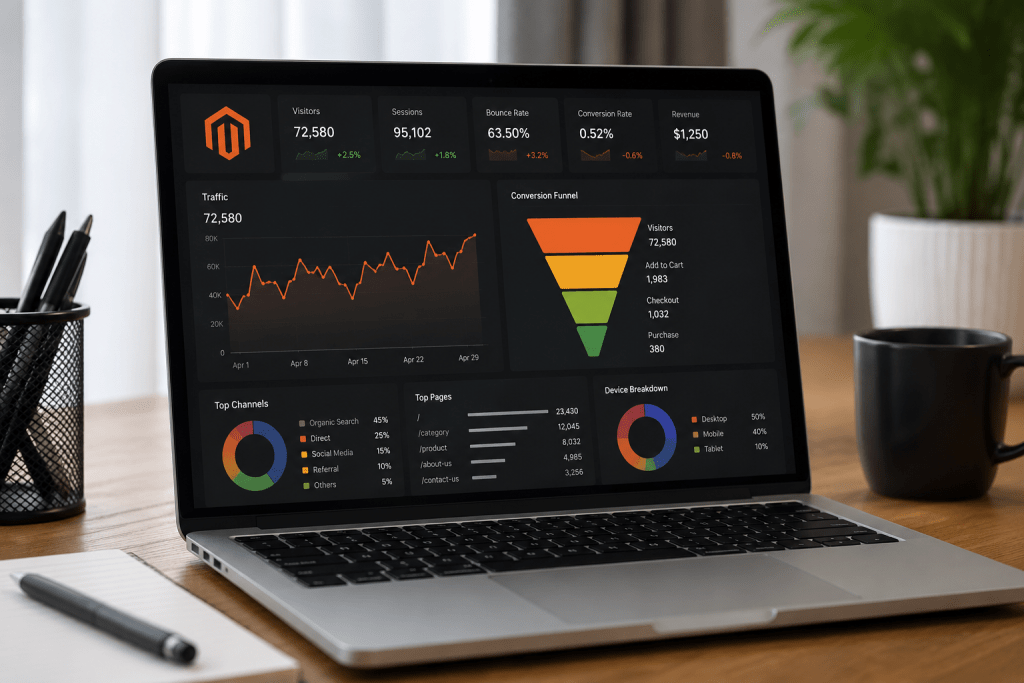

Every ecommerce business celebrates growing website traffic. More visitors usually feel like progress. Yet I’ve audited Magento stores where traffic increased month after month while revenue barely changed.
The problem wasn’t visibility.
It was friction.
Customers found products through Google, browsed multiple pages, added items to their cart, and then quietly disappeared. Increasing the advertising budget wouldn’t have solved that. Understanding why customers stopped buying would.
That’s where Magento CRO becomes one of the most profitable investments an ecommerce business can make.
Conversion Rate Optimization isn’t about redesigning your website because it looks outdated. It’s the discipline of removing obstacles that prevent shoppers from completing a purchase. Every unnecessary click, confusing page, hidden shipping fee, or slow-loading category page creates doubt. Doubt delays decisions. Delayed decisions become abandoned carts.
The businesses that consistently outperform competitors aren’t always the ones attracting the most traffic. They’re the ones that make buying feel effortless.
What Is Magento CRO?
Magento CRO (Conversion Rate Optimization) is the continuous process of improving a Magento or Adobe Commerce store so a greater percentage of visitors complete meaningful actions, whether that’s purchasing a product, requesting a quote, or creating an account.
Unlike a website redesign, CRO relies on evidence rather than assumptions. Every improvement should be guided by customer behavior, analytics, usability testing, and experimentation.
Adobe Commerce provides merchants with extensive flexibility through features like layered navigation, Page Builder, customer segmentation, promotions, and customizable checkout experiences. That flexibility is powerful, but it also means poor implementation can introduce unnecessary friction throughout the buying journey.
The objective isn’t to make your store look different.
It’s to make it easier for customers to buy.
More Traffic Doesn’t Always Mean More Sales
One of the biggest misconceptions in ecommerce is that sales problems are always traffic problems.
They’re often conversion problems instead.
Imagine two Magento stores selling similar products.
| Store | Monthly Visitors | Conversion Rate | Monthly Orders |
| Store A | 100,000 | 1.0% | 1,000 |
| Store B | 60,000 | 2.5% | 1,500 |
Store B attracts significantly fewer visitors but generates more orders because more shoppers successfully complete the buying journey.
That’s the real purpose of Magento conversion optimization.
Instead of asking, “How do we attract more visitors?” ask:
“Why aren’t our current visitors buying?”
That question usually leads to far more profitable answers.
The Webiators Magento CRO Framework

When I evaluate a Magento store, I don’t begin with design changes.
I begin by identifying friction.
Most conversion problems fall into one of five stages.
| Stage | Key Question | Typical Magento Issue |
| Product Discovery | Can customers find the right products quickly? | Weak navigation, poor search relevance, confusing category hierarchy |
| Buying Confidence | Does the product page answer every buying question? | Missing specifications, limited images, unclear delivery information |
| Performance | Does the website respond quickly? | Heavy extensions, poor caching, slow category pages |
| Checkout | Can customers complete a purchase without confusion? | Long forms, forced registration, hidden shipping costs |
| Optimization | Are improvements backed by data? | No testing process, limited behavioral analysis |
This framework helps prioritize improvements based on customer impact instead of personal opinion.
Customers Don’t Buy Products. They Buy Confidence.
Every customer silently evaluates risk before completing a purchase.
They ask themselves questions like:
“Is this the right product?”
“Can I trust this business?”
“What happens if I need to return it?”
“Will my order arrive when promised?”
If your Magento store doesn’t answer those questions naturally, uncertainty increases.
Research from the Baymard Institute consistently shows that missing product information and unnecessary checkout friction contribute to poor ecommerce usability. Likewise, Nielsen Norman Group’s usability research demonstrates that interfaces requiring greater mental effort often reduce task completion rates.
High-performing product pages reduce uncertainty by including:
- Detailed product descriptions
- Multiple high-quality images
- Product specifications
- Genuine customer reviews
- Delivery estimates
- Transparent return policies
- Clear stock availability
- Frequently asked questions
Trust isn’t created by adding more badges or promotional banners.
It’s built by removing reasons for hesitation.
Magento UX Should Reduce Decisions, Not Create Them
Many businesses confuse attractive design with effective user experience.
They aren’t the same.
A strong Magento UX helps customers make decisions quickly without feeling overwhelmed.
One behavior I regularly watch during CRO audits is shoppers repeatedly moving between category pages and product pages.
That pattern usually signals missing information.
For example, an electronics retailer may receive plenty of product page visits but few add-to-cart actions because technical specifications are buried below promotional content. A furniture store might lose buyers because estimated delivery times only appear during checkout.
The solution isn’t always a redesign.
Often, it’s presenting the right information at the right moment.
Magento’s layered navigation, configurable product options, related products, and merchandising tools should simplify product discovery rather than force customers to work harder.
Every interaction should move shoppers one step closer to a confident purchasing decision.
Website Performance Influences Customer Experience

Website speed alone doesn’t generate sales.
It removes friction.
Google’s Core Web Vitals focus on loading performance, responsiveness, and visual stability because these directly affect how users experience a website.
For Magento stores, performance bottlenecks frequently originate from:
- Poorly optimized third-party extensions
- Inefficient JavaScript execution
- Large uncompressed images
- Incomplete Full Page Cache implementation
- Incorrect Varnish Cache configuration
- Slow database queries
- Underpowered hosting environments
Businesses investing in Magento Performance Optimization often discover that improving technical performance benefits both search visibility and customer satisfaction.
The goal isn’t achieving a perfect PageSpeed Insights score.
The goal is ensuring customers never have to wait longer than necessary to continue shopping.
Optimize Magento Checkout Before You Redesign Your Store
Many businesses assume checkout is where conversion optimization begins.
In reality, it is where every earlier decision is validated.
If customers struggle to find products, question product information, or lose confidence before reaching the cart, even the best checkout experience won’t recover those lost sales.
That said, checkout remains one of the most important stages of the customer journey because every unnecessary action increases the chance of abandonment.
According to Baymard Institute’s ongoing checkout usability research, complex checkout flows, unexpected costs, and mandatory account creation remain common reasons shoppers leave without completing their purchase.
When auditing Magento stores, I look for practical friction rather than visual issues.
Questions I ask include:
- Can customers check out as guests?
- Are shipping costs visible before payment?
- Is every form field genuinely necessary?
- Are payment options appropriate for the target market?
- Does the checkout clearly indicate progress?
- Are validation errors easy to understand?
Magento allows extensive checkout customization, but flexibility should simplify purchasing rather than introduce additional complexity.
The easier customers reach the “Place Order” button, the less opportunity there is for hesitation.
CRO Is a Continuous Process, Not a One-Time Project

One of the biggest mistakes businesses make is treating CRO like a redesign.
A homepage is updated.
New banners are added.
Buttons change color.
Six months later, nobody knows whether those changes actually improved conversions.
That’s not conversion optimization.
A mature Magento CRO strategy follows a repeatable process.
| Step | Objective | Recommended Tools |
| Measure | Identify where visitors leave | Google Analytics 4, Google Search Console |
| Observe | Understand customer behaviour | Microsoft Clarity, Hotjar |
| Prioritise | Focus on highest-impact issues | Funnel analysis, heatmaps |
| Test | Validate one improvement at a time | A/B testing platforms |
| Measure Again | Confirm business impact | Analytics dashboards |
Every improvement should begin with a hypothesis.
For example:
“Displaying delivery estimates on product pages will reduce uncertainty and increase add-to-cart actions.”
The hypothesis is tested.
Results are measured.
The learning informs the next improvement.
This approach removes opinion from decision-making and replaces it with evidence.
Common Magento CRO Mistakes That Quietly Reduce Revenue
Some problems appear repeatedly during Magento audits, regardless of industry.
Avoid these common mistakes.
Treating every visitor the same
Returning customers and first-time visitors have different expectations. Adobe Commerce features such as customer segmentation can help deliver more relevant experiences where appropriate.
Installing too many extensions
Every extension introduces maintenance, security, and performance considerations. Regularly review whether each extension still provides business value.
Prioritising design over usability
Beautiful websites don’t automatically convert.
Clear navigation, understandable product information, and intuitive interactions usually influence purchasing decisions more than visual effects.
Hiding important information
Delivery estimates, return policies, warranty details, and payment information shouldn’t require customers to search.
Confidence grows when important questions are answered early.
Making decisions without data
Changing a website based on assumptions often creates new problems instead of solving existing ones.
Analytics should always guide optimisation priorities.
SEO Brings Visitors. CRO Turns Them Into Customers.
Many ecommerce businesses separate SEO and CRO into different conversations.
They shouldn’t.
SEO attracts qualified visitors searching for your products.
CRO ensures those visitors can complete their buying journey with minimal friction.
That’s why successful ecommerce growth usually combines technical optimisation, user experience improvements, and search visibility rather than treating them as independent projects.
Businesses investing in Ecommerce SEO Services often discover new opportunities for conversion optimisation because search behaviour reveals exactly what customers expect to find after clicking a result.
Likewise, many Magento Development Services projects uncover usability improvements while modernising navigation, improving performance, or refining checkout functionality.
The strongest ecommerce stores don’t optimise for rankings alone.
They optimise for outcomes.
When Should You Invest in CRO Services?
You don’t need millions of monthly visitors to benefit from conversion optimisation.
You need evidence that customers are struggling to complete their journey.
A professional Website Audit is often worthwhile if:
- Traffic continues growing while revenue remains flat.
- Product pages receive visits but few purchases.
- Cart abandonment remains consistently high.
- Mobile users convert significantly less than desktop users.
- Customers frequently leave during checkout.
- Website changes are based on assumptions instead of customer behaviour.
At Webiators, our CRO Services begin with understanding how customers interact with your Magento store rather than recommending immediate design changes. We analyse behavioural data, evaluate usability, review technical performance, and prioritise improvements based on measurable business impact. Every recommendation is intended to remove friction, strengthen customer confidence, and create sustainable growth over time.
Conclusion
The easiest way to grow an ecommerce business isn’t always attracting more visitors.
Sometimes it’s helping more of your existing visitors complete the purchase they already intended to make.
That’s the purpose of Magento CRO.
It combines customer psychology, usability, performance, analytics, and continuous testing into one disciplined process focused on reducing friction throughout the buying journey.
The highest-performing Magento stores rarely succeed because they guessed correctly.
They succeed because they measured customer behaviour, tested improvements, and kept refining the experience long after launching the website.
If your Magento store already attracts qualified traffic, your next opportunity may not be another marketing campaign.
It may be making every visit count.
FAQs
Magento CRO, or Magento Conversion Rate Optimization, is the process of improving a Magento or Adobe Commerce store so more visitors complete valuable actions, such as making purchases or submitting enquiries. It combines usability improvements, performance optimisation, customer behaviour analysis, and ongoing testing.
Several factors influence conversion rates, including product information, website speed, mobile usability, navigation, checkout experience, customer trust, pricing transparency, and the overall buying journey. Conversion optimisation works best when these elements are evaluated together rather than individually.
Yes, but indirectly. Faster websites reduce waiting time and improve user experience, which can encourage visitors to continue shopping. Google’s Core Web Vitals highlight the importance of loading performance, responsiveness, and visual stability because these contribute to a better page experience.
Absolutely. Product pages help customers evaluate whether a product meets their needs. Detailed descriptions, quality images, specifications, reviews, delivery information, and transparent return policies all contribute to stronger buying confidence.
Commonly used tools include Google Analytics 4, Google Search Console, Microsoft Clarity, Hotjar, and A/B testing platforms. Together, these help businesses understand customer behaviour, identify friction points, validate optimisation ideas, and measure the results of website improvements.
