

Did You Know?
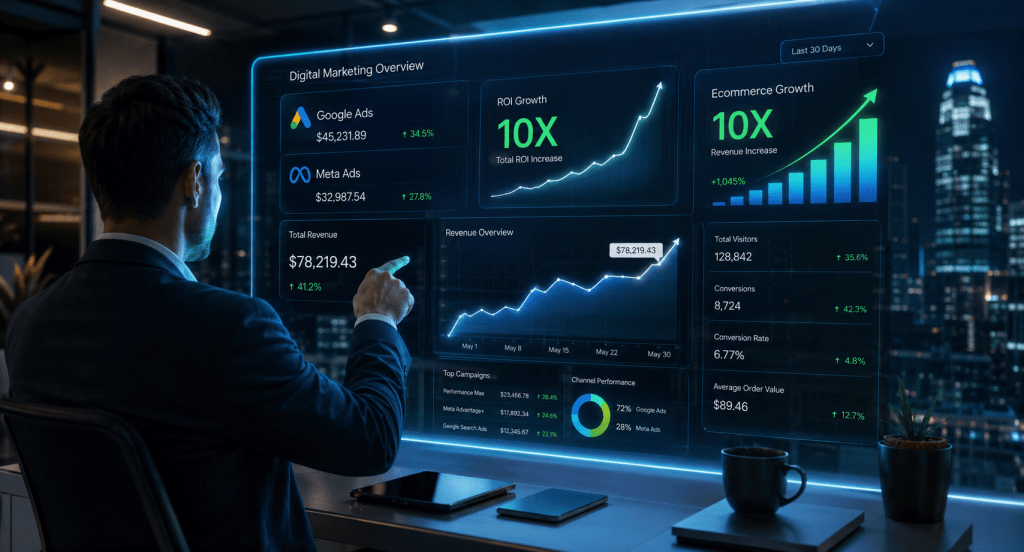
Businesses generally earn about $2 in revenue for every $1 spent on Google Ads, although actual results vary widely depending on industry, campaign quality, targeting, and optimization. At the same time, ecommerce brands continue to increase investment in paid advertising because it remains one of the fastest ways to generate qualified traffic and measurable sales when campaigns are managed effectively.
Here’s what has changed.
Winning brands aren’t spending dramatically more.
They’re spending smarter.
I’ve audited ecommerce stores that burned through thousands of dollars with almost nothing to show for it. I’ve also seen smaller brands outperform larger competitors by focusing on customer intent, first party data, creative testing, and disciplined optimization rather than simply increasing budgets.
That shift defines ecommerce PPC strategy in 2026.
Success is no longer about launching a few campaigns and hoping the algorithm finds buyers. Today’s highest-performing stores treat paid advertising as a complete growth system where Google Ads captures existing demand, Meta Ads creates new demand, creative is tested continuously, and every dollar is measured against actual profit instead of vanity metrics.
If your ads are generating clicks but not consistent revenue, or if your ROAS has started slipping despite higher budgets, you’re in the right place.
I’ll walk you through the same strategic principles that successful ecommerce brands use to scale paid advertising without wasting money.
What Is an Ecommerce PPC Strategy?
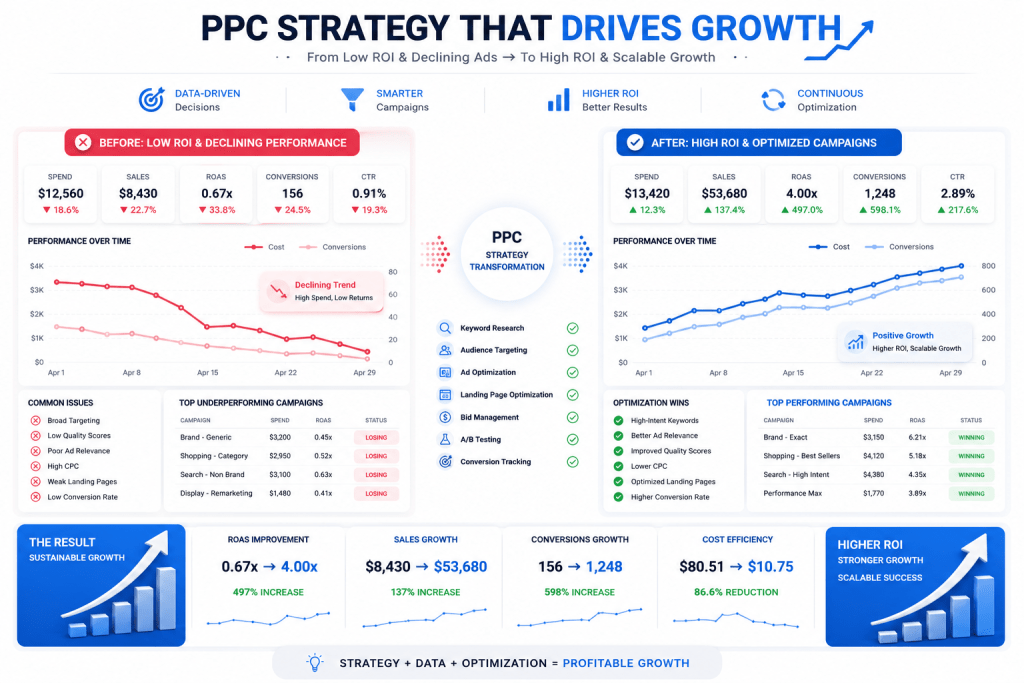
An ecommerce PPC strategy is the complete process of planning, launching, measuring, and optimizing paid advertising campaigns to generate profitable online sales.
It goes far beyond choosing keywords or boosting social media posts.
A successful strategy answers questions like:
- Which platforms deserve your budget?
- Which audience is most likely to buy?
- Which products should receive the highest investment?
- What return should every campaign generate?
- When should budgets be increased or reduced?
Think of PPC as running a physical retail store.
A poor strategy is like opening every door, hiring extra staff, and hoping customers walk in.
A smart strategy opens the right entrance, displays the right products, greets qualified shoppers, and tracks every purchase.
That’s exactly how profitable ecommerce advertising works today.
The Core Components of Modern Paid Ads Ecommerce
| Component | Purpose |
| Search Campaigns | Capture shoppers actively searching to buy |
| Shopping Campaigns | Showcase products directly in search results |
| Performance Max | Expand reach using Google’s automation |
| Meta Ads | Generate demand and retarget visitors |
| Landing Pages | Convert traffic into paying customers |
| Analytics | Measure profitability beyond clicks |
| Continuous Optimization | Improve campaigns every week |
Every successful campaign depends on these pieces working together rather than independently.
Why Many Ecommerce PPC Campaigns Fail
One of the biggest misconceptions I still see is believing that more ad spend automatically leads to more sales.
It doesn’t.
I’ve watched brands double their budgets only to double their losses because the underlying strategy never changed.
Here are some of the most common reasons paid campaigns underperform.
1. Weak Audience Targeting
Showing ads to everyone usually means converting almost no one.
The highest-performing campaigns focus on shoppers with genuine purchase intent rather than broad audiences that are unlikely to buy.
2. Sending Traffic to Poor Landing Pages
Even exceptional ads struggle when visitors land on slow, confusing, or untrustworthy pages.
A landing page should answer questions quickly, showcase benefits clearly, build trust with reviews, and make purchasing effortless.
3. Measuring the Wrong Metrics
High click-through rates can look impressive.
They don’t necessarily translate into revenue.
Instead of celebrating clicks, successful brands monitor:
- Revenue
- Profit margin
- Customer acquisition cost
- Conversion rate
- Lifetime customer value
- Return on ad spend
Those numbers tell the real story.
4. Ignoring Creative Fatigue
The same ad creative rarely performs well forever.
Customers become familiar with it, engagement declines, and acquisition costs rise.
Winning brands constantly refresh:
- Images
- Videos
- Headlines
- Product angles
- Calls to action
Fresh creative often improves results without increasing budgets.
5. Scaling Too Quickly
Many ecommerce businesses experience a few profitable days and immediately triple their daily budget.
Performance drops.
Costs increase.
Conversions become inconsistent.
Smart advertisers scale gradually while monitoring performance at every stage.
The Five Pillars of a Winning Ecommerce PPC Strategy
Whether you’re spending $2,000 per month or $500,000 per month, every profitable campaign is built on five essential pillars.
1. Start With Customer Intent
Every click has a purpose.
Some visitors are researching.
Others are comparing products.
A smaller group is ready to buy immediately.
Your messaging should reflect that intent instead of treating every visitor the same.
For example:
| Customer Intent | Recommended Campaign |
| Researching products | Educational Meta Ads |
| Comparing brands | Google Search Ads |
| Ready to purchase | Shopping Ads |
| Previous visitors | Remarketing Campaigns |
| Existing customers | Upsell Campaigns |
Matching campaign type with customer intent consistently improves conversions.
2. Build Platform Specific Strategies
Google and Meta solve different problems.
Google captures demand.
Meta creates demand.
Trying to use identical messaging across both platforms usually reduces performance.
A balanced Google Ads strategy and Meta ads strategy ensures your brand reaches shoppers throughout the buying journey.
3. Optimize for Profit, Not Just ROAS
High ROAS doesn’t always mean high profit.
Consider this example:
Campaign A
- ROAS: 8x
- Revenue: $8,000
- Profit: $600
Campaign B
- ROAS: 5x
- Revenue: $25,000
- Profit: $4,500
Which campaign would you scale?
The second one.
Successful brands evaluate advertising alongside fulfillment costs, margins, shipping expenses, and repeat purchases instead of relying on a single metric.
4. Test Every Month
Winning campaigns are rarely built in one attempt.
Top ecommerce advertisers routinely test:
- Product imagery
- Video ads
- Headlines
- Offers
- Pricing angles
- Landing page layouts
- Audience segments
Small improvements accumulate into significant revenue gains over time.
5. Never Stop Optimizing
This is where many brands gain a competitive advantage.
Optimization isn’t a quarterly task.
It’s an ongoing process.
Regular campaign reviews help identify:
- Expensive keywords
- Low performing audiences
- Creative fatigue
- Budget inefficiencies
- Product opportunities
Businesses that invest in PPC Optimization Services often uncover these issues earlier, allowing them to improve efficiency before wasted spend compounds.
Google Ads Strategy That Converts High Intent Shoppers
If I had to choose just one advertising platform for an ecommerce business with a limited budget, I’d start with Google Ads.
Why?
Because people searching on Google are already expressing intent. They’re not casually scrolling. They’re actively looking for a solution, comparing products, or preparing to buy.
That makes Google one of the most reliable channels for capturing demand.
The challenge is that many businesses still use a 2022 playbook in a 2026 market.
Successful brands have evolved.
Focus on Search Intent, Not Just Keywords
Instead of chasing high-volume keywords, group campaigns around purchase intent.
Here’s a simple framework:
| Search Intent | Example Search | Campaign Goal |
| Informational | best ergonomic office chair | Educate and build trust |
| Commercial | ergonomic office chair reviews | Compare products |
| Transactional | buy ergonomic office chair | Drive immediate sales |
| Brand | Nike running shoes | Capture branded demand |
The closer a keyword is to a buying decision, the more valuable it usually becomes.
That’s why experienced advertisers don’t judge keywords by traffic alone. They judge them by profitability.
Build Campaigns Around Product Categories
A common mistake is putting every product into one campaign.
That limits control over budgets, bidding, and optimization.
Instead, organize campaigns by:
- Best-selling collections
- Product categories
- Seasonal products
- High-margin items
- New arrivals
- Clearance inventory
This approach makes it much easier to identify where your advertising budget delivers the highest return.
Use Performance Max Strategically
Performance Max has matured significantly over the last few years.
When paired with clean product feeds, high-quality creative assets, and accurate conversion tracking, it can uncover new customer segments across Google’s ecosystem.
However, it shouldn’t replace every campaign.
A balanced account often includes:
- Search Campaigns
- Shopping Campaigns
- Brand Campaigns
- Performance Max
- Remarketing Campaigns
Each serves a different purpose in the customer journey.
Improve Your Product Feed
Your product feed often determines whether Shopping campaigns succeed or struggle.
Pay attention to:
- Clear product titles
- Detailed descriptions
- High-resolution images
- Updated pricing
- Product availability
- Accurate categories
- Relevant product attributes
A well-optimized feed helps Google understand exactly what you’re selling and when to display it.
Smart Bidding Works Better with Better Data
Automation isn’t magic.
Google’s bidding strategies perform best when they’re trained on accurate conversion data.
Make sure you’re tracking:
- Purchases
- Revenue
- Enhanced conversions
- First-party customer data
- Offline conversions when applicable
The stronger the data, the better Google’s machine learning performs.
If you’re looking to improve campaign efficiency, a detailed Google Ads ROI Guide can help identify areas where tracking, bidding, and campaign structure need refinement before increasing spend.
Meta Ads Strategy That Creates Demand Before Customers Search
Google captures existing demand.
Meta creates it.
That’s why both platforms work best together rather than competing against each other.
Many customers discover products on Facebook or Instagram long before they search on Google.
A compelling video, a relatable problem, or a strong customer story can introduce your brand to someone who wasn’t actively shopping five minutes earlier.
That’s powerful.
Prioritize Creative Over Targeting
Audience targeting has become more automated.
Creative has become the biggest differentiator.
The brands consistently achieving strong results with paid ads ecommerce invest heavily in content that feels authentic rather than overly polished.
Winning creatives often include:
- Customer testimonials
- Product demonstrations
- Before-and-after comparisons
- User-generated content
- Founder stories
- Short educational videos
People engage with content that feels genuine.
Your ads should look like valuable social content first and promotional material second.
Build a Full Funnel Campaign Structure
Many advertisers focus only on conversions.
That’s a mistake.
Every customer moves through different stages before purchasing.
A complete Meta strategy addresses each stage.
| Funnel Stage | Campaign Objective |
| Awareness | Introduce your brand |
| Consideration | Educate and answer objections |
| Conversion | Drive purchases |
| Retention | Encourage repeat orders |
| Loyalty | Increase lifetime value |
Each stage requires different messaging, offers, and creative.
Retarget Interested Visitors
Most people don’t purchase during their first visit.
Retargeting gives you another opportunity to earn their trust.
Create audiences such as:
- Product viewers
- Cart abandoners
- Checkout abandoners
- Previous customers
- Email subscribers
- High-value purchasers
Tailor your messaging based on what each audience has already done.
A shopper who abandoned checkout needs a different message than someone who only viewed your homepage.
Refresh Creative Before Performance Declines
Creative fatigue happens quietly.
Costs increase.
Click-through rates decrease.
Conversions slow down.
Many advertisers react too late.
Instead, establish a regular testing cycle.
Each month, experiment with:
- New hooks
- Video lengths
- Headlines
- Offers
- Product angles
- Call-to-action buttons
- Thumbnail images
Small creative improvements often produce larger gains than increasing the budget.
Brands looking to improve campaign efficiency across Facebook and Instagram frequently benefit from following a structured Meta Ads ROI Guide to identify winning creatives, audience signals, and optimization opportunities.
ROAS Optimization: The Metric That Actually Matters
Every advertiser wants higher ROAS.
But chasing the biggest number isn’t always the smartest strategy.
A campaign producing a 10x ROAS can still lose money if the products have low margins, high shipping costs, or expensive returns.
That’s why profitable brands evaluate advertising using a broader financial picture.
Look Beyond Return on Ad Spend
Track metrics together rather than in isolation.
| KPI | Why It Matters |
| ROAS | Measures advertising efficiency |
| Customer Acquisition Cost | Reveals how much it costs to win a customer |
| Conversion Rate | Indicates landing page effectiveness |
| Average Order Value | Increases revenue without increasing traffic |
| Lifetime Customer Value | Measures long-term profitability |
| Net Profit | Determines whether campaigns are truly sustainable |
When these metrics improve together, scaling becomes much safer.
Practical Ways to Improve ROAS
Rather than relying on a single tactic, successful ecommerce brands optimize multiple areas simultaneously.
Increase conversion rates by:
- Improving landing page speed
- Simplifying checkout
- Displaying trust badges
- Adding customer reviews
- Using stronger product photography
Increase average order value by:
- Product bundles
- Cross-selling
- Upselling
- Quantity discounts
- Free shipping thresholds
Reduce wasted spend by:
- Pausing underperforming keywords
- Excluding irrelevant search terms
- Refining audience segments
- Removing low-performing placements
- Adjusting bids based on device or location
Incremental gains across several areas often outperform one dramatic change.
A Simple ROAS Optimization Framework
Here’s the process I recommend before increasing ad budgets:
- Verify accurate conversion tracking.
- Review search terms and audience quality.
- Eliminate campaigns with consistently poor profitability.
- Refresh ad creatives and copy.
- Improve landing page experience.
- Increase budget gradually on proven winners.
- Monitor performance weekly rather than reacting daily.
This disciplined approach helps protect profitability while creating room for sustainable growth.
How to Scale Ecommerce Ads Without Losing Profit
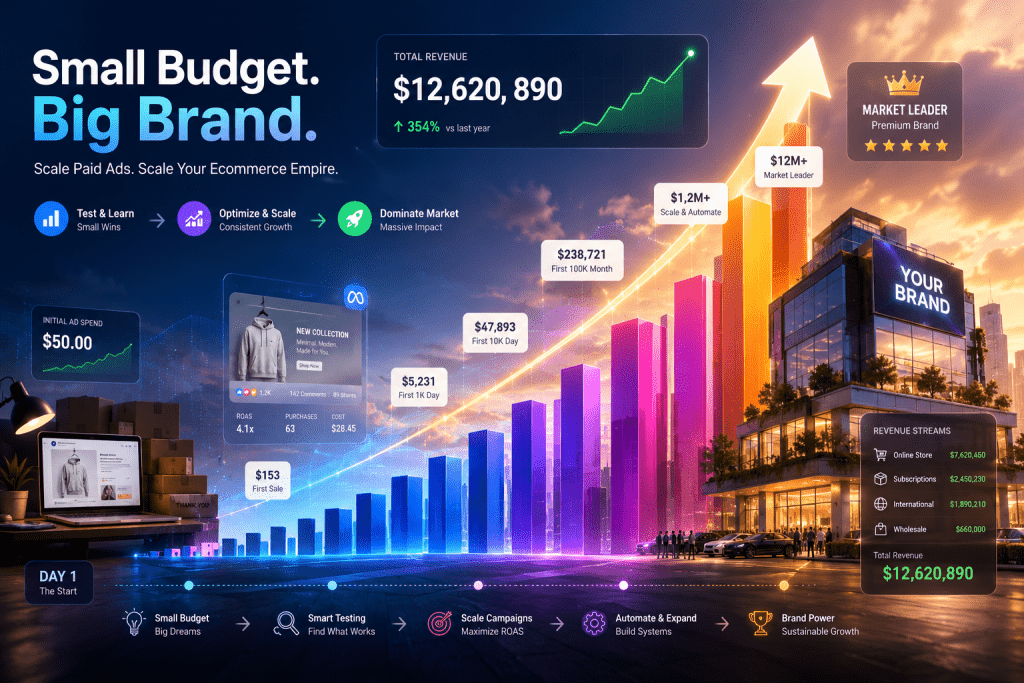
Scaling ad campaigns sounds exciting until performance suddenly drops.
I’ve seen it happen countless times. A campaign delivers a healthy 6x ROAS for several weeks, so the budget is doubled overnight. Within days, the cost per acquisition climbs, conversions slow, and the return that looked so promising starts to disappear.
Scaling isn’t about spending more. It’s about increasing revenue while protecting profitability.
The brands that consistently grow don’t chase rapid spikes. They follow a disciplined process backed by data.
Know When a Campaign Is Ready to Scale
Before increasing your budget, make sure the campaign has shown consistent performance.
Ask yourself:
- Has it generated profitable sales for at least two weeks?
- Is the conversion rate stable?
- Is ROAS meeting your target?
- Are you still reaching new customers?
- Is there enough search demand or audience size to support additional spend?
If the answer to most of these questions is yes, you’re in a much stronger position to scale confidently.
Increase Budgets Gradually
One of the safest approaches is making small budget adjustments instead of dramatic jumps.
A gradual increase allows advertising platforms to adapt without forcing the learning phase to reset.
For example:
| Current Daily Budget | Suggested Increase |
| $100 | $115 to $120 |
| $250 | $280 to $300 |
| $500 | $550 to $600 |
| $1,000 | $1,100 to $1,200 |
Patience often outperforms aggressive scaling.
Expand Winning Products First
Not every product deserves a larger budget.
Focus on products that already demonstrate:
- Strong profit margins
- Consistent conversion rates
- Positive customer reviews
- Low return rates
- Healthy inventory levels
Scaling proven winners usually produces better results than trying to force demand for weaker products.
Reach New Audiences Strategically
When existing audiences become saturated, look for opportunities to expand.
You can test:
- New geographic markets
- Different age groups
- Interest-based audience variations
- Lookalike audiences
- Seasonal campaigns
- New product bundles
The goal is to increase reach without sacrificing relevance.
Improve the Customer Journey Before Spending More
Sometimes the biggest opportunity isn’t inside your ad account.
It’s on your website.
If your landing pages convert only 2% of visitors, improving that to 3% can generate significantly more revenue from the same advertising budget.
Review areas such as:
- Mobile responsiveness
- Page speed
- Product descriptions
- Trust signals
- Checkout experience
- Payment options
- Shipping transparency
Better websites make every advertising dollar work harder.
Businesses investing in comprehensive Ecommerce Marketing Services often combine advertising, conversion rate optimization, and customer journey improvements to maximize long-term growth instead of relying solely on increased ad spend.
The Biggest PPC Mistakes That Drain Advertising Budgets
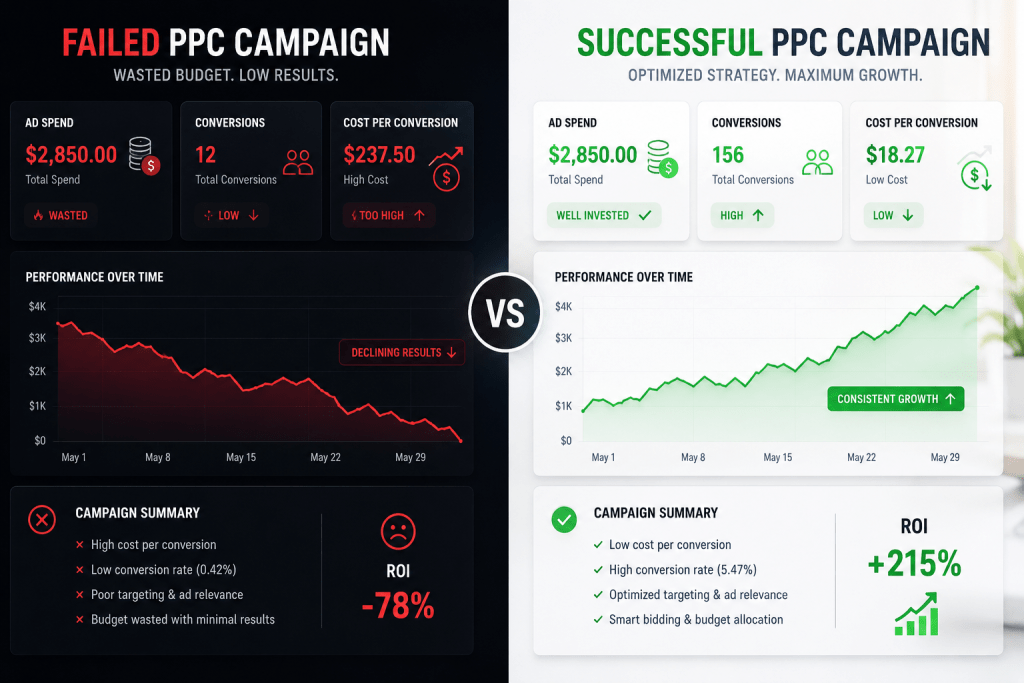
Every ecommerce business makes mistakes.
The difference is that successful brands identify them quickly and correct them before they become expensive.
Here are the issues I encounter most often.
Mistake #1: Optimizing for Clicks Instead of Sales
Traffic alone doesn’t pay the bills.
A campaign attracting thousands of visitors means very little if those visitors aren’t buying.
Always prioritize revenue and profitability over vanity metrics.
Mistake #2: Ignoring Search Terms
Google regularly shows ads for searches you didn’t specifically target.
Without reviewing search term reports, you may end up paying for irrelevant clicks.
Adding negative keywords helps eliminate wasted spend and improves campaign quality.
Mistake #3: Running the Same Creative for Months
Ad fatigue affects every account.
Customers stop noticing familiar ads, engagement drops, and acquisition costs increase.
Refresh creatives consistently, even if current performance still looks acceptable.
Mistake #4: Sending Every Visitor to the Homepage
Your homepage shouldn’t be the default destination for every campaign.
Instead, send visitors directly to:
- Relevant product pages
- Collection pages
- Category landing pages
- Promotional offers
- Best-selling products
The fewer steps customers take, the higher the likelihood of conversion.
Mistake #5: Ignoring Mobile Users
Most ecommerce traffic now comes from mobile devices.
If your store isn’t optimized for smaller screens, you’re likely losing potential customers before they even reach checkout.
Test your site regularly on different devices to ensure a smooth shopping experience.
Mistake #6: Scaling Based on Emotion
It’s tempting to increase budgets after a few successful days.
Resist the urge.
Look for consistent performance over time rather than reacting to short-term fluctuations.
Data should drive every scaling decision.
Ecommerce PPC Trends Defining 2026

Paid advertising continues to evolve rapidly.
Brands that adapt early often gain a competitive advantage while others struggle to catch up.
Here are the trends shaping ecommerce PPC this year.
1. AI Supports Decision Making, But Human Strategy Wins
Advertising platforms now automate bidding, audience expansion, and creative combinations more effectively than ever.
However, AI still depends on quality inputs.
Successful brands provide:
- Better product data
- Better creative assets
- Better conversion tracking
- Better customer insights
Human strategy remains the foundation.
2. First Party Data Is Becoming More Valuable
As privacy regulations continue to evolve, businesses are relying more on data they collect directly from customers.
Examples include:
- Email subscribers
- Purchase history
- Loyalty programs
- CRM data
- Website interactions
First-party data creates stronger audience signals while reducing dependence on third-party tracking.
3. Video Continues to Dominate Paid Social
Short-form videos consistently outperform many static formats across social platforms.
Product demonstrations, customer stories, behind-the-scenes content, and educational videos often capture attention more effectively than traditional promotional images.
The focus should be on authenticity rather than high production value.
4. Creative Testing Is Becoming a Competitive Advantage
Many businesses still treat creative as an afterthought.
Leading ecommerce brands test new concepts every month.
Even small improvements in messaging or visuals can significantly improve campaign performance over time.
5. Profitability Is Replacing ROAS as the Primary Goal
More businesses are moving beyond simple advertising metrics.
Instead of asking, “How high is our ROAS?”
They’re asking:
“How much profitable revenue did this campaign generate?”
That mindset leads to smarter investment decisions and healthier long-term growth.
Ecommerce PPC Success Checklist
Before increasing your advertising budget, review this checklist.
✅ Accurate conversion tracking is configured.
✅ Product feed is fully optimized.
✅ Landing pages load quickly.
✅ Mobile shopping experience is seamless.
✅ Google and Meta campaigns support different stages of the buying journey.
✅ Negative keywords are updated regularly.
✅ Ad creatives are refreshed consistently.
✅ Audience segmentation is based on customer intent.
✅ ROAS is evaluated alongside profit margins.
✅ Budget increases are gradual and backed by performance data.
If you can confidently check every item, your campaigns are positioned for sustainable growth rather than short-term wins.
Read Also:- Ecommerce PPC Management in 2026: Proven Strategies to Maximize ROI
Final Thoughts
Paid advertising has changed dramatically over the past few years, and it’s still evolving.
The brands winning in 2026 aren’t necessarily the ones with the biggest budgets. They’re the ones making smarter decisions.
They understand their customers, invest in better creative, track the right metrics, improve their websites, and optimize continuously instead of relying on guesswork.
That’s what separates profitable campaigns from expensive experiments.
If your current ads are generating traffic but not enough revenue, resist the urge to spend more. Start by improving the strategy behind every click. Even small gains in targeting, creative, landing pages, or conversion tracking can produce meaningful improvements in profitability over time.
A strong ppc strategy for ecommerce isn’t built overnight. It’s refined through testing, learning, and consistent optimization. Businesses that commit to that process are far more likely to achieve sustainable growth while staying competitive in an increasingly crowded market.
Ready to Grow Your Ecommerce Sales?
Running successful PPC campaigns takes more than launching ads. It requires the right strategy, accurate tracking, compelling creative, and ongoing optimization.
At Webiators, we help ecommerce businesses build data-driven advertising strategies that focus on measurable business growth, not vanity metrics. Whether you’re looking to improve campaign performance, increase ROAS, or scale across Google and Meta, our team combines technical expertise with real ecommerce experience to deliver results that matter.
Ready to turn your ad spend into profitable growth? Explore our PPC Optimization Services or connect with our experts to create an ecommerce PPC strategy tailored to your business goals.
Key Takeaways
- A successful ecommerce PPC strategy focuses on profitability, not just clicks or impressions.
- Google Ads captures shoppers with high purchase intent, while Meta Ads creates demand and builds brand awareness.
- ROAS should be evaluated alongside profit margins, customer acquisition cost, and lifetime customer value.
- Scaling works best when budgets increase gradually and campaigns have proven, consistent performance.
- Regular creative testing, audience refinement, and landing page optimization are essential for long-term success.
- First-party data, AI-assisted optimization, and high-quality creative are shaping the future of paid ecommerce advertising.
- Businesses that continuously optimize their campaigns are better positioned to achieve sustainable growth and maximize advertising ROI.
FAQs
What is PPC in ecommerce?
PPC (Pay Per Click) in ecommerce is an advertising model where online stores pay only when users click on their ads. These ads appear across platforms like Google, Facebook, Instagram, and YouTube. The main goal is to attract high-intent shoppers, improve conversions, and drive profitable sales rather than just traffic.
How much budget is needed for ecommerce PPC?
There is no fixed budget, as it depends on your industry, competition, product pricing, and goals. Generally, startups may begin with $1,000–$3,000 per month, growing brands with $3,000–$10,000, and established stores often invest $10,000+. The focus should be on achieving consistent profitable returns rather than a fixed spend amount.
What is ROAS?
ROAS (Return on Ad Spend) measures how much revenue is generated for every dollar spent on advertising. It is calculated as Revenue ÷ Ad Spend. For example, if you spend $2,000 and earn $10,000, your ROAS is 5x. However, it should be evaluated alongside profit margins, CAC, and LTV for a complete performance view.
Google Ads vs Meta Ads: Which Delivers Better ROI?
Neither platform is inherently better, as both serve different purposes. Google Ads targets users with high purchase intent, making it strong for conversions, while Meta Ads focuses on discovery and engagement through visual storytelling. Most successful ecommerce brands use both together to guide users from awareness to purchase.
