

You changed the button. Sales barely moved. You rewrote the headline. Nothing happened. Then someone suggested a complete redesign.
That cycle gets expensive.
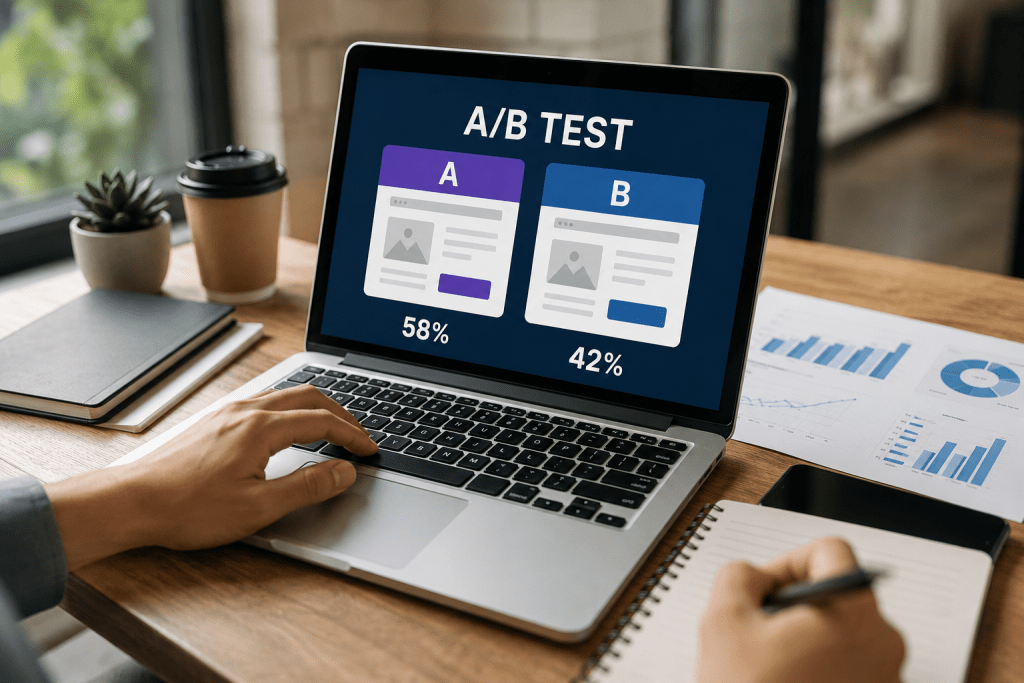
Ecommerce A/B Testing gives you a better way to make decisions. Instead of debating whether a page “looks better,” you compare two experiences with real shoppers and measure what actually changes.
I like testing for one reason: it turns assumptions into evidence. A winning experiment can reveal a small change worth keeping. A losing experiment can save you from spending thousands on the wrong idea.
Here are 10 ecommerce tests worth prioritizing.
What Should I A/B Test First?
Start with a page that already receives meaningful traffic and sits close to revenue.
A product page with thousands of monthly visitors and a weak add-to-cart rate is usually a better testing opportunity than a low-traffic blog post.
Before launching an experiment, ask:
- What problem are we trying to solve?
- What do we expect to change?
- Which metric will determine success?
- Is there enough traffic to produce useful evidence?
A Website Audit can help identify high-impact opportunities before you start testing.
1. Test Your Product Page Value Proposition
Your headline should quickly answer one question: why should I buy this?
Test a feature-focused headline against a benefit-focused version.
For example, “Stainless Steel Insulated Bottle” communicates what the product is. “Keeps Drinks Cold for 24 Hours” communicates why the shopper should care.
Measure: Add-to-cart rate and purchase conversion rate.
2. Test Product Images
Product photography can influence confidence before shoppers read a single paragraph.
Try standard product images against a combination of lifestyle, close-up, scale, or use-case images.
Do not assume more images automatically win. Test the sequence and presentation.
Measure: Product engagement, add-to-cart rate, and revenue per visitor.
3. Test the Add-to-Cart Experience
Your CTA has a simple job: make the next action obvious.
Test button copy, placement, size, surrounding reassurance, or a sticky mobile CTA.
The goal is not to create the loudest button on the internet. It is to remove hesitation at the moment of purchase intent.
Measure: Add-to-cart rate and downstream purchase rate.
4. Test Reviews Near the Buying Decision
Reviews are most useful when shoppers are deciding whether to trust the product.
Test review placement near the product details or purchase area against placement farther down the page. You can also test customer photos, review summaries, or verified-purchase indicators.
Measure: Add-to-cart rate and conversion rate.
5. Test Shipping Messages
Unexpected shipping costs can create friction late in the buying journey.
Test a clear free-shipping threshold against generic shipping messaging.
For example, “Free shipping on orders over $75” gives shoppers a concrete target. If the test increases average order value without hurting conversion, you may have found a particularly valuable combination.
Measure: Conversion rate, average order value, and revenue per visitor.
6. Test Your Landing Page Offer
Landing page testing works best when the hypothesis is specific.
Compare two versions of the same offer with different headlines, proof points, product benefits, or calls to action.
Do not change everything simultaneously. If the winner contains five different changes, you may know which page won but not which idea created the improvement.
Measure: Conversion rate and revenue generated from the landing page.
7. Test Cart Upsells and Product Recommendations
Your cart is not only a place to review an order. It can also create a relevant second purchase opportunity.
Test product recommendations against complementary bundles or no recommendation at all.
Keep relevance high. Nobody wants a random lawnmower recommendation after buying socks.
Measure: Average order value, items per order, and revenue per visitor.
8. Test Guest Checkout
Account creation can add friction when a shopper simply wants to buy.
Test a prominent guest checkout option against an account-first experience.
For returning customers, account benefits may still matter. The experiment should reveal whether forcing registration costs more sales than it creates long-term value.
Measure: Checkout completion and purchase conversion rate.
For stores with complicated purchasing journeys, Checkout Optimization can uncover additional friction beyond the checkout button itself.
9. Test Checkout Form Length
Every unnecessary field creates another opportunity for hesitation.
Test a shorter checkout against your current form. Remove fields only when they are genuinely unnecessary for fulfillment, payment, compliance, or the customer experience.
Track completion carefully. A shorter form is useful only if it improves the business outcome.
Measure: Checkout completion, purchase rate, and revenue per visitor.
10. Test Your Offer Structure
“20% off” is not always more compelling than “Save $20.”
Depending on your average order value, product category, and customer intent, percentage discounts, dollar discounts, bundles, free shipping, or tiered offers can produce very different results.
Run a controlled experiment rather than choosing based on personal preference.
Measure: Conversion rate, average order value, gross revenue, and margin.
How Long Should an A/B Test Run?
There is no magic seven-day or fourteen-day rule.
Run the experiment until you have enough representative data to make a reliable decision based on your predefined criteria. Account for normal variations in traffic, weekdays, promotions, devices, and customer sources.
Most importantly, do not stop a test simply because one version leads after two days.
Early results can be noisy.
Does A/B Testing Increase Conversions?
It can. It can also show that a proposed change makes no meaningful difference or performs worse.
That is valuable information.
Good experiment design protects you from expensive assumptions. The objective is not to manufacture a winning result. It is to discover what actually improves the customer journey and business performance.
For Shopify merchants, Shopify CRO can help turn testing opportunities into broader improvements across product discovery, merchandising, and checkout. Magento stores often require a more technical approach because catalog structures, custom functionality, and integrations can affect experimentation.
What Tools Help With A/B Testing?
Your analytics platform should provide the measurement foundation. Behavioral analytics can help you understand where shoppers struggle, while dedicated experimentation platforms can run controlled variants.
But software does not create a testing strategy.
The useful sequence is:
Find the problem → form a hypothesis → choose the metric → run the test → analyze the evidence → document the learning → test the next opportunity.
That is how CRO testing becomes a repeatable growth process rather than random button experiments.
Stop Treating Your Store Like a Finished Project
Your ecommerce site is never truly finished.
Customer expectations change. Competitors change. Traffic sources change. Even a winning page can eventually become the weakest link in the buying journey.
Start with one high-impact page. Test one meaningful hypothesis. Measure the metric that matters to revenue.
You do not need another opinion about whether your website could convert better.
You need evidence.
If your team has traffic but cannot identify where revenue is being lost, professional CRO Services can help turn analytics, customer behavior, and experimentation into a clearer optimization roadmap.
FAQs
What is A/B testing?
A/B testing compares two versions of a webpage or experience with real users to determine which performs better against a predefined goal.
How many changes should I test?
Ideally, test one major variable at a time when you need to understand what caused the result. Larger experiments can test multiple changes, but they require stronger experiment design.
Can A/B testing improve sales?
Yes, a successful test can improve conversion rate, average order value, or another revenue-related metric. Results depend on the problem, audience, and quality of the experiment.
What metrics should I measure?
Use a primary metric tied directly to your objective, such as purchase conversion rate, revenue per visitor, average order value, or checkout completion.
When should I stop a test?
Stop when your predefined decision criteria have been met and the data adequately represents normal customer behavior. Never stop solely because an early result looks promising.
