


If I had to pick one SEO mistake that quietly costs ecommerce businesses thousands of potential customers every month, it wouldn’t be slow page speed or missing meta descriptions.
It would be neglected category pages.
That may sound surprising because most SEO conversations revolve around product pages, blogs, or backlinks. Yet when I audit ecommerce websites, I repeatedly find the same pattern. Brands invest heavily in creating hundreds or even thousands of product pages while treating category pages as nothing more than product directories.
Google doesn’t see them that way.
For many high-intent searches, category pages are exactly what Google wants to rank. Someone searching for “men’s running shoes,” “ergonomic office chairs,” or “wireless gaming headphones” usually isn’t looking for one specific product. They’re comparing options, narrowing choices, and deciding where to buy.
A well-optimized category page serves that intent perfectly.
Unfortunately, most ecommerce stores never unlock that opportunity.
Their category pages have little or no content, poor internal linking, duplicate structures, weak metadata, and almost no signals that demonstrate expertise or authority. The result is predictable. Product pages compete against each other, rankings stagnate, and valuable commercial traffic ends up in the hands of competitors.
I’ve seen businesses spend months publishing blog content while ignoring the pages most likely to generate revenue. It’s like opening a beautifully designed retail store but forgetting to put signs above the aisles. Customers eventually find what they need, but many leave before they get there.
That’s why category page SEO deserves far more attention than it usually receives.
When done correctly, category pages don’t just improve rankings. They become powerful landing pages that attract qualified buyers, strengthen your website architecture, distribute authority across product pages, and increase conversions.
In this guide, I’ll share the strategies I use to improve ecommerce category page SEO, explain why so many stores struggle to rank, and show you how to turn category pages into some of the most valuable assets on your ecommerce website.
Why Category Pages Matter More Than Most Ecommerce Businesses Realize
Many businesses assume their product pages should generate the majority of organic traffic.
That isn’t how people search.
Most buying journeys begin with broad commercial searches.
Think about your own shopping habits.
If you’re looking for a laptop, you probably don’t start by searching for a specific model. You search phrases like:
- Best gaming laptops
- Lightweight business laptops
- Student laptops under $1,000
Only later do you narrow your options.
Google understands this behavior exceptionally well.
That’s why category pages frequently rank ahead of individual products for commercial keywords.
Search for terms like:
- Running shoes
- Coffee machines
- Office desks
- Bluetooth speakers
You’ll often see category pages from major retailers dominating the first page because they provide something individual product pages cannot.
Choice.
Instead of presenting one option, they help shoppers compare brands, prices, features, ratings, and availability in one place.
That aligns perfectly with search intent.
A Real-World Example
Search Google for “wireless headphones.“
You’ll notice that websites like Amazon, Best Buy, Walmart, and other large retailers rarely rank a single product for that search.
They rank category pages.
Why?
Because someone searching for wireless headphones usually hasn’t decided which model to buy. They’re comparing brands such as Sony, Bose, JBL, Apple, or Samsung.
Google knows a category page satisfies that intent better than an individual product.
The same principle applies whether you sell furniture, fashion, electronics, automotive parts, beauty products, or industrial equipment.
Your category pages are often your strongest opportunity to capture high-volume commercial searches.
Do Category Pages Rank on Google?
Yes, and in many industries they outperform product pages.
Google’s goal is simple.
Deliver the page that best satisfies the user’s intent.
For informational searches, blog articles often win.
For branded searches, product pages usually perform well.
For broad commercial searches, category pages are frequently the preferred choice because they allow users to compare multiple relevant products before making a purchase.
That’s why investing in SEO ecommerce category pages isn’t optional anymore.
It’s one of the most effective ways to increase qualified organic traffic without creating hundreds of additional pages.
Category Pages Drive More Than Rankings
One benefit that often gets overlooked is how category pages influence the rest of your website.
A strong category page can:
- Pass authority to related product pages through strategic internal links.
- Improve crawl efficiency by giving search engines a clear understanding of your website structure.
- Help shoppers discover complementary products naturally.
- Increase average session duration because visitors explore multiple products instead of leaving after viewing one.
- Support seasonal campaigns without creating entirely new landing pages.
Think of category pages as the central hub of your ecommerce website.
Your product pages are individual stores.
Your blog educates customers.
But your categories connect everything together.
When those hubs are weak, the entire website loses momentum.
When they’re optimized properly, they become some of the highest-performing commercial pages on your site.
That’s exactly why I consider category ranking Google one of the most valuable long-term SEO opportunities for ecommerce businesses.
Why 90% of Ecommerce Stores Fail at Category Page SEO
If category pages have so much ranking potential, why do so many ecommerce businesses struggle to get them onto Google’s first page?
After reviewing countless ecommerce websites, I’ve noticed that the problem is rarely competition.
It’s usually strategy.
Many stores unknowingly build category pages for their internal catalog rather than for the people using search engines. The page might make perfect sense to the merchandising team, but Google and potential customers see something very different.
Here are the biggest mistakes holding category pages back.
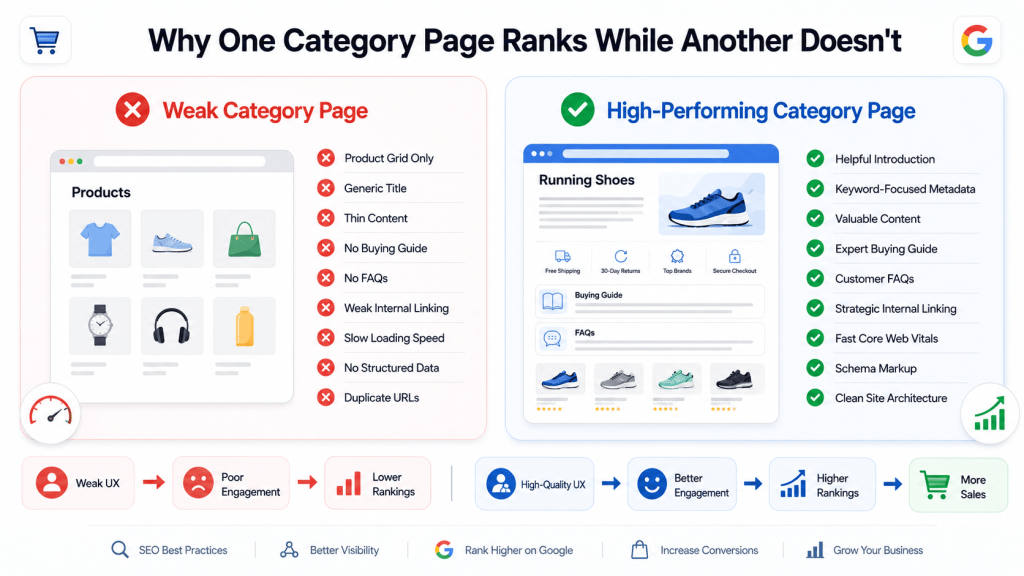
1. They Treat Category Pages Like Product Archives
One heading.
A grid of products.
Maybe a sorting filter.
That’s it.
Technically, the page works. From an SEO perspective, it contributes very little.
Search engines don’t rank pages simply because products exist on them. They rank pages that provide context, demonstrate relevance, and satisfy user intent.
Now compare two category pages selling running shoes.
Category Page A
- Product grid only
- Generic title
- No introduction
- No buying advice
- No FAQs
Category Page B
- Clear category overview
- Helpful buying tips
- Product filters
- Frequently asked questions
- Related categories
- Strong internal links
Which one would you trust if you were shopping?
Google asks the same question.
2. They Ignore Search Intent
One mistake I see repeatedly is trying to rank a single category page for every possible keyword variation.
For example, a furniture retailer creates one “Office Chairs” category and expects it to rank for:
- Ergonomic office chairs
- Executive office chairs
- Mesh office chairs
- Office chairs for back pain
- Cheap office chairs
- Gaming office chairs
Those searches may sound related, but they represent different customer needs.
Trying to satisfy all of them with one page usually weakens the relevance of each.
Successful SEO category optimization starts by understanding what the customer expects to find after clicking.
Google rewards pages that answer a specific intent exceptionally well, not pages attempting to rank for everything.
A Quick Example From an Ecommerce Audit
A while ago, I reviewed an ecommerce website with several thousand products spread across dozens of categories.
The marketing team couldn’t understand why their blog attracted visitors while their commercial pages barely appeared in search results.
The product pages were reasonably optimized.
The category pages weren’t.
Every category contained little more than a title and product listings.
There was no introductory content, no internal links to related collections, no buying guidance, and no supporting FAQs.
Instead of creating more blog posts, we focused on strengthening the pages customers were actually searching for.
The improvements included:
- Consolidating duplicate categories
- Writing helpful category introductions
- Improving internal linking between related collections
- Reorganizing page hierarchy
- Optimizing metadata around commercial search intent
The result wasn’t an overnight miracle.
SEO rarely works that way.
But over the following months, category visibility improved steadily because Google finally had enough context to understand what each page represented.
That’s the lesson.
Sometimes you don’t need hundreds of new pages.
You simply need to improve the pages that already deserve to rank.
3. Weak Internal Linking Breaks Topical Authority
Many ecommerce businesses rely almost entirely on navigation menus.
Unfortunately, navigation alone doesn’t build authority.
Google pays attention to contextual relationships between pages.
If your buying guides, comparison articles, seasonal collections, and blog posts never link to relevant categories, you’re missing one of the strongest signals available.
Think about a customer reading an article titled:
How to Choose the Right Hiking Backpack
At the end of the article, where should they go?
Ideally, directly to your Hiking Backpacks category.
That creates a logical journey for both users and search engines.
A strong internal linking SEO strategy helps Google understand which commercial pages matter most while guiding visitors naturally toward products they’re ready to explore.
4. Thin Content Leaves Google Guessing
One of the most common questions I hear is:
“Should categories have content?”
Absolutely.
Not because Google wants more words.
Because Google wants more understanding.
Imagine walking into a supermarket where every aisle simply says “Food.”
No signs.
No labels.
No recommendations.
You could eventually find what you need, but it would take far longer than necessary.
Category content works the same way.
It tells both customers and search engines:
- What products belong here
- Who they’re designed for
- Which features matter
- How to compare options
- What shoppers should know before buying
That’s useful information.
And useful information is exactly what Google wants to reward.
Weak Category Page vs High-Performing Category Page
The differences are often surprisingly simple.
| Weak Category Page | High-Performing Category Page |
| Product grid only | Helpful category introduction |
| Duplicate or generic page titles | Unique, keyword-focused metadata |
| No buying guidance | Expert buying tips and recommendations |
| Limited internal links | Strategic contextual internal linking |
| Poor image optimization | Compressed images with descriptive alt text |
| No structured data | Schema markup for better understanding |
| Slow loading experience | Fast, mobile-friendly performance |
| Competing category URLs | Clear website hierarchy |
Notice something?
None of these improvements involve trying to “game” Google.
They’re about building a better shopping experience.
That’s exactly why they work.
Google’s systems increasingly reward websites that genuinely help users complete their journey, especially on commercial pages where trust plays such a significant role.
When your categories become easier to understand, easier to navigate, and easier to shop, rankings often follow naturally.
That’s the foundation of successful ecommerce category page SEO.
How to Optimize Category Pages That Consistently Rank and Convert
There’s no shortage of ecommerce SEO checklists online.
Most of them tell you to add keywords, write a meta description, optimize images, and call it a day.
That might have worked years ago.
Today, ranking a category page requires something much more important.
It needs to become the best destination for that search.
When I optimize category pages, I don’t start with keywords. I start with one question:
“If someone landed here for the first time, would they immediately feel they’re in the right place?”
Everything else builds from that.
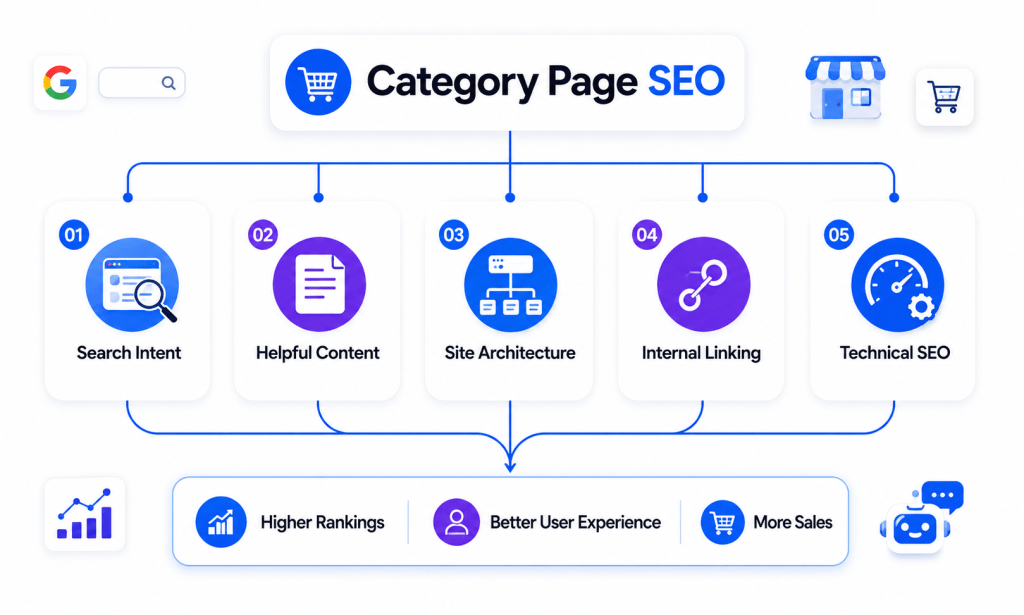
Step 1: Build Around Search Intent, Not Search Volume
Many ecommerce businesses chase the biggest keywords.
The smartest ones focus on matching customer intent.
Take these two searches:
- Men’s leather boots
- Waterproof hiking boots
Both involve footwear.
The buying intent is completely different.
Someone shopping for leather boots may care about style, office wear, or premium brands.
Someone searching for hiking boots is thinking about grip, waterproofing, ankle support, and durability.
Trying to optimize one category for both rarely produces strong results.
Instead, build categories that answer one primary commercial intent exceptionally well.
That’s how modern SEO category optimization works.
Google doesn’t reward pages that mention every keyword.
It rewards pages that completely satisfy the reason behind the search.
Step 2: Add Content That Helps Shoppers Buy
One concern I hear frequently is:
“Won’t adding content push products further down the page?”
Only if it’s written poorly.
Customers don’t want an essay before they start shopping.
They do appreciate helpful guidance.
A strong category page usually includes a short introduction above the product listings, followed by supporting content lower on the page for people who want more information.
A simple structure works well.
Above the Product Grid
Include around 100 to 150 words covering:
- What the category includes
- Who the products are designed for
- Key features shoppers should compare
This immediately confirms they’re in the right place.
Below the Product Grid
Expand with information that answers common buying questions, such as:
- Which products suit beginners?
- What’s the difference between premium and budget options?
- Which brands are most popular?
- How should customers choose the right size or specification?
This content improves user experience while naturally strengthening SEO ecommerce category pages.
It also keeps the page focused on helping people rather than chasing keywords.
Step 3: Create a Website Structure Google Can Understand
I’ve audited ecommerce stores with more than 50,000 products.
Surprisingly, many of them have confusing category structures.
If customers struggle to navigate your website, search engines usually do too.
A logical hierarchy makes everything easier.
Example:
Home
↓
Electronics
↓
Audio Equipment
↓
Wireless Headphones
↓
Noise Cancelling Headphones
Each level adds context.
Google understands exactly where the page belongs.
Customers reach products faster.
Authority flows naturally through the website.
That’s one of the biggest advantages of strong ecommerce structure SEO.
Step 4: Strengthen Internal Linking
Internal links are one of the few SEO improvements completely under your control.
Yet they’re often overlooked.
Instead of relying only on navigation menus, build contextual links throughout your website.
For example:
A buying guide titled:
How to Choose the Right Coffee Machine
should naturally link readers to:
- Espresso Machines
- Coffee Grinders
- Coffee Accessories
Similarly, a blog comparing standing desks should direct visitors toward your Standing Desk category instead of leaving them to search manually.
These contextual links improve navigation while strengthening internal linking SEO.
If you’re investing in Ecommerce SEO Services, this should be one of the first areas your SEO team evaluates because it influences nearly every important commercial page.
Step 5: Optimize Images for Search and Sales
Images aren’t only visual assets.
They’re SEO assets.
Every category image should help search engines understand the page while loading quickly for users.
Best practices include:
- Descriptive file names
- Keyword-relevant alt text
- Compressed image sizes
- WebP format where supported
- Responsive image delivery
- Lazy loading below the fold
Good image optimization contributes to faster load times, stronger accessibility, and better user experience.
Small improvements here often create noticeable gains in Core Web Vitals.
Step 6: Don’t Let Filters Create SEO Problems
Faceted navigation is incredibly useful for customers.
It can become a nightmare for SEO if left unmanaged.
Consider a clothing category.
A customer filters:
Blue
Medium
Cotton
Under $50
Now your website has generated another URL.
Multiply that across every possible combination, and suddenly Google discovers thousands of low-value pages.
The solution isn’t removing filters.
It’s controlling which filtered URLs should be indexed and which should remain available only for shoppers.
That preserves crawl budget while preventing duplicate content issues.
Why AI Search Is Making Category Pages Even More Important

Search is evolving quickly.
People aren’t relying solely on Google’s traditional results anymore.
They’re asking ChatGPT, Gemini, Claude, and Perplexity for product recommendations, buying advice, and comparisons.
These AI systems don’t simply count keywords.
They evaluate context.
They look for pages that clearly explain a topic, answer common questions, organize information logically, and demonstrate expertise.
That’s exactly what a high-quality category page should do.
For example, imagine someone asks an AI assistant:
“What’s the best place to buy ergonomic office chairs?”
The assistant is far more likely to recommend a category page that includes:
- Clear product organization
- Helpful buying guidance
- Frequently asked questions
- Strong website authority
- Relevant supporting links
than a page that only displays twenty products with no explanation.
In other words, optimizing category pages today isn’t just about improving category ranking Google.
It’s about increasing the likelihood that AI-powered search experiences confidently recommend your business as well.
That shift is already changing how successful ecommerce brands approach SEO.
They’re no longer creating pages simply to rank.
They’re creating pages that deserve to be trusted.
Technical SEO Checklist for High-Performing Category Pages
Even the best-written category page can struggle if technical SEO is holding it back.
I always tell clients that content and technical SEO work like two gears in the same machine. If one stops working, the other can’t perform at its full potential.
Before publishing or optimizing any category page, review these essentials.
| Technical Element | Why It Matters |
| Canonical tags | Prevent duplicate category URLs from competing with each other. |
| Breadcrumb navigation | Helps users and search engines understand your site hierarchy. |
| Schema markup | Improves how search engines interpret your category pages. |
| Core Web Vitals | Faster pages create a better shopping experience and support rankings. |
| Mobile responsiveness | Most ecommerce searches now happen on mobile devices. |
| XML sitemap | Ensures important category pages are discovered and crawled efficiently. |
| Optimized pagination | Helps Google understand large product collections without creating crawl issues. |
Many of these issues go unnoticed because they don’t produce obvious errors. That’s why businesses often benefit from a professional Technical SEO Audit before investing more time or budget into content creation.
Sometimes the rankings you’re chasing are already within reach. They just need a stronger technical foundation.
Five Category Page SEO Mistakes You Should Avoid
Even experienced ecommerce teams fall into these traps.
Avoiding them can save months of frustration.
Publishing Thin Category Pages
A category page should do more than display products.
Give customers enough information to understand what they’re buying, who the products are for, and how to compare their options.
Helpful content builds trust. Thin content rarely does.
Creating Duplicate Categories
I’ve seen stores with separate categories for:
- Running Shoes
- Running Footwear
- Men’s Running Shoes
- Running Sneakers
All selling nearly identical products.
Instead of strengthening one authoritative page, the website spreads ranking signals across several weak ones.
Before creating a new category, ask yourself:
Does this represent a genuinely different search intent?
If the answer is no, improve the existing page instead.
Ignoring Internal Links
Publishing excellent category pages isn’t enough if nothing points to them.
Every relevant blog, buying guide, seasonal campaign, and comparison article should naturally direct visitors toward related commercial pages.
A strong internal linking strategy benefits users first.
SEO follows naturally.
Copying Manufacturer Content
Many ecommerce websites still rely on supplier descriptions.
Unfortunately, those same descriptions often appear on dozens of competing websites.
Google has little reason to prefer one over another.
Instead, write original category introductions based on your own expertise.
Answer customer questions.
Explain product differences.
Provide genuine buying advice.
That’s the kind of content both customers and search engines value.
Treating SEO as a One-Time Project
Your categories shouldn’t remain untouched after they’re published.
Review them regularly.
Update seasonal recommendations.
Add new product collections.
Refresh internal links.
Expand FAQs based on customer support questions.
SEO isn’t about reaching the finish line.
It’s about staying relevant as your customers, products, and search behavior evolve.
Read Also:- How to Optimize an Ecommerce Website for ChatGPT, Gemini, and Perplexity
Final Thoughts
The biggest SEO opportunities are often hiding in plain sight.
For many ecommerce businesses, category pages are exactly that.
They’re already part of your website.
They’re already connected to your products.
Your customers are already searching for them.
The only question is whether those pages deserve to rank.
Strong category page SEO isn’t about adding more keywords or chasing algorithm updates. It’s about creating pages that genuinely help people compare products, answer their questions, and move confidently toward a purchase.
When you combine valuable content, logical website architecture, strategic internal linking SEO, technical excellence, and a customer-first experience, category pages become much more than navigation hubs.
They become powerful revenue-generating assets.
As search continues to evolve, this approach becomes even more valuable.
Google rewards helpful content.
AI search platforms reward trustworthy, well-structured information.
Customers reward businesses that make buying easier.
Those three goals point in exactly the same direction.
Ready to Turn Your Category Pages Into Revenue Drivers?
If your ecommerce store has hundreds or thousands of products but your category pages still struggle to attract qualified organic traffic, the issue may not be your products.
It may be the strategy behind the pages connecting them.
At Webiators, we specialize in building scalable ecommerce SEO strategies that deliver long-term business growth. Whether you need comprehensive Ecommerce SEO Services, a detailed Technical SEO Audit, improvements to your Product Page SEO, or data-driven Ecommerce Marketing services, our team focuses on solving the issues that directly impact rankings, traffic, and conversions.
We don’t believe in quick SEO wins that disappear after the next algorithm update.
We build ecommerce websites that search engines trust, AI platforms confidently recommend, and customers genuinely enjoy using.
Because when your category pages perform better, your entire ecommerce business grows with them.
FAQs
How long should category pages be?
There isn’t a universal word count. Focus on providing enough information to help customers make informed buying decisions while giving search engines meaningful context. For most ecommerce stores, 300 to 800 words of useful, well-structured content is more effective than lengthy filler.
Do images matter in SEO?
Yes. Optimized images improve page speed, accessibility, user experience, and image search visibility. Descriptive file names, alt text, and compressed image formats all contribute to stronger SEO performance.
What is internal linking structure?
Internal linking structure refers to how pages connect throughout your website. Strategic links between blogs, category pages, and product pages help search engines understand topical relationships while making navigation easier for shoppers.
Are categories important for SEO?
Absolutely. Category pages often target high-volume commercial keywords that attract shoppers early in the buying journey. When optimized correctly, they can become some of the highest-traffic and highest-converting pages on an ecommerce website.
