
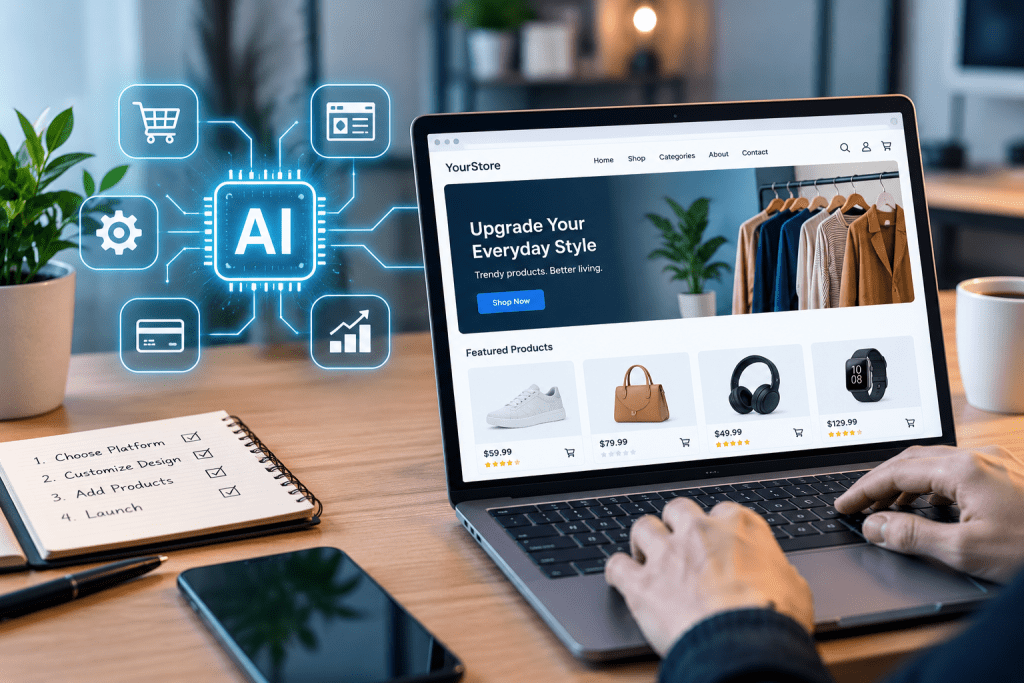

AI can help you get an ecommerce website up and running much faster than traditional development. But there is a catch. A website can be built quickly and still fail to sell. Generic product copy, confusing menus, weak product information, and a frustrating checkout can send customers straight to another store. If you’re figuring out how to create ecommerce website using AI, the smarter approach is to let AI handle repetitive work while you stay in charge of strategy, brand, accuracy, and the customer experience.
Start With Your Business, Not the AI Tool
The first mistake I see is opening an AI tool and typing, “Create my ecommerce website.”
That is not enough information.
AI needs context to produce something useful. Start by giving it your product categories, target customers, price range, brand personality, market, competitors, shipping options, payment methods, and what makes your products different.
Say you sell running shoes in the U.S. Instead of asking for “a shoe store,” tell AI you want a mobile-first store for runners comparing lightweight daily trainers under $180.
Now it has something to work with.
The quality of your instructions can have a surprisingly big effect on what comes back.
Build an Ecommerce Website With Shopiators
If you want to create an ecommerce website with AI without starting from a blank dashboard, Shopiators provides a guided AI store-building workflow. You provide basic information about your business, choose the desired style and audience, and the platform generates the initial store structure and design. You can then customize the storefront, add products and prepare the store for launch.
What is Shopiators?
Shopiators is an AI-powered ecommerce platform focused on helping businesses create and manage online stores without heavy technical involvement. Its current setup flow covers business details, AI-generated store creation, customization and launch.
For any business, Shopiators also positions its platform around India-focused ecommerce requirements, including UPI/GST readiness, WhatsApp commerce and store management features.
Choose an AI Website Builder Carefully
An AI website builder can speed up design, content creation, theme development, and other repetitive tasks. Shopify, for instance, currently provides AI capabilities through Shopify Magic and Sidekick, covering areas such as content generation, personalized themes, media creation, and store assistance.
Still, don’t choose a platform simply because its AI demo looks impressive.
Look at the actual Ecommerce platform underneath it. Can it handle your inventory? Payments? Shipping? Analytics? Integrations? SEO? What happens when you have ten times more products?
Those questions matter much more than a flashy AI-generated homepage.
Plan the Shopping Journey Before Building Pages
Once you’ve chosen your technology, map out how a customer should move through the store.
For many businesses, it might be:
Homepage → Collection → Product Page → Cart → Checkout
You can then build supporting pages such as About, Contact, Shipping, Returns, FAQs, and Privacy Policy.
AI is useful here because you can ask it to review your proposed navigation and point out unnecessary clicks, missing information, or weak calls to action.
But don’t accept every suggestion blindly. AI can give you ten reasonable options. You still need to know which one makes sense for your customers.
Use AI for Product Pages, But Check Every Claim
Product content is one area where AI can save a huge amount of time.
Give it real information about your products: materials, dimensions, ingredients, variants, features, benefits, and intended use. It can turn that information into draft descriptions, FAQs, headings, email copy, and other content.
Shopify currently supports AI-generated product descriptions based on information such as product titles, features, keywords, customer details, and specifications. It also tells merchants to review generated content because AI may produce inaccurate or unsupported claims.
That last part is important.
Never allow AI to make up a certification, warranty, ingredient, delivery promise, or product specification. A sentence can sound professional and still be completely wrong.
Build SEO Into Ecommerce Website Development
An AI-generated website still needs proper Ecommerce website development behind it.
Use clear URLs and headings. Link related products and categories. Write original product information. Optimize images. Make important answers easy to find.
Structured data is worth considering too. Google says Product structured data can make eligible pages suitable for richer search results that may show details such as price, availability, ratings, and reviews. Google Product structured data documentation
The same principle helps with AI search.
Do not bury important information beneath clever marketing language. Tell people what the product is, who it is for, how it works, what it costs, how it ships, and what makes it different.
Clear information gives both shoppers and search systems something useful to work with.
AI Still Has a Job After Launch
Launching the store is not the finish line.
This is where AI in ecommerce can become genuinely useful over time.
Use it to analyze recurring customer questions, find gaps in your content, review product feedback, suggest merchandising ideas, refresh outdated copy, and work through large product catalogs. Conversational AI for e-commerce can also help shoppers get answers to product-related questions, navigate their options, and receive assistance during the buying journey.
I like to think of AI as a capable junior teammate. Give it good information, ask it to do the repetitive work, check what it produces, and make the final call yourself.
Test the Store Before Your Customers Do
Before launch, place an actual test order.
Use your phone and desktop. Search for products. Change variants. Apply a discount. Check shipping. Complete checkout. Test forms, links, confirmation emails, and analytics.
Then hand the website to someone who knows nothing about your business.
Don’t explain anything.
Just watch.
If they cannot find a product, understand the offer, or complete checkout without asking for help, you’ve found something worth fixing.
FAQs
Can I create an ecommerce website with AI without coding?
Yes. AI ecommerce builders can automate much of the initial store creation, while you still control products, branding, pricing and other business decisions. Shopiators uses a guided AI setup designed for users without technical skills.
What information do you need to give AI to build an ecommerce website?
Give it your products, target customers, brand voice, pricing, specifications, market, competitors, shipping requirements, payment options, and business goals. Specific information gives AI a much stronger foundation.
Can AI generate ecommerce product pages and descriptions?
Yes. Current ecommerce AI tools can create product descriptions using information you provide. Always review the finished copy before publishing it. Shopify product description guidance
How can AI optimize an ecommerce website for SEO and AI search?
AI can help with content research, FAQs, internal linking ideas, content audits, and optimization suggestions. Pair that work with technical SEO, accurate product information, structured data, and useful original content.
Is an AI-built ecommerce website suitable for a growing online business?
It can be, provided the underlying platform can handle your growing catalog, traffic, customers, integrations, and operational needs. AI should help your business scale, not force you to rebuild the store later.
Want to create an ecommerce website using AI? Shopiators, born at Webiators, helps businesses launch and manage an AI-powered online store without heavy technical dependency. If your requirements go beyond a standard store, Webiators can provide the custom ecommerce development, integrations, and technical expertise needed to support more complex growth.
