
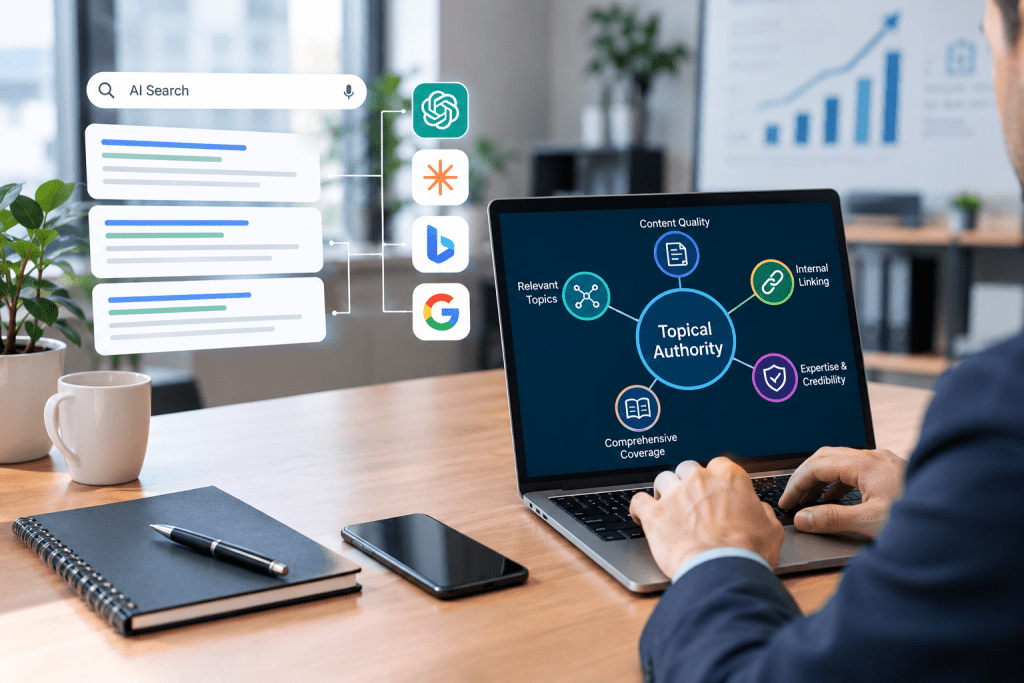

Your website can publish three articles a week and still fail to look like an expert.
That is the frustrating part.
One page targets Shopify SEO. Another talks about website speed. Then comes an article about AI search, followed by something about social media. Individually, the pages may be useful. Together, they can feel like a pile of disconnected answers.
More content does not automatically create more authority.
What matters is whether your website consistently demonstrates that it knows a subject well.
That is where topical authority comes in.
What Is Topical Authority in SEO?
So, what is topical authority?
It is the depth, relevance, and consistency of a website’s content around a particular subject.
Think of it as building a specialist library rather than collecting random articles.
For an ecommerce development company, one post about Shopify performance says very little on its own. Add useful content covering Shopify development, migrations, integrations, themes, security, SEO, conversion optimization, and store performance, and the picture changes.
The website now demonstrates broader knowledge of the Shopify ecosystem.
That matters because Google’s current guidance emphasizes helpful, reliable, people-first content. Its guidance for generative AI features also says established SEO best practices remain important when creating content for AI-powered Search experiences.
Topical Authority vs Domain Authority
These terms are often confused.
They should not be.
Domain Authority is a third-party SEO metric used by tools to estimate the strength of a website, particularly its link profile.
Topical authority is about demonstrated expertise around a specific subject.
Consider a smaller agency specializing in Magento migrations. It may have nowhere near the backlink profile of a major technology publication. Yet it could publish genuinely useful resources covering migration planning, redirects, data integrity, SEO preservation, testing, integrations, and post-launch checks.
That is meaningful subject expertise.
So, topical authority vs domain authority is not really a competition between two scores. They describe different concepts.
How to Establish Topical Authority
Start with what your business actually knows.
Then map the questions surrounding that expertise.
Suppose your core subject is ecommerce development.
Your supporting topics might include:
- Shopify development
- Magento development
- Ecommerce SEO
- Website performance
- UX and CRO
- Payment integrations
- Ecommerce migrations
- Product page optimization
- Ecommerce security
- AI search visibility
Each topic can lead to more specific questions based on customer needs.
Build around real buying journeys
Your prospects rarely move from one broad query straight to a purchase.
A store owner might search:
“Why is my ecommerce website slow?”
Then:
“How to improve Shopify store speed?”
Then:
“Shopify performance optimization agency.”
Those searches reveal a progression from problem to solution to commercial intent.
Your content should support that progression.
This is where topical authority becomes useful for lead generation, not just rankings.
How Content Clusters Strengthen Your Website
A content cluster connects related information.
A broader page establishes the main subject. Supporting pages answer narrower questions. Relevant internal links connect those pages.
For a user, this makes research easier.
For search systems, it creates clearer relationships between related information.
That structure also fits the direction of modern search. Google says its generative AI features can provide responses using information from multiple sources, while its current guidance continues to recommend unique, valuable content and sound SEO practices.
This is where Generative Engine Optimization can complement a broader organic search strategy.
Answer Engine Optimization can similarly help businesses structure useful responses around the questions their customers actually ask.
The important point is simple: neither should become an excuse for creating shallow content.
What Is Topic Authority in LLMs?
There is no universal authority score that tells you whether ChatGPT, Gemini, Claude, or another AI system considers your website an expert source.
So, avoid anyone promising a secret formula.
Instead, make your expertise easier to understand and verify.
Useful signals include:
- Consistent coverage of a subject
- Original insights and examples
- Relevant internal linking
- Accurate and updated information
- Credible references
- Clear authorship and business expertise
- Relevant third-party mentions
- Logical site structure
Google’s current spam policies also warn against scaled content created primarily to manipulate Search. That includes generating large volumes of low-value pages with AI or other tools without adding meaningful value.
In other words, 500 thin articles do not beat 30 genuinely useful ones simply because the number is bigger.
How Many Articles Do You Need?
There is no magic number.
The right amount depends on the breadth of your subject, your audience’s questions, and the gaps your existing content needs to fill.
Start with the questions that influence real decisions.
Cover them properly.
Link related resources. Remove duplication. Update information when it changes.
Then look beyond traffic.
Are qualified prospects discovering your services? Are visitors moving from educational content to commercial pages? Are enquiries becoming more relevant?
Those are stronger indicators of whether your content strategy is working.
Build Expertise People Can See
Topical authority is not about making your blog look busy.
It is about making your expertise obvious.
Search Engine Optimization remains the foundation for helping people discover that expertise.
AI search optimization extends that thinking to newer discovery environments, where clear, useful, trustworthy information can influence how a brand is understood and surfaced.
For ecommerce businesses, the payoff is bigger than another ranking.
A well-built topic ecosystem can bring the right prospects to your website, answer objections before a sales call, support commercial pages, and give your brand a stronger knowledge footprint across search.
Start with what you genuinely know.
Go deeper.
Connect the pieces.
Keep improving them.
That is how a blog becomes more than a publishing channel. It becomes evidence of expertise.
FAQs
Why is topical authority important for SEO and AI search visibility?
It helps a website demonstrate consistent expertise around a subject while giving search systems clearer context about its content, relevance, and relationships between topics.
How many articles do you need to build topical authority around a subject?
There is no fixed number. Focus on covering meaningful customer questions and genuine content gaps rather than publishing a predetermined number of articles.
Can a website have strong topical authority without high domain authority?
Yes. Topical authority and third-party Domain Authority metrics measure different concepts. A specialist website can demonstrate strong subject expertise without having a large backlink profile.
How do content clusters help search engines and LLMs understand a brand’s expertise?
Content clusters connect a broad subject with related subtopics through relevant pages and internal links. This creates a clearer information structure and helps establish relationships between related concepts.
What signals can help LLMs identify a website as a reliable source on a specific topic?
Consistent subject coverage, original information, credible references, clear expertise, relevant third-party mentions, logical site architecture, and accurate, updated content can all contribute to a stronger overall trust profile.
