
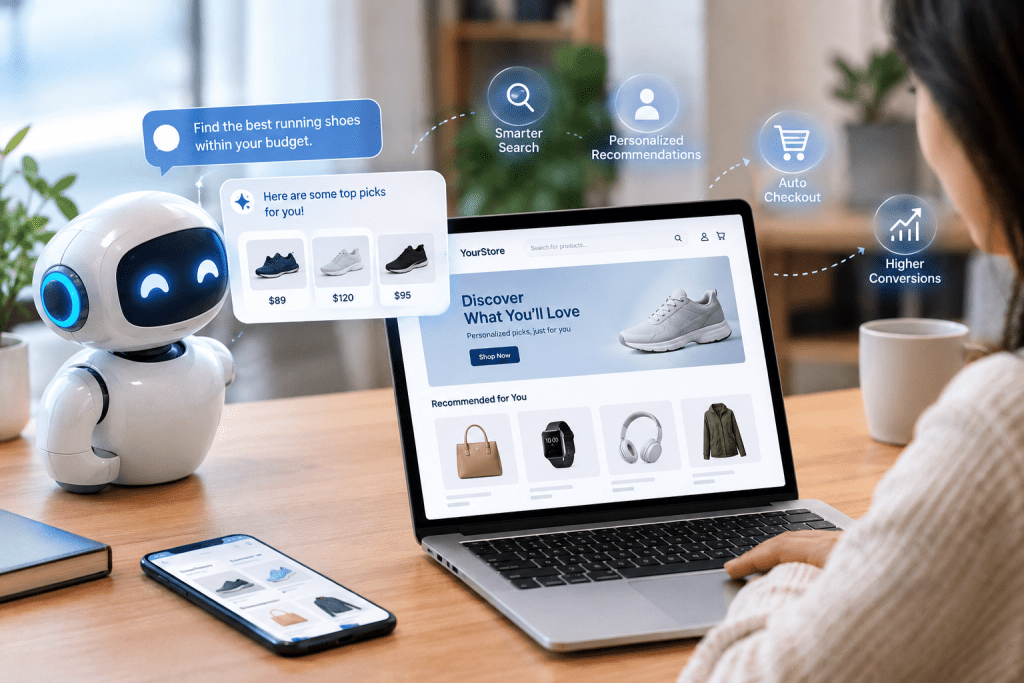

Your next customer may never visit your homepage.
That sounds dramatic, but the shift is already underway. In September 2026, Mastercard and Trip.com demonstrated an AI-powered shopping journey where an agent can search, compare, book, and complete selected travel purchases. Commercial rollout is expected to begin in early 2027.
At the same time, Shopify reports that AI-driven traffic to Shopify stores grew 8x year over year in Q1 2026, while orders originating from AI-powered searches increased nearly 13x.
The message for ecommerce businesses is simple: AI shopping agents are becoming another route to your products.
The bigger question is whether your ecommerce website can actually serve that route.
What Are AI Shopping Agents?
An AI shopping agent goes beyond answering a product question.
A traditional chatbot might tell a customer which running shoes match a certain budget. An AI shopping agent can potentially:
- Understand the shopper’s requirements
- Search product catalogues
- Compare products, prices and specifications
- Check availability
- Recommend suitable options
- Handle parts of the checkout journey
- Complete an authorised purchase
That distinction matters.
The shopper may no longer move through the familiar Google → product page → cart → checkout path. Instead, the journey could become:
Customer prompt → AI agent → product comparison → merchant → purchase
This is the foundation of what the industry calls agentic commerce.
And the infrastructure is catching up. NIQ and Similarweb announced a 2026 initiative designed to measure AI-driven product discovery, AI visibility, traffic, conversion and sales across platforms including ChatGPT, Gemini, Google AI Mode, Perplexity and Claude.
Why AI Shopping Is Becoming a Serious Ecommerce Issue
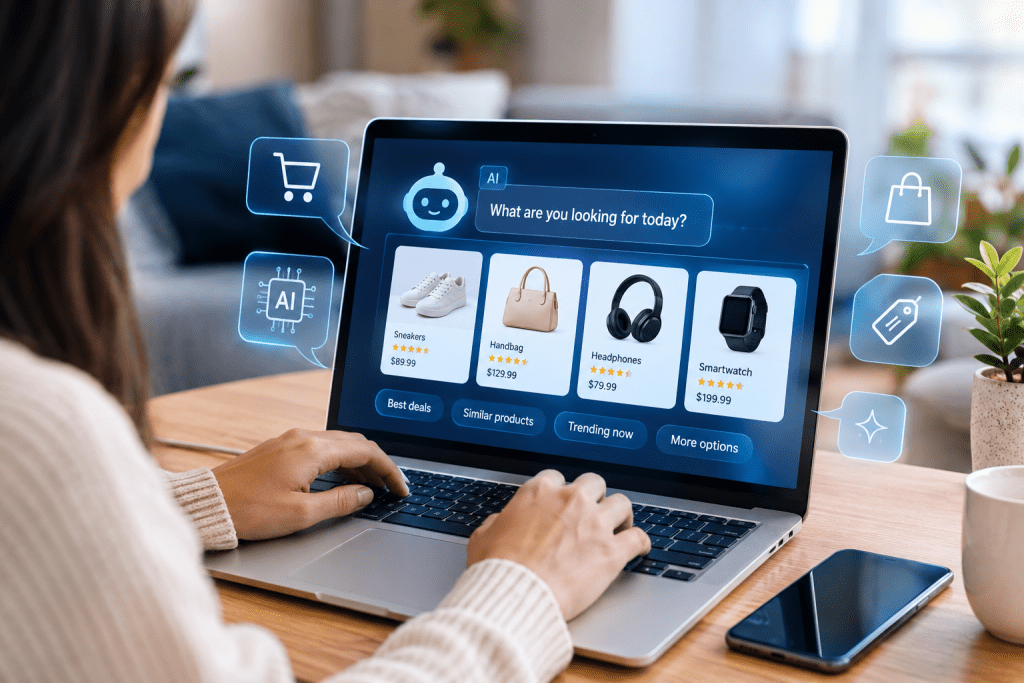
AI shopping is no longer confined to experimental demos.
Three developments are pushing it forward.
1. Product discovery is moving into AI interfaces
Consumers can increasingly ask AI tools questions such as:
“Find me a lightweight laptop under $800 for video editing.”
The opportunity for a merchant is different from traditional search. The customer is asking for a solution, while the AI decides which products fit that request.
That makes product information, structured data, reviews, pricing and availability increasingly important.
2. Payment infrastructure is being built for agents
Mastercard’s September 2026 collaboration with Trip.com demonstrates how AI agents could move from product research into authorised transactions. Mastercard says its Agent Suite for Merchants is designed to support product discovery, research and consumer-authorised purchases.
That does not mean every ecommerce store will suddenly become agentic.
It does mean developers can no longer treat AI shopping as purely a content or marketing issue.
3. Businesses are starting to measure AI visibility
SEO teams already monitor rankings and traffic.
The next question is becoming:
When someone asks an AI assistant for a product like mine, does my brand appear?
NIQ and Similarweb’s planned measurement solution specifically addresses this emerging gap by connecting AI-driven discovery with traffic, conversion and sales data.
What Changes When AI Becomes the Shopper’s Assistant?

The biggest change may be what happens before someone reaches your website.
A customer could tell an AI agent:
“I need an ergonomic office chair for long workdays, under $100, with adjustable lumbar support.”
The agent could evaluate multiple products before sending the shopper to one or several merchants.
Your homepage design still matters. Your checkout still matters. Your brand still matters.
But now your product data has another audience: machines making purchasing decisions.
That changes what ecommerce teams need to prioritise.
| Traditional Ecommerce Priority | AI Shopping Priority |
| Keyword-focused product copy | Clear, machine-readable product information |
| Visual merchandising | Accurate product attributes |
| Search rankings | AI discovery and recommendation visibility |
| Manual browsing | Product data accessible through systems and APIs |
| Human-led comparison | Agent-led product comparison |
| Website checkout | Flexible commerce and payment integrations |
This does not make traditional SEO or CRO irrelevant. It adds another discovery layer to the buying journey.
What Makes an Ecommerce Website AI-Ready?
An AI-ready ecommerce website is not simply a store with an AI chatbot added to it.
The underlying commerce system needs to make important information accessible, accurate and usable.
Start with product data
AI systems need more than a product name and price.
Important information can include:
- Product specifications
- Size, colour and variants
- Materials and ingredients
- Compatibility
- Availability
- Pricing
- Shipping information
- Return policies
- Product identifiers
- Reviews and ratings
- High-quality descriptions
If these details are incomplete or contradictory, an AI system has less reliable information to work with.
Build cleaner commerce infrastructure
AI shopping creates another reason to invest in strong APIs and integrations.
Your ecommerce platform may need to communicate with:
- Product catalogues
- Inventory systems
- Pricing engines
- CRM platforms
- ERP systems
- Payment gateways
- Shipping providers
- Customer accounts
- Analytics platforms
This is where AI ecommerce development becomes more than adding a generative AI feature.
The goal is to create a commerce system that can exchange reliable information with the tools sitting around it.
AI Ecommerce Development: What Should Developers Focus On?
For ecommerce development teams, the opportunity is broader than building an AI assistant.
Product discovery
AI-powered search can help customers describe what they need naturally instead of relying on exact product keywords.
For example:
“Show me waterproof hiking shoes for weekend treks under $100.”
The system should be able to interpret the intent and match relevant products.
Personalisation
AI can use permitted customer and behavioural data to make product discovery more relevant.
That could mean recommendations based on previous purchases, preferences, browsing behaviour or stated requirements.
Privacy, consent and data governance still need to be built into the experience.
APIs and integrations
A product recommendation is only useful if the underlying information is current.
If an AI agent recommends an item that went out of stock hours ago, the experience breaks.
Real-time or regularly synchronised inventory, pricing and product data therefore become increasingly important.
Agentic commerce integrations
Payment and commerce providers are beginning to build infrastructure specifically for AI-led transactions.
For developers, this means watching standards, APIs, authentication, permissions and payment technologies instead of treating agentic commerce as a distant concept.
Are Shopify and Magento Ready for AI Shopping?
The answer depends less on the platform name and more on how the store is built.
Shopify’s agentic commerce resources already describe selling through AI shopping channels, including ChatGPT, Google AI Mode and Microsoft Copilot. Shopify also highlights its product catalogue infrastructure as part of this process.
For Shopify merchants, this makes clean catalogue data, integrations and compatible commerce channels increasingly relevant.
Magento and Adobe Commerce stores can approach the opportunity through their APIs, catalogue architecture, integrations and custom development capabilities.
The practical takeaway is:
Do not ask only, “Is my platform AI-ready?” Ask, “Is my implementation AI-ready?”
A poorly structured store can create problems regardless of the platform behind it.
AI Shopping Agents Are Changing Ecommerce SEO Too
SEO used to revolve heavily around getting a webpage into search results.
AI shopping introduces another visibility question:
Can AI systems correctly understand and recommend my products?
That puts greater value on:
- Clear product information
- Consistent product attributes
- Structured data
- Helpful product content
- Strong category architecture
- Reviews and trust signals
- Accurate availability and pricing
- Brand authority
- Relevant external references
This is where Ecommerce SEO and AI visibility start to overlap.
A page can rank well for a conventional keyword and still provide poor information for an AI-driven product comparison.
CRO Still Matters, But the Journey Gets Longer
It would be a mistake to assume AI shopping makes conversion rate optimization less important.
The opposite may happen.
Once an AI agent recommends a product, the customer may still reach your website to:
- Verify product details
- Check reviews
- Compare variants
- Read delivery information
- Confirm returns
- Complete payment
That means page speed, mobile UX, checkout usability, trust signals and clear product information remain critical.
The difference is that the customer may arrive with far more purchase intent because an AI system has already narrowed the options.
What Should Ecommerce Businesses Do Now?
You do not need to rebuild your entire store around AI tomorrow.
Start with the foundations.
AI-readiness checklist
Audit your product catalogue:
Look for missing specifications, inconsistent attributes, duplicate information and outdated pricing or stock data.
Strengthen structured data:
Make product, price, availability, review and organisational information easy for systems to interpret.
Review your APIs:
Check whether important commerce information can be accessed reliably by approved integrations.
Improve product content:
Write descriptions that answer real buying questions rather than stuffing pages with keywords.
Track AI-driven traffic:
Separate AI-referred visits where your analytics stack allows it.
Test AI discovery:
Search major AI platforms for the products and categories you sell. Check whether your brand appears, how your products are described and whether important facts are accurate.
Prepare your checkout:
Review payment, authentication, fraud prevention and order workflows as AI-led commerce develops.
The Ecommerce Storefront Is Becoming More Than a Website
The most interesting part of AI shopping agents is not the chatbot itself.
It is the possibility that the storefront becomes distributed.
Your products could be discovered through your website, Google, marketplaces, social platforms, AI assistants and other emerging commerce interfaces.
The merchant still owns the product, pricing, fulfilment and customer experience. But discovery can happen somewhere else.
That is why ecommerce development in 2026 increasingly involves more than building attractive storefronts.
It involves creating commerce systems that are discoverable, connected, structured and ready to exchange information with new shopping interfaces.
The Bottom Line
AI shopping agents are moving from an interesting AI concept into a developing commerce channel.
The September 2026 Mastercard and Trip.com demonstration shows that agent-led discovery and purchasing are becoming technically viable in real commerce environments, while Shopify’s reported growth in AI-driven traffic and orders shows that AI-assisted discovery is already producing measurable activity.
For ecommerce businesses, the immediate task is not to predict exactly how shopping will work in five years.
It is to make today’s store easier for both people and intelligent systems to understand, trust and transact with.
That starts with better product data, stronger ecommerce architecture, reliable integrations, useful content and a checkout experience built for what comes next.
For businesses planning an AI-ready ecommerce website, Webiators Ecommerce Development Services can help connect ecommerce development, integrations, SEO, CRO and AI capabilities into one commerce strategy.
FAQs
What are AI shopping agents?
AI shopping agents are systems that can help shoppers discover, compare and potentially purchase products based on natural-language requests and predefined permissions.
How are AI shopping agents different from chatbots?
A chatbot primarily responds to user questions. An AI shopping agent can connect to product, inventory, payment or other commerce systems and perform multiple steps in a shopping journey.
Why is product data important for AI shopping?
AI systems need reliable information to identify suitable products. Complete specifications, pricing, availability, variants and other product attributes can make products easier to interpret and compare.
Do Shopify and Magento support AI commerce?
Both can support AI-enabled commerce through their available platform capabilities, integrations, APIs and implementation choices. Shopify is already promoting agentic commerce and AI shopping channels, while Magento and Adobe Commerce can be extended through APIs and custom development.
Should every ecommerce business build an AI shopping agent?
Not necessarily. The first priority should be getting the fundamentals right: accurate product data, strong technical architecture, reliable integrations, useful content, analytics, security and a friction-free checkout. Those foundations can support future AI commerce opportunities without forcing an unnecessary rebuild.
