
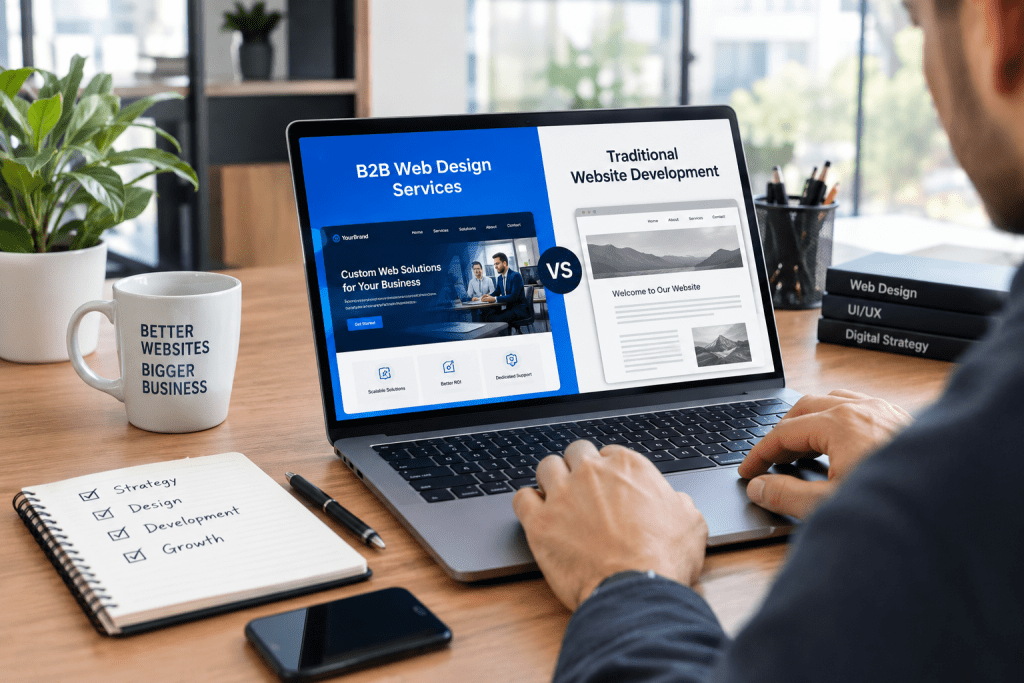

A B2B website can look impressive and still cost you leads. A prospect lands on the site, cannot quickly find the right service, sees vague marketing language, or has no obvious next step. They leave. The sales team never gets the opportunity. Gartner reports that 76% of B2B buyers say they would avoid suppliers that provide a poor website experience.
That is why b2b web design services need to do more than produce attractive pages. A strong B2B site should help prospects research your company, evaluate your offer, find proof, and move closer to a buying decision.
Traditional Development Builds a Site. B2B Design Builds a Journey.
Traditional website development often begins with the technical checklist: CMS, templates, responsive layouts, forms, integrations, and performance.
Those foundations matter.
The difference comes from what happens around them.
B2B website design begins by asking what a prospect needs at each stage of their research. Someone discovering your company for the first time needs different information from a procurement manager comparing vendors.
| Traditional Website | B2B-Focused Website |
| Presents company information | Supports buying decisions |
| Uses standard page structures | Maps content to user intent |
| Broad navigation | Task-focused navigation |
| One primary contact path | Multiple relevant conversion paths |
| Content supports the design | Content drives discovery and trust |
| Website acts as a brochure | Website supports sales and marketing |
The shift toward digital research is substantial. Gartner’s 2026 research found that 67% of surveyed B2B buyers preferred a sales-rep-free experience, while 70% preferred a completely digital, self-service buying experience.
Your website now has more responsibility.
What Should B2B Web Design Services Deliver?
Good b2b web design services bring business strategy, UX, content, and technology together.
Consider a manufacturer selling specialized equipment. Its prospects may want technical specifications, certifications, product comparisons, documentation, and distributor information before contacting sales.
A SaaS company might need integration details, security information, use cases, pricing guidance, and implementation resources instead.
The website should reflect those differences.
Look for these fundamentals:
- Clear positioning: State what you offer, who it serves, and the problem it addresses.
- Intent-based navigation: Help visitors reach services, industries, solutions, and resources without hunting for them.
- Smarter CTAs: Match the action to the visitor. A research-stage prospect may want a guide, while a qualified lead may want a consultation.
- Visible proof: Case studies, certifications, customer evidence, reviews, and business credentials can strengthen trust.
- Useful content: Answer questions prospects are likely to ask before speaking with sales.
- Technical quality: Prioritize mobile usability, accessibility, security, crawlability, and performance.
A beautiful homepage cannot compensate for a confusing buying experience.
When Does Custom B2B Web Design Make Sense?
Not every company needs a fully custom website.
But if your business has several audiences, complex services, long sales cycles, specialized products, or demanding integrations, an off-the-shelf structure can quickly become limiting.
Custom web design allows the experience to follow your actual sales process rather than forcing your business into someone else’s template.
Depending on the business, that could include:
- Industry-specific landing pages
- Product comparison tools
- ROI or pricing calculators
- Technical resource libraries
- Customer portals
- CRM integrations
- Marketing automation
- Buying-stage content hubs
The point is not to add more features.
The point is to remove more friction.
AI Has Changed What B2B Websites Need to Publish
There is another audience worth considering: AI-powered search and research tools.
Gartner reported in May 2026 that 45% of surveyed B2B buyers had used generative AI to gather information about vendors and products.
That makes thin, generic website copy a poor long-term strategy.
Google’s current guidance says its AI search experiences rely on the same fundamental SEO practices as traditional Search, including crawlable pages and helpful, people-first content. It also warns against creating large volumes of low-value content to manipulate visibility.
For B2B companies, that means answering the questions that actually matter.
Explain technical subjects clearly.
Compare solutions honestly.
Publish original research and first-hand insights.
Support important claims with credible evidence.
A page written for humans first has a much stronger foundation for search and AI discovery.
Read Also:- AI Shopping Agents Are Reshaping Ecommerce in 2026: Is Your Online Store Ready?
Development Should Connect the Website to the Business
Modern Website development services should go beyond publishing pages.
Your website may need to exchange data with your CRM, analytics tools, marketing automation, lead-routing systems, or content platform. When those connections work properly, marketing teams can understand what prospects do after they arrive, rather than guessing.
That is where B2B web development becomes commercially important.
The real question is not, “What features should we add?”
Ask this instead:
What does a qualified prospect need to understand and trust before they are ready to talk to us?
Build the website around that answer.
FAQs
What makes a B2B website effective for generating qualified leads?
Clear positioning, useful content, strong proof, intuitive navigation, and conversion paths that reflect different stages of the buying process.
Which features should every modern B2B website have?
Responsive design, secure forms, clear service pages, analytics, strong CTAs, useful resources, and solid technical SEO foundations.
How can AI improve the design and user experience of a B2B website?
AI can support personalization, content discovery, recommendations, behavioral analysis, and customer assistance when each application solves a genuine user problem.
How can B2B websites become more visible in AI-generated search results?
Focus on crawlable pages, sound SEO fundamentals, clear answers, original information, and helpful people-first content. Google says there are no additional technical requirements specifically for appearing in its AI search features.
What content helps B2B websites build authority and earn AI citations?
Original research, detailed guides, case studies, expert insights, first-hand experience, and well-supported answers can provide stronger information for both prospects and AI systems.
