
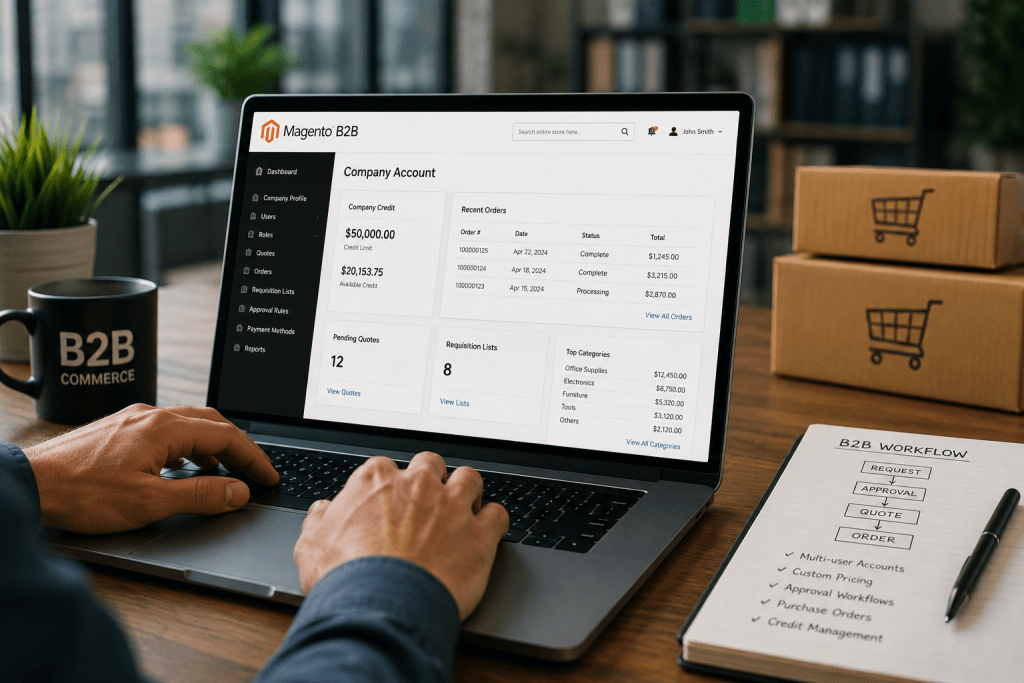

Magento B2B is worth considering when ecommerce complexity starts costing your business more than the platform required to manage it.
That is the honest answer.
A wholesaler with 100 products, fixed pricing, one buyer per account, and straightforward orders may not need an enterprise B2B platform. A manufacturer managing dealer pricing, multiple purchasing roles, negotiated quotes, approval rules, repeat orders, and ERP integration has a very different problem.
For that second business, the question is not whether Magento can support B2B.
It can.
The real question is whether its capabilities create enough operational value to justify the investment.
When people search for Magento B2B, they are generally evaluating the B2B capabilities available through Adobe Commerce. Adobe’s current documentation describes company accounts, shared catalogs, Quick Order, negotiable quotes, purchase orders, approval workflows, and requisition lists as part of Adobe Commerce B2B.
Why B2B Buyers Are Moving Toward Self-Service
B2B buyers increasingly expect to research and purchase without needing a salesperson for every routine task.
Gartner’s 2026 research found that 67% of B2B buyers prefer a rep-free experience, while 45% reported using AI during a recent purchase.
A separate Gartner study found that 70% prefer a completely digital, self-service buying experience, yet 69% still turn to sales representatives to validate AI-generated insights. Read Gartner’s 2026 digital B2B buying research
That tells us something important.
B2B buyers do not necessarily want less human support.
They want less friction.
They want to place a routine order themselves and involve a salesperson when the purchase actually requires expertise.
That is exactly the type of workflow a strong B2B ecommerce platform should support.
McKinsey’s 2026 Global B2B Pulse Survey reached a similar conclusion. Across nearly 4,000 decision-makers in 13 countries, 71% of B2B companies reported offering ecommerce, and roughly one-third of revenue flows through digital channels among companies that do. Buyers also use an average of ten channels throughout their purchasing journey. Read McKinsey’s 2026 Global B2B Pulse Survey
Magento B2B Features: Feature, Advantage, Benefit

The easiest way to judge Magento B2B is through the FAB framework.
A feature tells you what the platform does.
An advantage explains how it improves the workflow.
The benefit tells you what the business actually gains.
Company Accounts and Buyer Permissions
Feature: Adobe Commerce supports company accounts with multiple buyers, roles, permissions, and company structures.
Advantage: A company can give different employees different purchasing responsibilities instead of sharing one generic account.
Benefit: Your B2B customers get a buying process that reflects their internal organization, while your team spends less time managing routine account requests.
A purchasing employee can create an order.
A manager can approve it.
The technology follows the customer’s real workflow.
Feature: Adobe Commerce Shared Catalogs allow merchants to create gated catalogs with custom pricing for different companies.
Advantage: Each business customer can see the products and prices relevant to its commercial agreement.
Benefit: Buyers do not need to contact sales every time they want to confirm their contracted pricing, and your team reduces the risk of sending the wrong price.
That is particularly valuable in wholesale ecommerce, where different customers rarely receive identical terms.
Quick Order and Requisition Lists
Feature: Quick Order lets buyers order using product names or SKUs, while requisition lists allow frequently purchased products to be saved and reused.
Advantage: Experienced buyers can bypass unnecessary browsing.
Benefit: Repeat purchases become faster and easier, reducing friction for customers and repetitive order-processing work for sales teams.
For an industrial buyer ordering the same 30 components every month, that difference matters.
They do not need inspiration.
They need speed.
Negotiable Quotes
Feature: Adobe Commerce supports quote negotiation between company buyers and sellers, including quantity and discount changes during the negotiation. See Adobe’s Negotiable Quotes documentation
Advantage: Negotiations can remain connected to the commerce workflow instead of disappearing into scattered email threads.
Benefit: Sales teams gain better visibility into negotiated orders while customers get a more structured buying experience.
That is useful when an order changes from “buy 100 units” to “what price can you offer for 5,000?”
Purchase Orders and Approval Rules
Feature: Adobe Commerce supports company purchase orders and approval rules for B2B purchasing.
Advantage: Businesses can introduce purchasing controls based on their internal authority structure.
Benefit: High-value orders can follow the customer’s approval process without relying entirely on manual email chains.
For larger organizations, that is operational infrastructure, not a minor ecommerce feature.
Is Adobe Commerce Better Than Magento Open Source for B2B?
This is where businesses need to make a careful distinction.
Magento Open Source can be extended with custom development and third-party solutions.
Adobe Commerce provides a native B2B framework.
Adobe’s documentation identifies B2B capabilities such as company accounts, shared catalogs, quotes, purchase orders, and requisition lists within Adobe Commerce. See Adobe’s current B2B guide
So the comparison is not simply:
Can Magento Open Source support B2B?
With enough development, many requirements can be built.
The better question is:
How much customization, maintenance, testing, and long-term ownership will those requirements demand?
That is where B2B Ecommerce Development becomes strategically important.
Who Should Use Magento B2B?
Adobe Commerce B2B makes the most sense when your business has several of these requirements:
- Customer-specific pricing
- Multiple buyers per company
- Complex catalogs
- Repeat ordering
- Bulk SKU ordering
- Negotiated quotes
- Purchase approvals
- Dealer or distributor networks
- B2B and B2C operations
- ERP, CRM, PIM, or other integrations
The product count is not the deciding factor.
Business complexity is.
A company with 10,000 products and one pricing structure may have a simpler operation than a company with 500 products and 20 customer-specific price lists.
That is why platform selection should begin with workflows, not features.
Real Business Use Cases
Wholesale Distributor
Feature: Customer-specific catalogs, pricing, Quick Order, and requisition lists.
Advantage: Buyers can access approved products, use their correct pricing, and repeat known orders quickly.
Benefit: Sales representatives spend less time processing routine purchases and more time growing accounts.
Manufacturer With Dealers
Feature: Company accounts, buyer permissions, quotes, pricing controls, and approval workflows.
Advantage: Dealers can self-serve routine purchases while sales representatives remain involved in complex opportunities.
Benefit: The manufacturer can scale digital ordering without removing human expertise from high-value sales.
Industrial Supplier
Feature: SKU-based ordering, requisition lists, and integrations with operational systems.
Advantage: Buyers can reorder known parts without navigating a large catalog every time.
Benefit: Faster purchasing, fewer manual steps, and a smoother connection between ecommerce and back-office operations.
When Magento B2B Is Probably Overkill
Magento B2B may be unnecessary if:
- Customers all receive the same prices.
- Your catalog is small.
- Orders are straightforward.
- Customers rarely reorder.
- Each organization has one buyer.
- Approval workflows are unnecessary.
- Your integration requirements are minimal.
- Your existing platform already works well.
More technology does not automatically create more value.
If a simpler platform solves the problem efficiently, use the simpler platform.
How Much Does Magento B2B Cost?
There is no responsible universal price for a Magento B2B project.
The real investment can include:
| Cost area | What it covers |
| Platform | Adobe Commerce licensing |
| Development | Storefront, configuration, custom functionality |
| B2B setup | Accounts, pricing, catalogs, quotes, approvals |
| Integrations | ERP, CRM, PIM, payment, shipping |
| Migration | Products, customers, orders, business data |
| Infrastructure | Hosting and technical environment |
| Ongoing support | Maintenance, upgrades, security, optimization |
The important point is total cost of ownership.
A platform that looks cheaper initially may become expensive if your team needs multiple extensions, manual pricing processes, custom workarounds, or disconnected systems.
That is why Magento Development Services should begin with a business requirements assessment rather than jumping directly into implementation.
Is Magento B2B Worth It?
Yes, when its capabilities solve problems that are already costing your business money, time, or customers.
The FAB case is straightforward.
Features: Company accounts, custom pricing, shared catalogs, quotes, approvals, Quick Order, and requisition lists.
Advantages: Less manual processing, faster purchasing, better control, and workflows that reflect how B2B companies actually buy.
Benefits: Better customer experience, greater operational efficiency, scalable wholesale commerce, and less dependence on sales teams for routine transactions.
If your business has outgrown basic customer accounts, spreadsheets, email-based approvals, and manual wholesale ordering, Adobe Commerce deserves serious consideration.
If your B2B operation is still simple, it may not.
The smartest Magento B2B implementation is not the one with the longest feature list.
It is the one where every feature solves a measurable business problem.
If you are evaluating whether Adobe Commerce fits your operation, Adobe Commerce Solutions can be assessed around your actual workflows, integrations, and growth plans. If you are moving from another platform, Magento Migration Services should protect business logic and customer experience, not merely transfer product data.
FAQs
What is Magento B2B?
Magento B2B generally refers to B2B ecommerce capabilities available through Adobe Commerce, including company accounts, customer-specific pricing, shared catalogs, quotes, purchase orders, and repeat-order tools. See Adobe’s official B2B documentation
Does Magento support custom pricing?
Yes. Adobe Commerce Shared Catalogs allow merchants to create custom pricing for different companies and customer groups. See Adobe’s Shared Catalog documentation
Can buyers have company accounts?
Yes. Company accounts can contain multiple buyers, roles, permissions, company structures, purchase orders, quotes, and approval rules. See Adobe’s company account documentation
Is Magento suitable for manufacturers?
Yes. It can be particularly useful for manufacturers managing dealers, distributors, customer-specific pricing, repeat orders, quotes, approvals, and complex product catalogs.
Does Magento support bulk ordering?
Yes. Adobe Commerce supports Quick Order for SKU or product-name ordering and requisition lists for frequently purchased products. See Adobe’s B2B feature documentation.
