
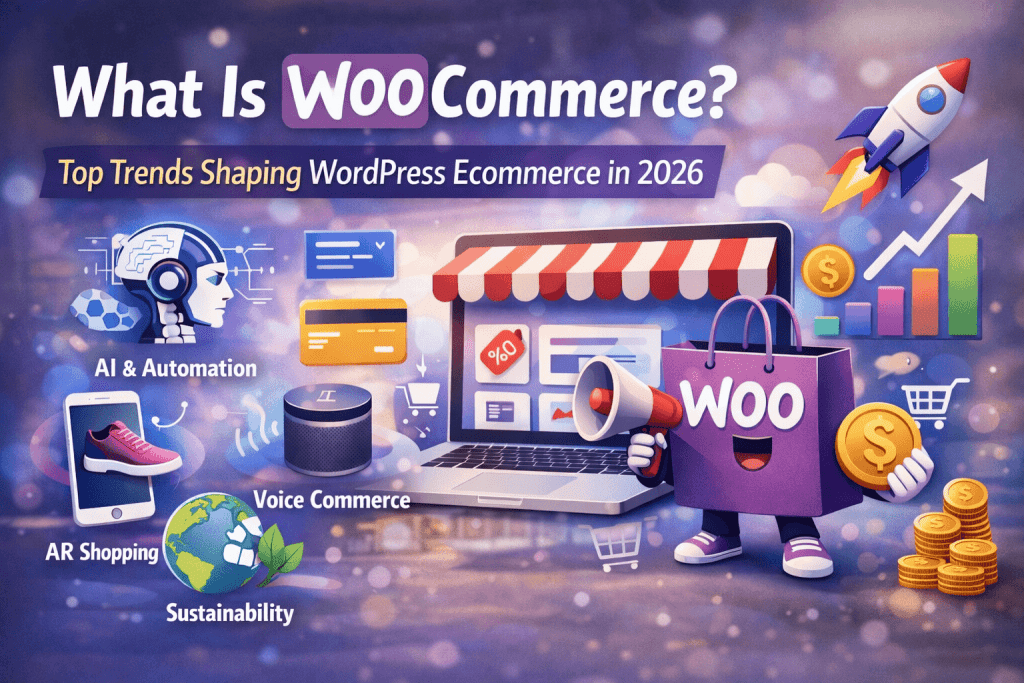

Online shopping has changed more in the last few years than it did in the previous decade. If you have ever added a product to your cart at midnight, only to abandon it because the checkout felt clunky, you already know how important smooth ecommerce experiences have become. For many store owners, that experience starts with one simple question: what is WooCommerce, and why does nearly every serious WordPress store seem to rely on it?
Let’s unpack that in a practical, no-fluff way and then look at the ecommerce trends 2026 that are quietly reshaping how WordPress stores are built and grown.
What Is WooCommerce and Why Store Owners Love It
At its core, WooCommerce is a free, open-source ecommerce plugin designed specifically for WordPress. It turns any WordPress website into a fully functional online store. You can sell physical products, digital downloads, subscriptions, bookings, and even memberships without touching complicated backend systems.
What makes WooCommerce stand out is control. You are not locked into a rigid platform. You decide how your store looks, how it performs, and how it scales.
Here is a simple way to think about it. WordPress is your empty retail space. WooCommerce is the shelving, counter, and payment system. Together, they give you a shop that can grow from a street-side booth to a full-blown mall.
That flexibility is one of the biggest drivers of WordPress ecommerce growth, especially among brands that want ownership of their data and freedom to customize.
How WordPress Ecommerce Growth Is Changing the Playing Field
WordPress is no longer just for bloggers. Today, it powers a massive percentage of ecommerce stores worldwide, from small handmade shops to enterprise-level brands.
This growth is driven by three realities:
- First, store owners want lower long-term costs. Closed platforms get expensive fast. WooCommerce stays budget-friendly while still offering powerful extensions.
- Second, performance matters more than ever. A slow store is a silent sales killer. WordPress combined with optimized WooCommerce setups gives brands more control over speed and performance.
- Third, personalization is no longer a luxury. Customers expect tailored product recommendations, localized pricing, and real-time stock visibility. WooCommerce plays well with modern customization tools, which makes it ideal for 2026-ready stores.
Now, let’s talk direction. These are the online retail trends that will define serious WooCommerce stores in the near future.
Ecommerce Trends 2026 Every WooCommerce Store Should Watch
AI Ecommerce Tools Taking Over Daily Store Operations
Artificial intelligence is no longer “coming soon.” It is already here, quietly running product recommendations, automated emails, dynamic pricing, and customer support.
AI ecommerce tools are becoming the digital store manager behind successful WooCommerce shops. They analyze browsing behavior, predict what customers are likely to buy, and even help optimize product descriptions.
A realistic example? A clothing store that automatically shows winter jackets to shoppers in colder states while promoting lighter options to warmer regions. That level of smart automation used to be enterprise-only. Now it is becoming standard.
Headless Ecommerce Changing Frontend Experiences
Headless ecommerce is one of the most exciting shifts happening right now. Instead of tying the frontend and backend together, headless setups let WooCommerce handle the backend while modern frameworks control the user experience.
That means faster load times, smoother animations, and app-like shopping experiences.
Think of it like a kitchen and dining area in a restaurant. The kitchen runs independently, focused on perfecting the food, while the dining area is designed purely for customer comfort. Headless ecommerce lets both sides excel without slowing each other down.
Smarter Mobile-First Shopping
Mobile is no longer an afterthought. It is the main stage. By 2026, poorly optimized mobile stores will feel outdated overnight.
WooCommerce stores are moving toward app-style mobile experiences, faster checkouts, biometric logins, and simplified navigation that works with thumbs, not just desktops.
If you have ever tried tapping tiny buttons on a crowded train, you already understand why this matters.
Voice Commerce and Conversational Shopping
Voice search is steadily becoming a normal part of online shopping. Customers are using smart speakers and mobile assistants to search for products, compare prices, and reorder favorites.
WooCommerce store owners are preparing by optimizing product content for natural language queries and building conversational shopping flows using chat-based interfaces.
It feels less like browsing a catalog and more like asking a friendly store associate for help.
Sustainable and Transparent Online Retail Trends
Customers in 2026 care more about where products come from, how they are made, and how brands treat the planet.
WooCommerce allows stores to showcase certifications, ethical sourcing badges, and real-time shipping impact details. Transparency is no longer a bonus. It is an expectation that directly influences buying decisions.
Why WooCommerce Is Still the Smartest Move for 2026
So, back to the big keyword question: what is WooCommerce really offering that others cannot?
It offers freedom, scalability, and future readiness.
Unlike closed platforms, WooCommerce evolves with the ecosystem. New AI integrations, headless frameworks, and cutting-edge marketing tools appear rapidly, and WooCommerce adapts fast.
When paired with professional Ecommerce development services, the platform becomes a serious revenue engine. It stops being just a store and starts behaving like a smart, automated sales machine.
Brands that invest in specialized WooCommerce Development Services are already preparing their stores for AI-driven personalization, advanced checkout flows, and headless performance optimizations.
And when WooCommerce runs on a strong technical base powered by expert WordPress Development Services, it scales smoothly instead of cracking under traffic spikes.
Real-World Feel: Why This Matters More Than You Think
A small business owner in Texas once shared how switching from a hosted ecommerce builder to WooCommerce doubled their average order value. Not because of magic. Because they could finally customize the experience.
They added smart product bundles, personalized discounts, and streamlined checkout. Customers felt understood. Sales followed.
That is the quiet power behind WordPress ecommerce growth. It gives businesses room to breathe, test, and evolve.
Your Store, Your Rules, Your Future
The future of ecommerce feels faster, smarter, and more personal than ever. WooCommerce is not just keeping up. It is helping shape that future.
If you are serious about turning traffic into loyal customers, this is the moment to invest in scalable foundations. Your store should feel effortless for your buyers and powerful for you.
Working with a team that offers trusted Ecommerce development services can give your business that edge. The right WooCommerce Development Services can turn ideas into revenue. Strong WordPress Development Services can future-proof your store so you are ready for whatever 2026 brings.
Your customers are evolving. Your store should too.
FAQs
Ans. WooCommerce is a WordPress plugin that transforms your website into a fully functional ecommerce store. It manages products, payments, shipping, and orders while running inside the WordPress ecosystem.
Ans. Yes. With proper hosting and professional optimization, WooCommerce can handle large product catalogs, high traffic, and complex store functionality.
Ans. AI tools integrate as plugins or external services that connect with WooCommerce to handle product recommendations, automated marketing, and intelligent customer support.
Ans. Headless ecommerce separates the backend from the frontend, allowing WooCommerce to manage data while a faster, more flexible frontend delivers a better shopping experience.
Ans. Because WordPress and WooCommerce give businesses ownership, flexibility, and the ability to adapt quickly to changing online retail trends without expensive platform limitations.
