
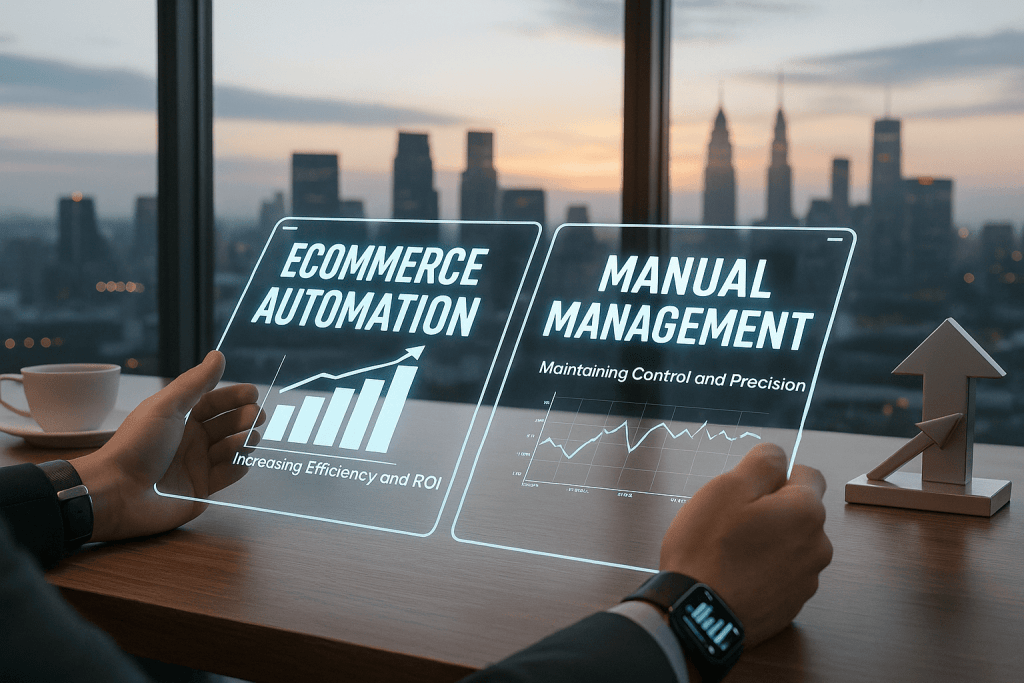

Running an eCommerce business in 2026 feels like steering a ship through shifting winds. Orders flood in, customer queries pile up, returns roll back, and marketing campaigns hum in the background — all demanding precision, speed, and human care.
And then comes the big question every store owner faces sooner or later:
Should I keep doing things manually or hand over control to automation?
This isn’t just a technical choice. It’s a philosophical one — between human touch and machine precision, between intuition and data-driven rhythm.
In this blog, we’ll unpack the real-world pros and cons of eCommerce automation versus manual management, explore where the world is heading in 2026, and help you decide which side — or blend — fits your business story best.
What Is eCommerce Automation, Really?
Let’s clear the fog first.
eCommerce automation is not just about software doing your work; it’s about designing a system that thinks ahead for you. Imagine your store running like a synchronized orchestra — orders auto-routed to the right warehouse, emails triggered at just the right moment, inventory synced across every channel, all while you focus on strategy and growth.
Typical examples include:
- Automatically syncing product stock between Shopify, Amazon, and your warehouse.
- Sending a discount email the moment a cart is abandoned.
- Flagging suspicious transactions before they turn into chargebacks.
- Generating real-time analytics for faster decision-making.
On the flip side, manual management means running these operations through human effort — spreadsheet updates, manual approvals, personalized emails, and physical order tracking.
Manual systems give you control, but they also demand your time — a currency no entrepreneur can print more of.
Why Automation Is Winning the Race in 2026
The eCommerce landscape in 2026 is fast, global, and unforgiving of inefficiency. Automation has shifted from luxury to necessity — not because it’s trendy, but because the math simply works.
Here’s why:
1. Speed, Scale, and Sanity
Let’s face it — growth exposes cracks. A business processing 50 orders daily can manage manually. A business processing 5,000 cannot.
Automation ensures every step — from checkout to delivery — flows without human friction. Real-time syncing, automated invoicing, and self-triggered workflows eliminate bottlenecks.
Your time, once swallowed by repetitive admin tasks, is suddenly freed for strategy, partnerships, and innovation.
2. Precision Without Burnout
Human error is inevitable. Automation is the antidote.
Inventory mismatches, duplicate listings, missed customer messages — these small cracks often cost big money.
Automated systems maintain consistency and accuracy, whether it’s tracking thousands of SKUs or managing returns with precise timestamps.
In short: machines don’t get tired, distracted, or emotionally overwhelmed — they just work.
3. Customer Experience That Feels Effortless
The modern shopper doesn’t just want a product; they crave instantaneity.
When a customer adds an item to the cart, waits too long for a response, or receives a delayed shipment, trust erodes.
Automation bridges that gap — sending a thank-you message right after purchase, providing live tracking updates, and ensuring customer service bots handle FAQs within seconds.
And when customers feel seen and valued, retention rises.
4. Cost Efficiency Over Time
Automation may start as an investment, but it compounds like interest.
Yes, you’ll pay for tools, setup, and training — but soon, those tools replace dozens of manual hours every week.
Fewer errors mean fewer refunds, fewer support tickets, and less chaos.
For growth-stage eCommerce brands, automation isn’t just about efficiency — it’s about survival.
5. Keeping Up with AI-Driven Competition
2026 isn’t a year of automation hype — it’s the year of AI-empowered commerce.
Retail giants like Amazon and Walmart are deploying AI agents to predict trends and optimize pricing in real-time.
If you’re managing your store manually while competitors run on predictive intelligence, you’re already behind the curve.
Automation isn’t replacing you — it’s amplifying you.
Why Manual Management Still Matters
Now, before you automate everything under the sun, let’s pause. Because manual management — though slower — still holds irreplaceable strengths.
1. The Human Touch That Technology Can’t Imitate
No AI workflow can truly replace empathy.
Responding to a frustrated customer, writing a heartfelt thank-you note, or personalizing a gift box — those moments build brand love.
Manual management allows for emotional intelligence, something no algorithm has mastered yet.
2. Flexibility and Creative Control
Automation thrives on rules. But creativity often thrives in chaos.
When testing new products, pricing strategies, or marketing ideas, manual tweaks often yield more insight than automated routines.
3. Lower Initial Costs for Small Stores
A small business just starting out doesn’t always need complex automation suites.
Sometimes, all you need is an Excel sheet, a reliable fulfillment partner, and personal care.
Manual systems can serve as training wheels until your business grows big enough to justify automation.
4. Handling the Unexpected
Automations work perfectly — until something unpredictable happens.
Lost shipments, incorrect addresses, or emotional customer escalations? These require human judgment and flexibility.
Even in 2026, humans remain the fail-safe switch in every great system.
eCommerce Automation vs Manual Management: Head-to-Head
| Criteria | Automation | Manual Management |
| Speed & Scalability | Lightning-fast, scales infinitely | Slows down with growth |
| Error Margin | Extremely low once set up | Higher risk of mistakes |
| Initial Cost | Moderate to high | Low |
| Human Touch | Limited unless customized | Strong, personal |
| Adaptability | Needs programming changes | Immediate flexibility |
| Best Fit For | Growing or large-scale stores | Early-stage or niche artisans |
Verdict: In 2026, automation wins in performance, while manual wins in personalization.
But the best businesses aren’t choosing one — they’re blending both.
The Hybrid Future: Humans + Machines
The smartest eCommerce brands are not asking “Automation or manual?” They’re asking, “How do we make both work together?”
This hybrid model looks like:
- Automated inventory syncs, but human oversight for anomalies.
- AI-driven marketing emails, but manual storytelling campaigns.
- Automated order tracking, but personal follow-ups for premium customers.
By blending automation with human intuition, you get precision and heart.
It’s the future-proof formula for customer loyalty.
How to Build an Automation Strategy That Works
Automation is not just about plugging in tools; it’s about designing intentional systems. Here’s how to start right:
1. Audit Before You Automate
List every recurring task — from customer service to stock management — and identify time-draining patterns.
These are your first automation targets.
2. Start Small, Scale Smart
Pick one area, automate it, measure results, and then expand.
Trying to automate everything at once leads to chaos.
3. Choose Tools That Integrate Seamlessly
Your automation should feel invisible, not intrusive.
Partner with a reliable expert like Webiators, in ecommerce development services, who can build scalable, integration-friendly backends.
4. Keep Humans in the Loop
Automation without oversight is dangerous.
Always maintain checkpoints for human review — especially for financial, customer, or brand-sensitive areas.
5. Sync Marketing Automation With Your Strategy
Working with professional eCommerce Marketing Services ensures your automated email flows, ads, and customer journeys stay aligned with your brand’s voice — not robotic spam.
6. Review, Refine, Repeat
Automation isn’t “set and forget.”
Keep optimizing rules, workflows, and triggers based on analytics. The best systems evolve continuously.
Real-World Example: From Chaos to Clarity
Consider “Luna & Loom,” a small handmade decor brand that scaled from 200 to 5,000 orders per month in a year.
Initially, every order was manually confirmed, and stock updates were entered into spreadsheets. Mistakes multiplied, delays increased, and customers grew restless.
They implemented automated inventory management, shipment tracking, and customer email flows — all integrated through custom ecommerce development services.
Within three months:
- Order errors dropped by 80%
- Fulfillment time cut in half
- Team productivity tripled
The founders finally had time to focus on creativity and product design — the heart of their brand.
The Balance of Efficiency and Empathy
So, which side wins the battle — eCommerce automation or manual management?
In truth, neither wins alone.
The future belongs to those who understand balance — who let machines handle repetition and let humans handle relationships.
As 2026 unfolds, automation will keep evolving. But the brands that rise above will be the ones that never forget the warmth behind every transaction.
Here’s a challenge for you:
Think about one task in your store that drains your time but doesn’t need your creativity.
Now imagine what your business could become if that task ran automatically.
That’s where your transformation begins.
In short: The smartest stores in 2026 aren’t choosing sides — they’re crafting synergy.
Automation gives them speed. Humanity gives them soul.
Together, they give your brand its edge.
FAQs
Q1. What is ecommerce automation?
Ans. It’s the use of intelligent software, workflows, and AI to handle repetitive tasks — such as inventory updates, order routing, or customer emails — allowing you to focus on growth.
Q2. Can small businesses benefit from automation?
Ans. Yes, even partial automation (like automated invoicing or email flows) saves hours weekly and prevents costly errors — perfect for scaling startups.
Q3. Is manual management outdated in 2026?
Ans. Not entirely. Manual management remains valuable for customer interactions, boutique personalization, and creative decision-making.
Q4. How can I decide what to automate first?
Ans. List repetitive, time-heavy, or error-prone processes — start with one (like order management) and measure improvements before expanding.
Q5. Should I fully automate my store?
Ans. No. Full automation without oversight is risky. Combine smart automation tools with human monitoring and regular audits for optimal results.
