
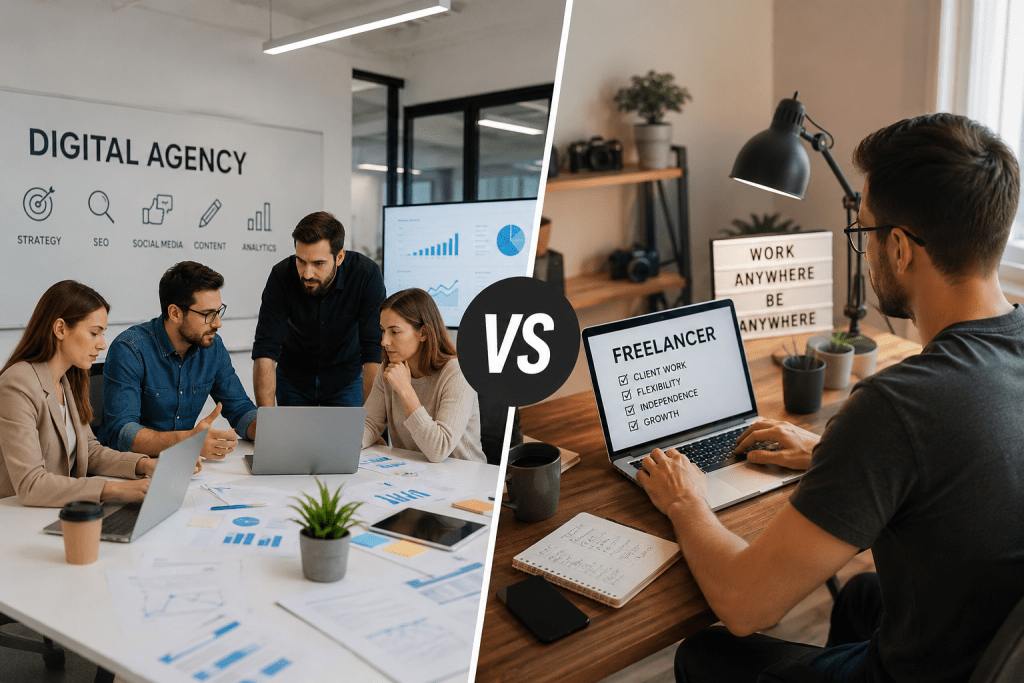

Running a global B2C or D2C brand in 2026 is an absolute thrill, but it’s also a wild, fast-moving puzzle. With hyper-personalized shopping, multi-channel social commerce, and complex tech stacks becoming the absolute standard, you can’t afford a sluggish website, outdated marketing campaigns, or sudden technical glitches.
Your online storefront is your global empire, and to scale it, you need a reliable hands-on deck. It brings every ambitious founder straight to a critical, business-altering crossroad: agency vs freelancer. Who do you trust to take your business to the next level?
Should you hire a skilful, independent solo specialist, or partner with a fully structured, multi-disciplinary team? In this comprehensive deep dive, we’ll break down the realities of both paths in today’s market so you can confidently make the right call for your brand’s growth.
The Freelancer Route: Agility on a Budget

Freelancers are the independent mercenaries of the digital landscape. They are highly specialized, fast on their feet, and operate with minimal organizational overhead. For a growing B2C brand testing new waters, hiring a freelancer can feel incredibly liberating.
The Pros: Direct Access and Low Overhead
- When you work with a freelancer, you’re talking directly to the person doing the work. There are no account managers, no layers of bureaucracy, and no complex ticketing systems.
- If you need a quick adjustment on a graphic or a single landing page tweaked, they can often jump on it immediately.
- Furthermore, because they don’t maintain large corporate office spaces or cross-functional payrolls, their hourly rates or project fees are generally much friendlier on your cash flow.
The Cons: The “One-Person” Bottleneck
However, the biggest strength of a freelancer is also their greatest vulnerability: they are just one person. If your freelancer gets sick, takes a vacation, or suddenly gets overwhelmed with a larger client, your project grinds to a sudden halt. More importantly, e-commerce requires an incredibly diverse mix of skills.
A brilliant coding wizard might be completely lost when it comes to visual conversion rate optimization or building a comprehensive metadata framework. Expecting a single freelancer to handle your entire operation expertly often leads to patchy results and operational burnout.
The Agency Route: A Collective Powerhouse

On the flip side of the agency vs freelancer debate sits the digital agency. This isn’t just a group of people sharing an office; it’s a cohesive ecosystem designed to handle complex, interconnected scaling challenges simultaneously.
The Pros: Multi-Disciplinary Expertise and Redundancy
When you partner with an agency, you aren’t just hiring a developer or a marketer—you’re onboarding a collective brain trust. Agencies house specialized UI/UX designers, front-end developers, backend engineers, copywriters, and performance marketers under one roof.
They collaborate seamlessly behind the scenes, ensuring that your branding matches your code, which matches your ad copy. Additionally, agencies offer built-in redundancy. If your primary developer goes on leave, another qualified engineer steps right in without missing a single beat or delaying your launch timelines.
The Cons: Higher Upfront Commitment
The primary barrier for most D2C founders is the cost. Agencies carry structural overhead, which naturally reflects in their pricing.
Onboarding an agency also takes a bit more structural planning, as they utilize standardized communication channels, project managers, and formal discovery phases. It’s an investment tailored for brands looking for long-term predictability and rapid acceleration, rather than a quick, cheap patch.
Agency vs Freelancer: Tabular Comparison
| Feature | Agency | Freelancer |
| Skill Diversity | Highly specialized in a single niche | Full-stack cross-functional team |
| Cost Structure | Lower, flexible hourly/project rates | Premium, structured project fees |
| Operational Redundancy | None (Single point of failure) | High (Back-up teams and PMs) |
| Scalability | Limited by individual daily hours | Easily scales to meet massive traffic |
Evaluating the Three Pillars of E-Commerce Success
To truly understand how the choice of an agency vs freelancer impacts your day-to-day operations, let’s analyze how each model performs across the three essential operational pillars of an online storefront in 2026.
Pillar A: Premium Ecommerce Development Services
Building a modern, headless, or highly custom e-commerce store requires meticulous architectural planning. While a solo freelancer can configure basic out-of-the-box themes, advanced custom integrations require professional ecommerce development services.
An agency can deploy dedicated solutions that bridge your warehouse inventory management, CRM, and customer checkout flows smoothly, minimizing code bloat and maximizing site speed across all global regions.
Pillar B: Growth-Driven Ecommerce Marketing Services
In 2026, capturing consumer attention requires an omnichannel approach spanning social media, targeted search, email automation, and creator networks. Relying on a freelancer for comprehensive ecommerce marketing services can be risky, as one person rarely masters both technical media buying and deeply emotional copywriting.
Agencies provide dedicated growth teams that run cohesive, multi-channel campaigns backed by real-time data analysis, driving down your customer acquisition costs (CAC).
Pillar C: Uninterrupted Ecommerce Website Maintenance Services
Your online store never sleeps. A server crash at 2:00 AM on a high-traffic holiday weekend can cost you thousands of dollars in lost revenue. Freelancers usually work standard hours and cannot guarantee round-the-clock protection.
To protect your revenue, structured ecommerce website maintenance services from a dedicated agency provide continuous monitoring, regular security patches, automated backups, and instant threat mitigation, ensuring your checkout funnel stays active 24/7/365.
The Final Verdict: Which One Should You Choose?
Ultimately, the classic debate of agency vs freelancer doesn’t have a single universal answer—it’s entirely about aligning your choice with your current stage of business growth and financial bandwidth.
- Choose a Freelancer if: You are in the early validation phase, have a highly restricted budget, or simply need an isolated, specific task completed (like a basic custom script) where you can manage the project directly.
- Choose an Agency if: You are actively scaling your revenue, managing an omnichannel brand, or cannot afford technical downtime. If you want a unified team to take ownership of your development, marketing, and continuous optimization while you focus entirely on your business vision, an agency is your definitive path forward.
Read Also:- Top Adobe Commerce Agency Services to Elevate Your Online Store in 2026
Global Scaling with Webiators Technologies
If you’ve decided that your brand requires the strategic stability, deep technical expertise, and flawless execution of an agency, look no further than Webiators Technologies. Established as a leading global e-commerce agency, Webiators specializes in transforming ambitious B2C and D2C online storefronts into high-converting machines.
We have built a formidable reputation delivering world-class end-to-end e-commerce solutions specifically tailored for demanding clients across the US, UK, Australia, UAE, and New Zealand.
Whether you need heavy enterprise-grade development, continuous system optimization, or high-ROI marketing engines, Webiators provides the seamless, timezone-aligned global support that modern international business owners demand.
FAQs
1. In the agency vs freelancer debate, which option is more cost-effective long-term?
While freelancers have lower initial costs, an agency often proves more cost-effective long-term by eliminating costly project delays, missed deadlines, and technical errors.
2. Can a freelancer handle full-scale ecommerce development?
Rarely. Large-scale e-commerce development requires deep UI/UX expertise, complex backend integrations, and meticulous performance testing, which usually demands a collaborative agency team.
3. Why should I choose an agency for ecommerce marketing?
Agencies bring a complete growth squad, combining professional data analysts, copywriters, and media buyers, resulting in much more cohesive and profitable omni-channel campaigns.
4. What happens if my site crashes and I only use a freelancer?
If your freelancer is asleep, offline, or busy with other clients, your store remains offline. Agencies offer robust SLA guarantees and emergency support to handle crashes immediately.
5. Why do global brands trust Webiators Technologies?
Webiators Technologies delivers reliable, cross-functional e-commerce expertise with smooth cross-border communication, making them a preferred growth partner across the US, UK, AUS, UAE, and NZ.
