
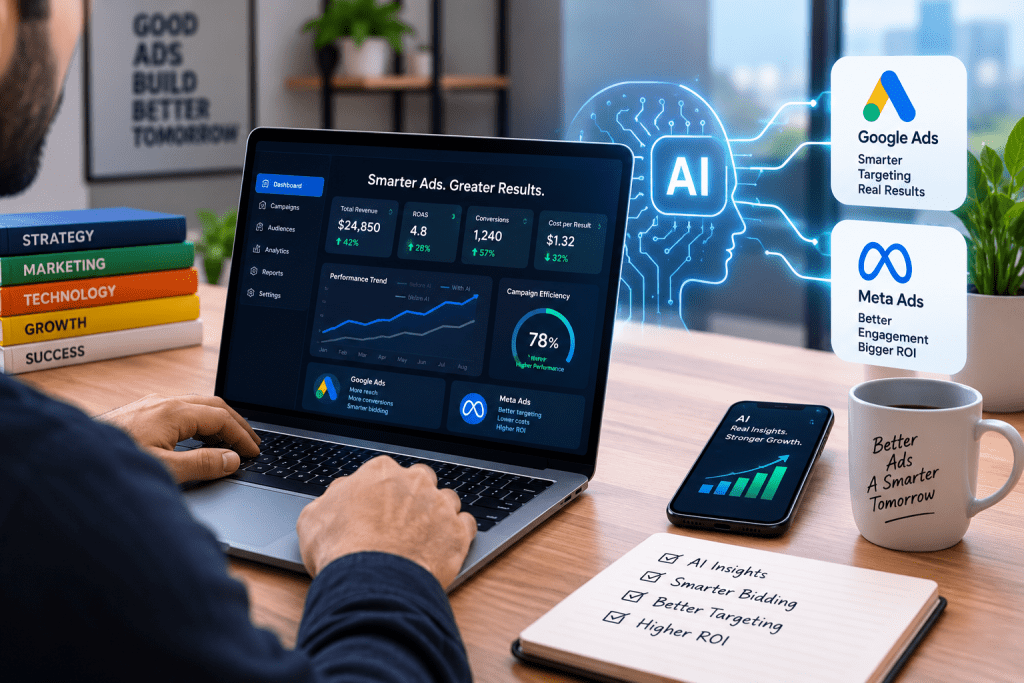

PPC advertising is changing faster than most ecommerce teams realise.
Google and Meta can now make thousands of advertising decisions using AI, from bids and audiences to placements, creative combinations, and conversion signals. Google Smart Bidding uses AI to optimise bids at auction time, while Performance Max applies AI across bidding, targeting, creative, and inventory. Google’s AI Max also brings AI-powered optimisation into Search campaigns.
The result?
AI PPC management is changing the role of the advertiser itself.
The job is becoming less about manually adjusting every campaign setting and more about feeding AI the right data, objectives, creative, and commercial context.
What Is AI PPC Management?
AI PPC management uses artificial intelligence and machine learning to automate and optimise paid advertising decisions.
Depending on the platform and campaign type, AI can help with:
- Bid optimisation
- Audience discovery
- Budget allocation
- Search-term matching
- Creative optimisation
- Conversion prediction
- Placement selection
- Campaign performance optimisation
Google’s Smart Bidding, for example, can use contextual signals to determine auction-level bids for conversion or conversion-value goals.
That is a huge change from manually increasing or decreasing bids based on yesterday’s spreadsheet.
How Is AI Changing PPC?
The biggest shift is from manual control to signal-based optimisation.
| Traditional PPC | AI-driven PPC |
| Manual bid changes | Auction-time AI bidding |
| Heavy keyword management | Broader intent matching |
| Fixed audience segments | Predictive audience signals |
| Manual budget adjustments | Automated budget optimisation |
| Static ad variations | AI-assisted creative optimisation |
| Frequent campaign edits | Strategic human intervention |
For ecommerce brands, this matters because customer behaviour changes constantly. AI can evaluate far more signals, much faster, than a human team can reasonably process.
But there is a catch.
AI does not fix bad strategy. It can execute it faster.
If purchase tracking is wrong, the algorithm learns from bad information. If the campaign optimises for the wrong conversion, automation can make the wrong outcome look successful.
That is why strong PPC Services still require strategic oversight.
Can AI Manage Google Ads?
Yes, AI can manage a substantial portion of campaign execution.
Google’s Performance Max uses AI across bidding, audiences, creative, and Google’s advertising channels. AI Max for Search can expand search-term matching, customise ad text, and use landing-page expansion to connect users with potentially relevant pages.
But AI does not understand your business automatically.
Suppose two products generate the same revenue but have very different profit margins. Unless your conversion values and optimisation strategy communicate that difference, the system may not make the decision you would make as a business owner.
This is where professional Google Ads Management becomes more strategic.
The human role shifts toward:
- Conversion tracking
- Profitability analysis
- Campaign objectives
- Product-feed quality
- Creative strategy
- Landing-page optimisation
- Budget planning
- Performance analysis
Less button clicking.
More decision-making.
Is AI Better Than Manual Bidding?
Often, AI bidding has an advantage because it can evaluate signals and make auction-level decisions at a scale humans cannot match. Google’s Smart Bidding is specifically designed for this type of automated optimisation.
But AI is not automatically better for every account.
New campaigns may have limited data. Tracking may be unreliable. Business goals may be unclear. A target ROAS can also be unrealistic for the economics of a particular product.
So I would not frame the decision as AI versus humans.
The stronger model is:
Human strategy + reliable data + AI execution + continuous measurement.
How Is AI Changing Meta Ads?
Meta is following the same broader direction through its Advantage+ advertising products.
AI and automation can influence audience selection, placements, budget allocation, delivery, and creative optimisation.
That changes how Meta Ads Management works.
Instead of manually defining every audience combination, advertisers can increasingly provide strong creative, accurate conversion signals, and a clear business objective while Meta’s systems search for opportunities.
Creative therefore becomes even more important.
AI can test and optimise variations.
It cannot manufacture genuine product-market fit.
If your offer is weak, your landing page is poor, or your creative fails to explain why someone should buy, more automation will not magically solve the problem.
Which AI Tools Help PPC?
The most useful AI PPC tools are often already built into Google and Meta.
Google: Smart Bidding, Performance Max, AI Max, AI-powered search-term matching, creative optimisation, and landing-page expansion.
Meta: Advantage+ campaigns, automated audience optimisation, automated placements, budget optimisation, and AI-assisted creative tools.
Third-party AI marketing tools can also support reporting, anomaly detection, feed analysis, creative testing, and performance monitoring.
The goal should not be collecting as many AI tools as possible.
Use the technology that solves a measurable advertising problem.
Should Ecommerce Brands Use AI for Advertising?
For most established ecommerce businesses, yes, but automation should come after the fundamentals.
Before increasing AI-driven optimisation, check:
- Is purchase tracking accurate?
- Are conversion values trustworthy?
- Is your product feed complete?
- Are margins understood?
- Are campaigns optimising for meaningful business outcomes?
- Are landing pages converting?
- Does the account have enough quality data?
If the answer to several of these is no, more automation may simply produce faster noise.
Fix the foundation first.
Then scale the intelligence.
Is AI Replacing PPC Managers?
AI is replacing repetitive PPC tasks.
It is not eliminating the need for strategic PPC professionals.
Manual bid adjustments, repetitive reporting, and some routine optimisation can increasingly be automated. Strategic decisions around positioning, profitability, attribution, creative direction, experimentation, and customer behaviour still require human judgement.
That is why the best PPC managers are becoming more valuable in a different way.
They are managing the system, not just the settings.
For ecommerce companies investing seriously in paid acquisition, Performance Max, Meta automation, and other AI-driven advertising systems can create significant scale. But the results still depend on what goes into those systems and how intelligently the output is evaluated.
Read Also:- How to Start AI E-commerce Optimization for Beginners in 2026
The Real Future of AI Advertising
The future is not fully automated advertising.
It is better collaboration between people and machines.
AI can process enormous volumes of signals, predict likely outcomes, adjust bids, and find opportunities. Humans still define the commercial objective, validate the data, understand the customer, and decide what profitable growth actually means.
That is where AI Solutions become useful for ecommerce brands.
If your advertising account is generating clicks and conversions but you cannot clearly explain where profitable growth is coming from, the answer may not be another campaign.
It may be a better advertising system.
The opportunity is clear: use AI for the decisions machines handle better, and use human expertise for the decisions that determine whether those decisions actually grow the business.
FAQs
What is AI PPC Management?
AI PPC management uses artificial intelligence to automate and optimise bidding, targeting, budgeting, creative, search-term matching, and conversion-focused advertising decisions.
Does AI improve ad performance?
It can, provided campaigns have reliable tracking, appropriate objectives, quality data, and suitable creative. AI does not guarantee better results by itself.
Which platforms use AI?
Google Ads and Meta Ads both use AI extensively. Google applies it through Smart Bidding, Performance Max, and AI Max, while Meta uses AI throughout its Advantage+ advertising products.
Can AI reduce advertising costs?
AI can improve efficiency, but lower costs are not guaranteed. Ecommerce brands should focus on profitable acquisition rather than simply chasing the lowest CPA.
Is AI replacing PPC managers?
AI is replacing many repetitive tasks, but strategic PPC management remains important for tracking, profitability, creative strategy, experimentation, and business decisions.
