
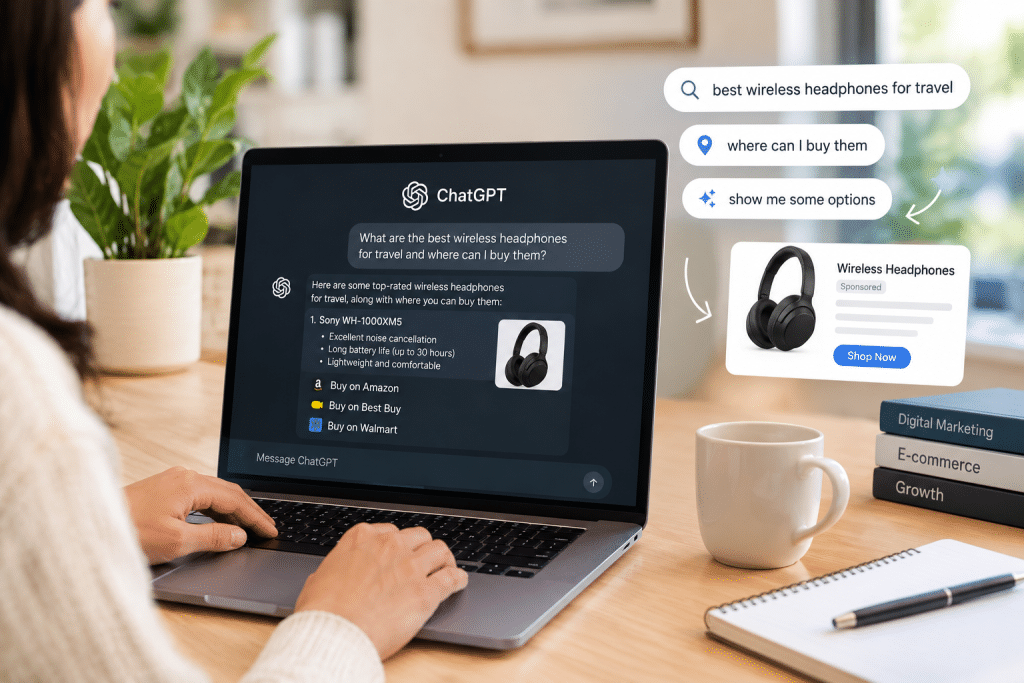

Your customers may already be asking ChatGPT what to buy, which product to choose, where to find it, and what fits their budget. Now businesses have another way to enter that journey: ChatGPT Ads.
OpenAI’s advertising platform lets eligible businesses create campaigns through Ads Manager and reach people while they explore options, compare alternatives and make decisions. Unlike traditional search ads, ChatGPT advertising can use conversational context and intent to determine relevance.
But before you rush to advertise on ChatGPT, there is an important question: how does it actually work, and what does it mean for your existing SEO, PPC and GEO strategy?
What Are ChatGPT Ads?

ChatGPT Ads are paid advertisements displayed within the ChatGPT experience.
OpenAI currently describes the advertising experience around three key moments:
- Exploring options
- Comparing alternatives
- Making decisions
Ads appear below ChatGPT responses and are clearly identified as advertisements. An ad can include the advertiser name, logo, headline, description, image and landing page.
Most importantly, ads are separate from ChatGPT’s answers. Advertisers cannot pay to change or influence the answer generated by ChatGPT.
That distinction matters because advertising on ChatGPT and appearing organically in an AI answer are two different things.
How to Advertise on ChatGPT
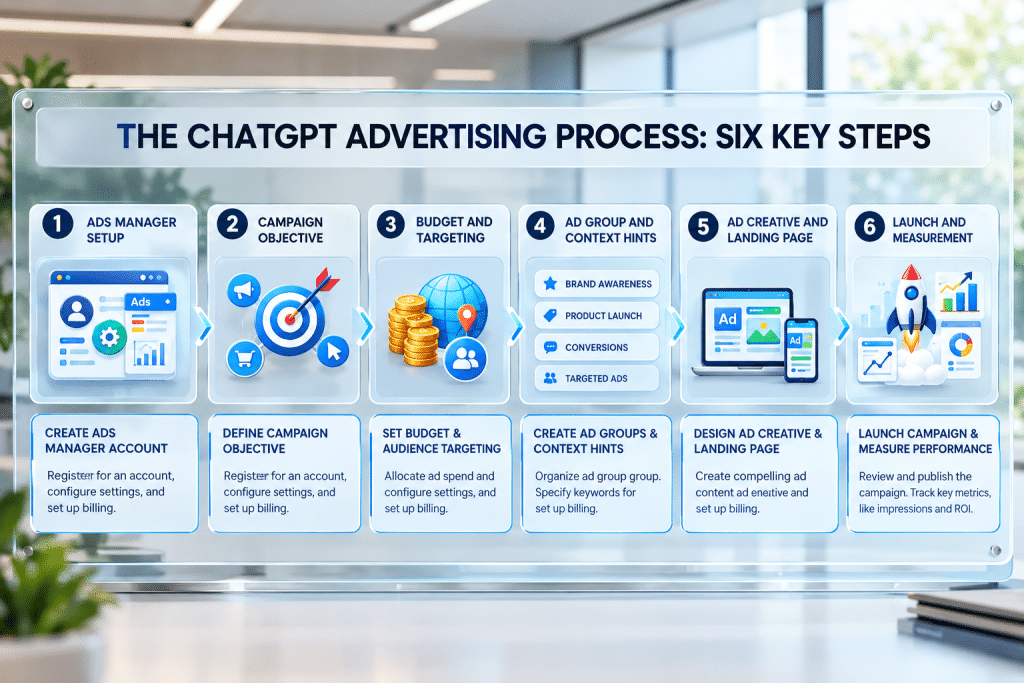
If you’re asking, “How can I advertise my business on ChatGPT?”, the process currently runs through OpenAI Ads Manager.
1. Set Up Your Ads Manager Account
Campaign creation and management take place through Ads Manager. You need to set up your business information, billing profile and payment method, then complete account verification.
2. Choose a Campaign Goal
You can currently create campaigns around:
- Views: Optimise for impressions
- Clicks: Drive traffic to your website or product
- Conversions: Optimise towards supported conversion events
Your objective affects how the campaign is priced and optimised.
3. Set Your Budget and Targeting
Campaigns can have a total or daily budget. You can also select countries and, where supported, more specific locations and platforms.
For new self-service accounts, international targeting can initially be restricted until identity verification and other requirements are met.
4. Create Ad Groups and Context Hints
This is one of the more interesting differences from traditional PPC.
You can provide context hints describing the conversations, topics or keywords where your product or service could be relevant.
These aren’t traditional exact-match keywords and they don’t guarantee that your ad will appear in a particular conversation. OpenAI’s system considers them alongside other signals, including the conversation’s context and intent, your ad and its landing page.
5. Create Your Ad
Your ad can include:
- Headline
- Description
- Image
- Landing page
The strongest creative should make the connection between the customer’s need and your offer obvious.
For example, instead of:
“Quality Running Shoes”
a more specific message could focus on a customer need:
“Running Shoes Built for Your Next Long Run”
The closer the message is to the problem being discussed, the more naturally it fits the conversational environment.
6. Launch, Measure and Improve
After submitting your campaign for review, you can monitor impressions, clicks, spend, CTR, average CPC, average CPM and conversions when conversion measurement is configured. UTM parameters can also help connect ChatGPT traffic with your existing analytics.
How Are ChatGPT Ads Different From Google Ads?
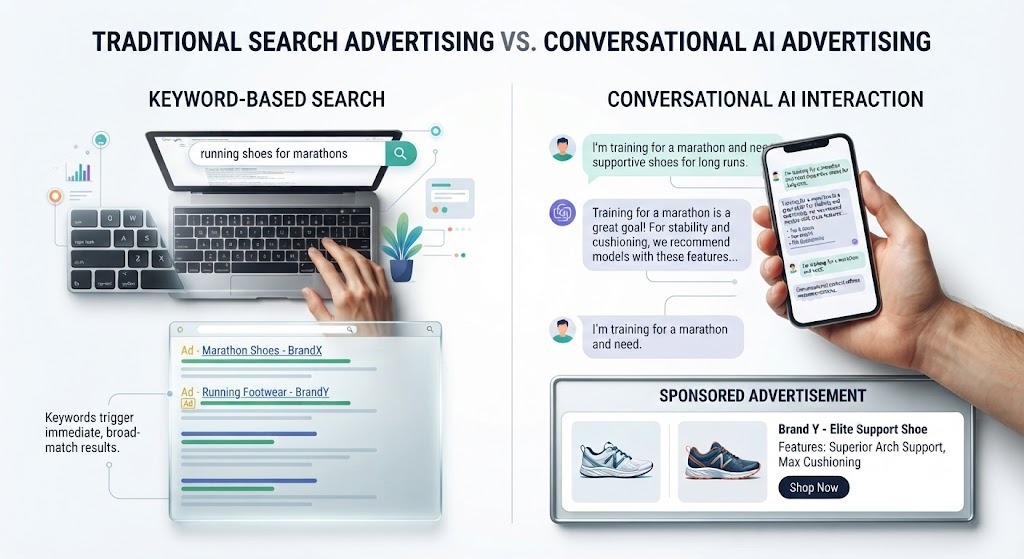
Here’s where the advertising model gets interesting.
A traditional search might be:
“best laptop for video editing”
A ChatGPT conversation could be:
“I edit 4K videos, travel frequently and have a budget of $1,500. Which laptop should I buy?”
The second query contains much richer information about the customer’s situation.
ChatGPT Ads can consider the context and intent of the current conversation, along with the ad’s landing page, title, copy and advertiser-provided context hints. When ads personalisation is enabled, certain signals from a user’s broader ChatGPT experience may also be considered.
So the opportunity isn’t simply about matching an advertisement to a keyword.
It’s about being relevant to a buying conversation.
Read Also:- Google Shopping Ads Agency: How to Scale Your Ecommerce Sales in 2026
ChatGPT Ads vs Traditional Search Ads
| Traditional search advertising | ChatGPT advertising |
| Often begins with a search query | Begins within a conversation |
| Keywords play a major role | Context and intent can provide richer signals |
| User enters a specific search | User can explain a broader need |
| Ad appears within search results | Ad appears below ChatGPT responses |
This doesn’t make one approach universally suitable over the other. They simply operate in different search environments.
Where Can Your Ad Fit Into the Buying Journey?
Consider a shopper researching a new smartphone.
Their conversation could progress from:
“Which phone has the best camera?”
to:
“Which one is better for travel photography?”
to:
“Where can I buy it?”
Instead of treating these as isolated searches, conversational AI can connect them as part of one broader decision-making process.
That is the opportunity OpenAI is positioning for advertisers: reaching people while they explore, compare and decide.
For brands, this makes relevance particularly important.
Your ad needs to make sense in the moment it appears, not merely contain the right keyword.
How Much Does It Cost to Advertise on ChatGPT?
ChatGPT Ads currently supports impression-based and valid-click billing.
Depending on the campaign, advertisers can choose:
- Views: CPM-based buying
- Clicks: CPC-based buying
- Conversions: Optimisation towards supported conversion events
For CPC campaigns, OpenAI currently recommends starting with a maximum bid of $3-$5 USD per click. Actual delivery and costs can vary depending on competition and campaign conditions.
There is also a minimum daily budget for self-service campaigns. For accounts billed in INR, OpenAI currently lists ₹725 as the minimum daily budget.
Rather than treating these figures as a guaranteed acquisition cost, businesses should judge campaigns using metrics such as CTR, CPC, conversions and cost against the actual business outcome.
Who Can Advertise on ChatGPT?
Availability depends on the advertiser’s country and access type.
OpenAI currently lists India among the countries with self-service Ads Manager availability. Availability can change, so businesses should check the current country list before planning a campaign.
Advertisers must also comply with OpenAI’s advertising policies and any applicable restrictions.
So, before building a campaign, check:
- Is Ads Manager available in your market?
- Is your business eligible?
- Does your product or service comply with advertising policies?
- Is your website ready to receive paid traffic?
What Does ChatGPT Advertising Mean for Ecommerce?
For ecommerce brands, the timing is particularly interesting.
A shopper can use ChatGPT to:
- Discover products
- Compare features
- Understand differences
- Narrow down options
- Explore alternatives
- Decide what to buy
That means product discovery is becoming increasingly conversational.
OpenAI’s own advertising platform positions ChatGPT Ads around moments when people explore, compare and make decisions. The platform also provides tools for advertisers to create campaigns, test messaging and measure results.
For an ecommerce business, this makes the basics more important than ever:
Relevant product → useful landing page → clear value proposition → easy conversion path.
If the ad earns the click but the landing page doesn’t answer the customer’s question, the advertising budget is doing too much work.
ChatGPT Ads vs GEO: What’s the Difference?
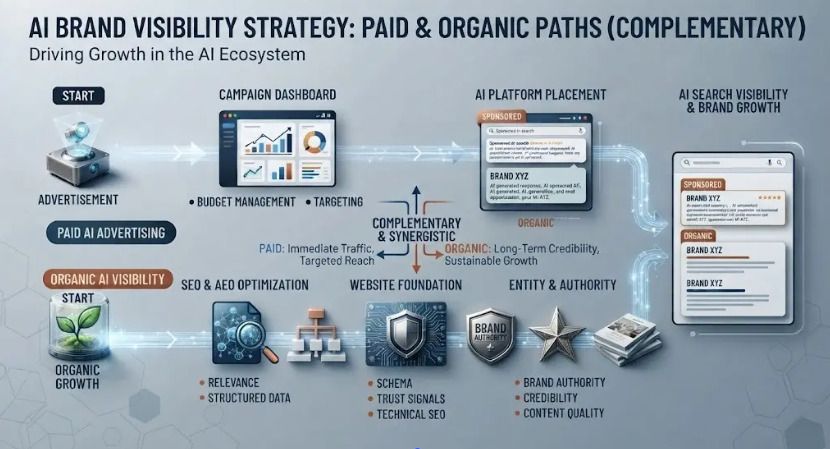
This is where businesses need to separate paid AI visibility from organic AI visibility.
ChatGPT Ads = paid visibility.
GEO/AEO = organic visibility across AI-powered search and answer experiences.
Buying an advertisement doesn’t mean ChatGPT will organically recommend your brand.
Likewise, investing in GEO doesn’t automatically place a paid advertisement beside a ChatGPT response.
They can, however, work alongside each other.
A business could use:
PPC + ChatGPT Ads
to reach customers through paid channels.
SEO + GEO + AEO
to build long-term organic visibility across traditional and AI search.
For Webiators, this creates a natural connection between its PPC, ecommerce SEO, AI solutions and ecommerce development capabilities. The goal isn’t simply to buy another advertising placement. It’s to make the entire website and customer journey ready for the way people increasingly discover and evaluate businesses.
Is Your Website Ready for ChatGPT Ads?
Before spending money on any new advertising channel, check the destination.
Your landing page should have:
- A clear headline
- A specific value proposition
- Accurate product or service information
- Strong trust signals
- Mobile-friendly design
- Fast-loading pages
- A visible CTA
- Consistent messaging between the ad and landing page
- Conversion tracking
- UTM tracking where appropriate
Think of it this way:
The ad earns attention.
The landing page earns consideration.
The product or service earns the conversion.
A weak link can undermine the entire campaign.
The Bigger Shift: From Search Queries to Buying Conversations
ChatGPT advertising is part of a larger change in digital discovery.
People aren’t always searching with short phrases anymore. They can explain what they need, provide constraints, compare options and ask follow-up questions in one conversation.
For marketers, that means the old question:
“Which keyword should we target?”
increasingly sits alongside:
“Which customer conversation should our brand be relevant to?”
That’s a significant shift in how businesses can think about AI advertising.
But paid visibility is only one piece of the puzzle.
Brands also need accurate information, useful content, technically sound websites and strong entity signals if they want to build visibility across AI-driven discovery.
The takeaway?
Yes, your customers can see ads in ChatGPT.
But the bigger opportunity is understanding why they are there, what they are trying to solve and how your business can be genuinely relevant at that moment.
For businesses entering AI advertising, ChatGPT Ads are another channel to test. For businesses thinking longer term, the smarter question is broader:
Can your brand be found, trusted and chosen wherever your customers are asking what to buy?
FAQs
How do I advertise on ChatGPT?
Eligible businesses can create and manage campaigns through OpenAI Ads Manager. You can set an objective, budget and targeting, create ad groups and ads, submit them for review, then monitor performance.
Can businesses advertise on ChatGPT?
Yes. Businesses in supported markets can use OpenAI Ads Manager to create ChatGPT advertising campaigns, subject to eligibility and advertising policies. India is currently listed as a self-service market.
How do ChatGPT Ads work?
ChatGPT Ads appear below ChatGPT responses. Ad selection can consider conversation context and intent, the ad’s landing page, title, copy and advertiser-provided context hints, among other signals.
How much does it cost to advertise on ChatGPT?
Pricing depends on the campaign objective and billing model. ChatGPT Ads supports CPM and CPC approaches, as well as conversion-focused campaigns. OpenAI currently recommends a starting maximum CPC bid of 3–5 USD for CPC campaigns.
Are ChatGPT Ads the same as Google Ads?
No. They operate in different advertising environments. ChatGPT Ads can use conversational context and intent alongside other signals, while traditional search advertising commonly relies heavily on search queries and keyword targeting.
What is the difference between ChatGPT Ads and GEO?
ChatGPT Ads are paid placements. GEO focuses on improving a brand’s organic visibility within AI-generated search and answer experiences. A paid ad does not guarantee an organic recommendation from ChatGPT.