
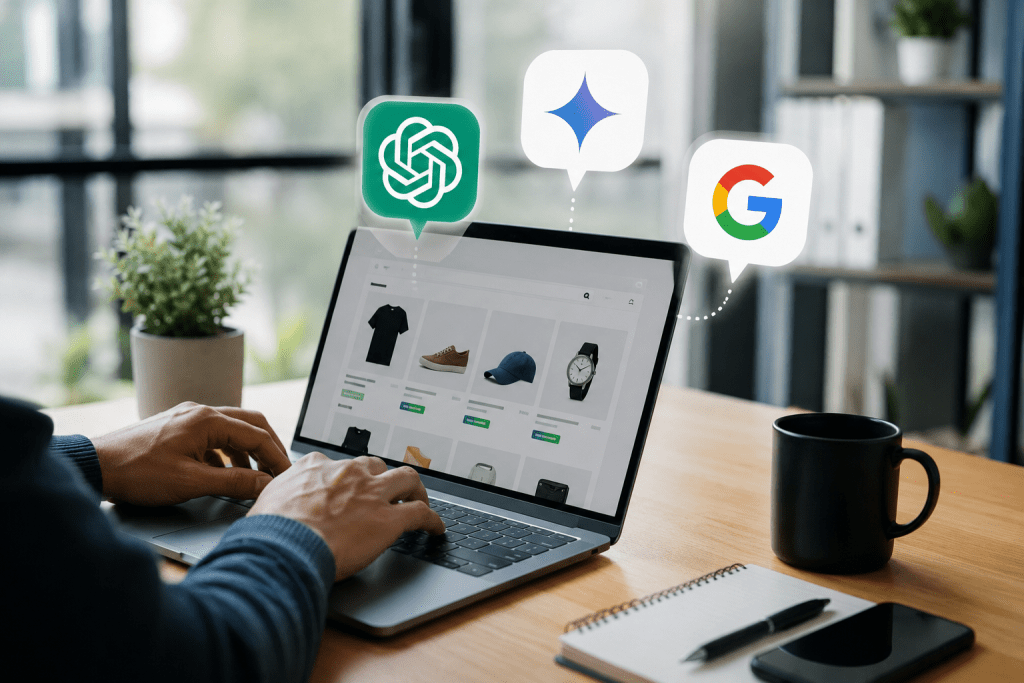

When someone wanted to buy a product a few years ago, they usually opened Google, compared a few websites, and clicked whichever result looked promising. That habit is changing faster than most businesses realize. Today, people ask ChatGPT for product recommendations, use Gemini to compare brands, or rely on AI-powered search experiences to shorten their buying journey.
Here’s what caught my attention. The businesses showing up in these AI-generated answers aren’t necessarily the ones with the biggest advertising budgets. They’re often the brands with trustworthy content, clear expertise, and websites that AI systems can easily understand.
If you run an online store, this shift creates both a challenge and an opportunity. Traditional SEO still matters, but it’s no longer the entire strategy. To improve your chances of being discovered in AI-driven search experiences, you also need Ecommerce GEO.
What Is Ecommerce GEO?
Ecommerce GEO (Generative Engine Optimization) is the practice of creating and organizing your ecommerce website so AI-powered search experiences can better understand, reference, and recommend your business when users ask relevant questions.
Unlike traditional SEO, which primarily focuses on improving visibility in search engine results pages, Generative Engine Optimization focuses on making your content useful, trustworthy, and easy for AI systems to interpret.
That includes:
- Publishing accurate, experience-driven content
- Organizing information logically
- Demonstrating topical expertise
- Using structured data where appropriate
- Building strong trust signals across your website
The goal isn’t to “game” AI. It’s to become a source AI can confidently rely on.
How Do AI Search Engines Decide What to Recommend?
This is one of the biggest misconceptions in digital marketing.
There isn’t a single AI ranking algorithm that decides which business gets recommended.
Different AI platforms work differently. Depending on the platform, responses may be generated using a combination of search indexes, retrieval systems, structured data, authoritative websites, knowledge graphs, and publicly available information.
Although each platform has its own approach, they generally perform better when websites demonstrate:
- Helpful and original content
- Clear expertise in a specific topic
- Strong website structure
- Consistent business information
- High-quality user experience
- Reliable external references
- Structured data that improves machine readability
That’s why AI search optimization is less about chasing algorithms and more about building genuine authority.
Can ChatGPT Recommend My Store?
Yes, but not because you’ve optimized for ChatGPT alone.
ChatGPT can recommend businesses when reliable information about those businesses is available through its retrieval systems, search integrations where applicable, and trustworthy public sources. The same principle applies to many other AI-powered search experiences.
If your website consistently publishes valuable content, answers customer questions, and demonstrates expertise, you’re giving AI far more confidence to reference your brand.
There is no guaranteed shortcut.
Instead, focus on becoming the business people trust first. AI systems increasingly reward that same trust.
Why Ecommerce GEO Matters for Online Stores
Ecommerce has become incredibly competitive.
Selling good products is only part of the equation. Customers need to discover your store before they can become buyers.
AI search is influencing that discovery process.
Someone searching for “best Shopify agency for fashion brands” or “reliable ecommerce development company” may receive a summarized list of recommendations before clicking any website.
If your business isn’t part of that conversation, you’re missing qualified opportunities.
Investing in Ecommerce GEO can help improve:
- Ecommerce visibility
- Brand authority
- Customer trust
- Qualified organic traffic
- Visibility across emerging AI search experiences
For growing ecommerce businesses, that’s becoming a competitive advantage rather than an optional marketing tactic.
How Is GEO Different From SEO?
Many people ask whether GEO is replacing SEO.
The short answer is no.
The two strategies complement each other.
| SEO | Ecommerce GEO |
| Optimizes webpages for search engines | Optimizes content for AI-generated search experiences |
| Focuses on keywords, rankings, and search traffic | Focuses on context, authority, and AI discoverability |
| Improves visibility in search results | Improves the likelihood of being referenced in AI responses |
| Measures rankings and clicks | Measures visibility, citations, and brand presence across AI experiences |
Strong SEO creates discoverability.
Strong GEO increases the chances that AI systems recognize your expertise.
Businesses that combine both are better prepared for the future of search.
Seven Practical Ways to Improve Your AI Visibility
1. Create content that genuinely answers customer questions
Instead of writing articles for search engines, write them for real people.
Answer questions completely, explain concepts clearly, and avoid thin content.
Helpful content is easier for both readers and AI systems to trust.
Cover your niche in depth.
For example, if you specialize in ecommerce development, publish content around platform migrations, conversion optimization, technical SEO, AI search optimization, and ecommerce growth strategies.
A well-connected content library demonstrates expertise far better than isolated blog posts.
Businesses already investing in Ecommerce SEO Services have an excellent foundation for building topical authority.
3. Strengthen your technical foundation
Even the best content struggles if search engines can’t efficiently crawl and understand your website.
A comprehensive Technical SEO Audit helps identify issues affecting indexing, performance, structured data, and crawlability.
Technical improvements benefit both traditional search and AI-powered search experiences.
4. Help machines understand your content
Structured data remains valuable because it provides additional context about products, organizations, FAQs, reviews, and authors.
Implementing Schema Markup Services improves machine readability and helps search systems interpret important information more accurately.
5. Build stronger business entities
Modern search relies heavily on entities rather than isolated keywords.
Using Entity SEO helps connect your brand, products, services, authors, and expertise across the web, making your business easier for search systems to recognize consistently.
6. Demonstrate real expertise
Publish case studies.
Share practical insights.
Highlight customer success stories.
Include author information where appropriate.
Original experience creates stronger trust than generic content rewritten from existing articles.
7. Adapt your SEO strategy for AI
Traditional optimization remains essential, but businesses should also consider content formats that support AI retrieval, conversational search, and topical depth.
Professional AI SEO Services can help businesses develop content strategies that strengthen both search visibility and AI discoverability without sacrificing user experience.
Is GEO Replacing SEO?
Not at all.
SEO remains the foundation of online visibility.
Without solid technical SEO, quality content, and a strong user experience, it’s difficult to succeed anywhere, including AI search.
Think of GEO as the next layer.
SEO helps people find your website.
GEO helps AI understand why your business deserves to be recommended.
The businesses gaining the most visibility today are combining both strategies instead of treating them as competing approaches.
Read Also:- Technical SEO Audit for Ecommerce: Fix These Hidden Issues Killing Your Rankings
Final Thoughts
Search behavior is evolving, and ecommerce businesses have an opportunity to evolve with it.
AI-powered search experiences are encouraging brands to focus less on shortcuts and more on expertise, trust, and genuinely helpful content. That’s a positive direction for both businesses and customers.
If you want your ecommerce store to be visible not only in traditional search results but also in AI-generated recommendations, now is the right time to invest in Ecommerce GEO. Build authoritative content, strengthen your technical foundation, organize your information clearly, and continue earning trust across the web.
Those efforts won’t just improve your visibility today. They’ll position your business for the future of search.
FAQs
What is Generative Engine Optimization?
Generative Engine Optimization (GEO) is the process of optimizing websites and content so AI-powered search experiences can better understand, retrieve, and reference them when generating responses.
Why is GEO important?
GEO helps businesses improve their visibility in AI-powered search experiences while strengthening trust, topical authority, and long-term digital presence.
Does Google AI Mode use GEO?
Google AI-powered search features build on Google’s existing search systems while using AI to generate summaries from multiple relevant sources. Websites with helpful content, strong technical foundations, and clear expertise are better positioned to appear in these experiences.
Can small businesses benefit from GEO?
Yes. Small businesses with focused expertise, high-quality content, structured websites, and consistent branding can compete effectively without enterprise-level marketing budgets.
How do I start optimizing for AI search?
Start by creating helpful content, improving technical SEO, implementing structured data, building topical authority, strengthening your brand entities, and regularly updating your website with accurate, experience-based information.
