


Last year, a skincare brand published dozens of SEO blogs targeting keywords like “best moisturizer for dry skin.” Traffic looked healthy on paper. Rankings stayed stable. Yet sales barely moved.
Then something changed.
Customers began discovering competing brands through AI-generated recommendations instead of traditional search results. People were asking tools like ChatGPT for skincare suggestions, product comparisons, and buying advice. The brands getting recommended were not always the biggest companies. They simply had clearer, more trustworthy, and better-structured content.
That shift explains why AI search optimization matters in 2026.
Search engines are no longer just indexing webpages. They are interpreting information, summarizing answers, and helping users make decisions faster. If your website content feels generic, confusing, or overloaded with keywords, AI systems are less likely to surface it.
For ecommerce businesses, startups, and growing brands, this change is already affecting visibility and conversions.
What Is AI Search Optimization?

AI search optimization is the process of making your website easier for AI-powered search systems to understand, trust, and reference.
Instead of relying mainly on keyword matching, modern AI-driven search experiences evaluate:
- Context
- Relevance
- Clarity
- Expertise
- User intent
- Overall website quality
This applies to:
- ChatGPT SEO
- Google SGE SEO
- AI-generated search summaries
- Conversational search tools
- Voice-based search queries
Here’s a simple example.
A traditional search might look like this:
“best ecommerce website agency”
But inside an AI-powered search tool, users often ask more detailed questions:
“Which ecommerce agency can improve online sales without rebuilding my entire store?”
That requires deeper understanding. AI systems look for pages that answer the actual problem clearly, not content stuffed with repeated keywords.
Why Many Websites Struggle in AI Search
Many business websites still rely on outdated SEO tactics.
You’ve probably seen pages filled with:
- Repetitive keywords
- Generic marketing phrases
- Long introductions with little value
- Surface-level advice copied from competitors
- Vague claims with no practical insight
AI systems are becoming much better at filtering out this type of content because users do not find it useful either.
Search platforms want content that helps people solve problems quickly and confidently. If a page feels bloated or artificial, AI tools may struggle to extract meaningful answers from it.
That’s why a modern AI SEO strategy focuses heavily on clarity, usefulness, and genuine expertise.
Write Content That Answers Real Questions
Strong AI search optimization begins with understanding what users are actually trying to solve.
For example, someone searching:
“How do I improve ecommerce conversions?”
is usually concerned about issues like:
- Low sales
- Cart abandonment
- Slow website speed
- Weak mobile experience
- Lack of customer trust
A short article packed with buzzwords will not help much.
A more useful article would explain:
- Why checkout friction reduces conversions
- How mobile speed impacts buying decisions
- Which trust signals influence customers
- What design mistakes hurt sales
Content that genuinely solves problems has a much stronger chance of appearing in AI-powered search responses.
Structure Matters More Than Most Businesses Realize
AI systems process information more effectively when pages are well organized.
Helpful formatting includes:
- Clear H2 and H3 headings
- Short paragraphs
- Logical topic flow
- Direct explanations
- FAQ sections
- Concise lists where appropriate
Large walls of text are difficult for both readers and AI systems to scan.
Think of your content like a well-organized retail store. If visitors cannot quickly find what they need, they leave.
Search systems respond similarly.
Google SGE SEO Is Changing Search Behavior
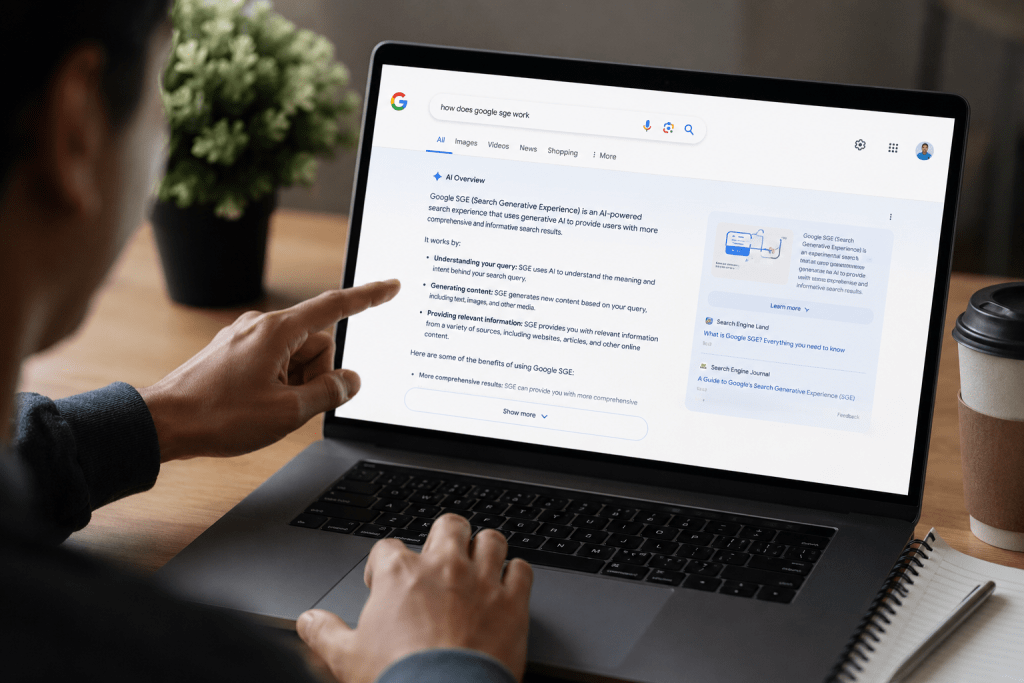
Google’s Search Generative Experience is changing how users interact with search results.
People increasingly see:
- AI-generated summaries
- Direct answers
- Follow-up prompts
- Product recommendations
This means users may get useful information before clicking several websites.
For businesses, that creates both competition and opportunity.
If your content is accurate, well-structured, and genuinely useful, Google may reference it within AI-generated search summaries. That visibility can build trust before a customer even lands on your website.
ChatGPT SEO Requires Natural Language
One of the biggest shifts in search behavior is conversational language.
People no longer search like machines.
Very few users type:
“best ecommerce seo agency scalable affordable”
Instead, they ask:
“Who can help improve my ecommerce store without slowing the site down?”
Your content should reflect how real people speak and search.
Natural language helps AI systems understand intent more accurately. It also makes your website more trustworthy and easier to read.
Interestingly, content written for humans often performs better in AI-driven search environments than content written only for algorithms.
Technical SEO Still Matters
AI search optimization is not only about content quality.
Technical performance still plays a major role.
Important areas include:
- Fast loading speed
- Mobile responsiveness
- HTTPS security
- Clean navigation
- Internal linking
- Crawlable site structure
For ecommerce websites, performance directly affects customer behavior. Even small delays during checkout can increase abandonment rates.
That’s one reason businesses investing in professional Ecommerce development services often improve both user experience and search visibility at the same time.
Build Trust Instead of Chasing Algorithms
Some SEO strategies still focus on trying to manipulate rankings.
That approach rarely works for long.
AI-powered search systems increasingly prioritize:
- Accurate information
- Clear expertise
- Helpful content
- Transparency
- Positive user experience
Brands that consistently publish thoughtful, experience-based content are more likely to build long-term visibility.
Not because they found a shortcut.
Because they became genuinely useful.
That distinction matters more every year.
Conclusion
AI search optimization is ultimately about making your website more understandable, trustworthy, and useful.
The businesses succeeding in 2026 are not necessarily publishing the most content. They are publishing the clearest and most helpful content. The kind that answers real questions without sounding robotic or exaggerated.
That is exactly what AI-powered search systems are trying to surface.
If your website combines:
- Strong technical performance
- Clear structure
- Natural language
- Real expertise
- Helpful insights
you are already building a stronger foundation for future search visibility.
And more importantly, you are creating a better experience for your customers too.
FAQs
1. What is AI search optimization?
Ans. AI search optimization is the process of improving website content and structure so AI-powered search systems can better understand, evaluate, and reference your content.
2. Is AI search optimization different from traditional SEO?
Ans. Yes. Traditional SEO focuses mainly on rankings and keywords, while AI search optimization emphasizes context, clarity, user intent, and content usefulness.
3. Why is ChatGPT SEO important for businesses?
Ans. ChatGPT SEO helps businesses create content that conversational AI tools can interpret and recommend when users ask detailed or problem-focused questions.
4. What is Google SGE SEO?
Ans. Google SGE SEO refers to optimizing content for Google’s AI-generated search experiences, where summaries and direct answers appear directly within search results.
5. Does technical SEO still matter in AI search?
Ans. Absolutely. Website speed, mobile usability, navigation, and crawlability still play a major role in both user experience and search visibility.
