

Every shop owner hits that same wall at 2:00 AM. You’re staring at a dashboard, watching the bounce rates, and wondering why the “Build it and they will come” philosophy failed so miserably. Your products are stellar. Your site is sleek. But the virtual aisles are silent.
This brings us to the ultimate crossroads of digital growth: Should you dump your budget into the instant gratification of Paid Ads, or play the long, grueling game of Search Engine Optimization?
It is rarely a “one or the other” answer. Instead, it is about understanding the metabolic rate of your business. How fast do you need to grow, and how much “rent” are you willing to pay to Google or Meta?
The High-Octane Rush of PPC
Think of Pay-Per-Click (PPC) as a high-performance faucet. The moment you twist the handle, traffic pours in. If you have a seasonal product or a flash sale, waiting six months for a blog post to rank is business suicide. You need eyes on your landing page by Tuesday.
Paid ads offer surgical precision. You can target a 28-year-old in Austin who enjoys rock climbing and just searched for “waterproof chalk bags.” That level of intent is a goldmine for immediate revenue. However, the moment your credit card hits its limit or you pause the campaign, the faucet runs dry. You don’t own that traffic; you’re just leasing it, especially when using facebook ads management services.
The Compound Interest of SEO
SEO is the digital equivalent of buying the building instead of renting a booth. It takes a massive amount of manual labor, technical tinkering, and patience. You’re optimizing meta tags, building high-quality backlinks, and ensuring your site architecture doesn’t confuse a crawler.
But here is the magic: a well-ranked page keeps bringing in visitors while you sleep, long after the initial work is done. It builds trust. Most savvy shoppers skip the “Sponsored” tags because they subconsciously trust organic results more. They know Google’s algorithm is a brutal judge of quality, and if you’re on Page 1, you probably earned it.
Also Read – How to Do Keyword Research for Ecommerce Websites
SEO vs PPC: A Side-by-Side Reality Check
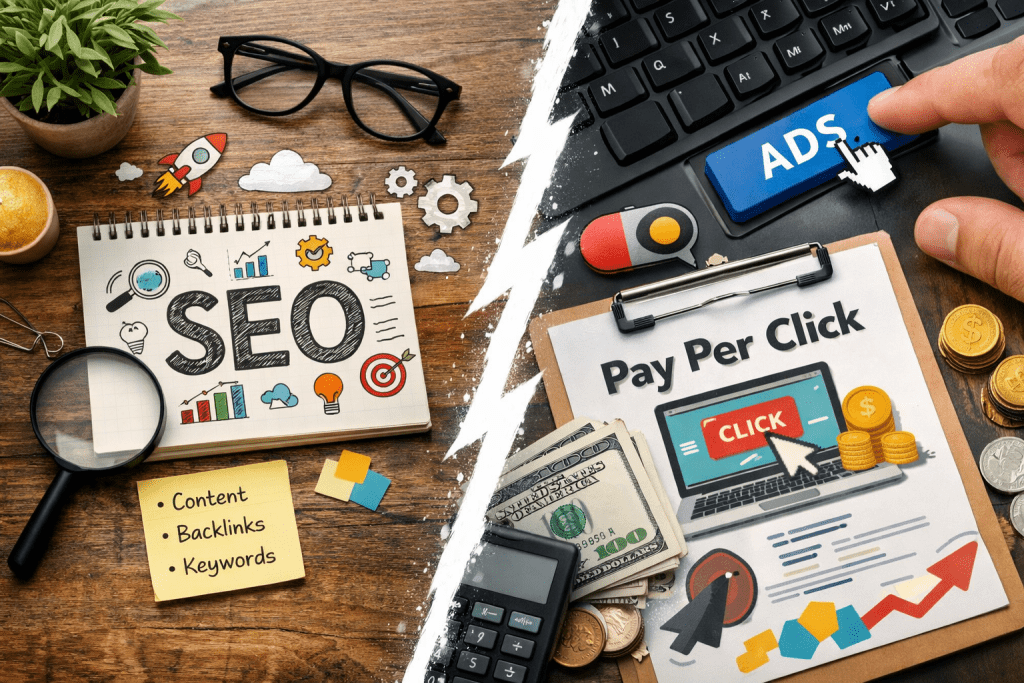
| Feature | Search Engine Optimization (SEO) | Pay-Per-Click (PPC) |
| Speed | Slow (Months to see traction) | Instant (Minutes to go live) |
| Cost Basis | Time and Sweat Equity | Direct Spend per Click |
| Sustainability | High (Long-term asset) | Low (Stops when spend stops) |
| Trust Factor | High (Earned authority) | Moderate (Clearly an ad) |
| Scalability | Linear growth over time | Rapid, budget-dependent scaling |
The “Hidden” Cost of Poor Strategy
Many startups treat an ecommerce marketing strategy like a gambling habit. They throw money at ads without fixing their site’s conversion rate. If your “Search Engine Optimization Services” are neglected, your paid traffic is landing on a leaky boat.
Why pay $3.00 for a click if your checkout page takes five seconds to load? High-performance growth requires a “Search-First” mindset. By tightening up your technical SEO, you actually lower your ad costs. Better landing pages lead to higher Quality Scores, which means Google charges you less for the same ad placement. It’s a feedback loop that most businesses ignore, especially when leveraging ecommerce performance marketing services.
Moving Toward Agentic Commerce
The landscape is shifting. We are moving away from simple keyword matching toward “agentic commerce,” where AI agents and sophisticated algorithms evaluate the actual value you provide to a human. This means your content can’t just be a list of keywords. It needs to solve a problem.
If you are looking to scale, consider a hybrid approach. Use PPC to test which keywords actually convert into sales, then double down on those terms with your Ecommerce Marketing services and organic content. This data-driven crossover ensures you aren’t guessing with your SEO budget.
Also Read – How to Start AI E-commerce Optimization for Beginners in 2026
Which One Wins?
If your cash flow is tight and you need survival revenue today: PPC is your lifeline.
If you want to build a brand that dominates its niche for years: SEO is your foundation.
The most successful founders don’t choose. they balance. They use ads to fuel the engine while the organic roots take hold. They recognize that organic vs paid traffic isn’t a war; it’s a partnership.
Ready to stop guessing and start growing? Whether you need precision-tuned Digital Marketing Services or a complete technical overhaul, the right strategy by Webiators is the one that fits your current stage of growth.
Frequently Asked Questions
1. How long does it actually take to see SEO results?
Ans. Generally, you should expect 3 to 6 months to see significant movement. It depends on your niche competition and the current health of your domain.
2. Can I do PPC without an SEO strategy?
Ans. Yes, but you’ll pay a “ignorance tax.” Without SEO, your site’s relevance is lower, often leading to higher costs per click and lower conversion rates.
3. Is SEO still relevant with AI search engines?
Ans. More than ever. AI models train on high-quality, authoritative data. If your site provides the best answers, you become the “source of truth” for AI-generated responses.
4. What is a good starting budget for ecommerce ads?
Ans. There is no magic number, but you need enough to “buy data.” Start with an amount that allows for at least 50–100 clicks per day to see if your offer actually resonates.
5. Should I hire an agency or do it myself?
Ans. If you have more time than money, do it yourself. If you have a business to run and need to scale ROI, professional services save you from expensive “beginner” mistakes.
