


Magento Open Source 2.4.9 is the latest stable release of the open-source e-commerce platform, landing on May 12, 2026. A beta (2.4.9-beta1) was made available on March 10, 2026, so developers could kick the tires early. This isn’t a “flashy new features” kind of release; it’s a serious platform modernization.
Think of it as a foundation upgrade: newer PHP, a swapped-out MVC framework, a brand-new WYSIWYG editor, tighter security, and over 500 bug squashes. If your store has been running well on 2.4.8, this is the natural next step to keep you on a supported, future-ready stack.
👋 Quick contextMagento Open Source 2.4.9 is available to everyone for free. Adobe Commerce customers get additional B2B features and cloud tools on top. This article focuses on the open-source release
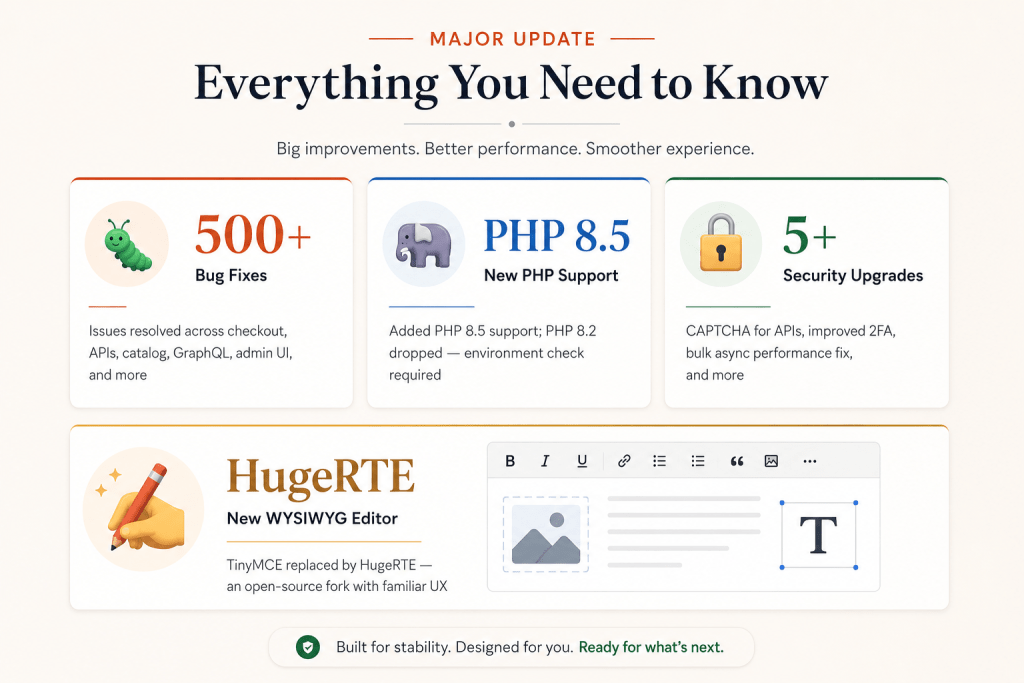
Key Highlights of Magento Open Source 2.4.9 at a Glance
Before we dive into the specifics, here’s the 30,000-foot view of what makes Magento 2.4.9 notable.
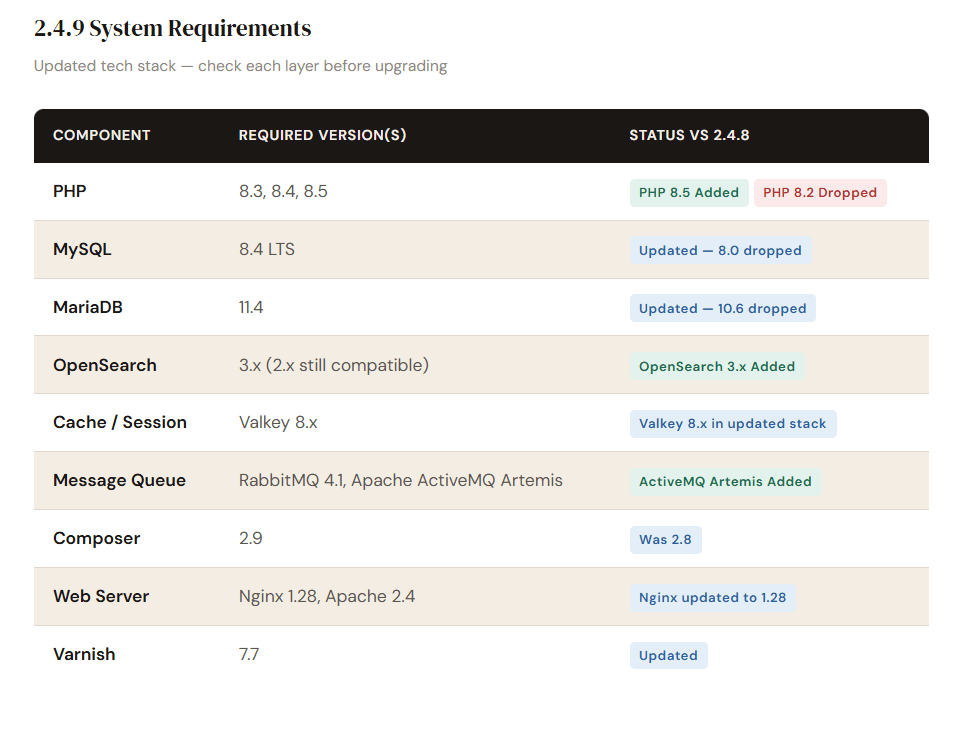
Platform Stack & System Requirements
It is the most impactful area for DevOps and hosting teams. Before you even think about running composer update, verify your server environment matches the 2.4.9 stack.
⚠️ Critical check
If your server is still running PHP 8.2, you must upgrade to PHP 8.3, 8.4, or 8.5 before installing Magento 2.4.9. There’s no way around this one.
Framework & Editor Changes
The internals of 2.4.9 got a significant shake-up. Most of this is invisible to shoppers, but it absolutely matters for developers and anyone with custom code or third-party extensions.
- MVC & Caching Framework
Two big swaps happened under the hood: Laminas MVC was replaced with a native PHP MVC implementation, and Zend_Cache was replaced with Symfony Cache. Symfony dependencies were also bumped to Symfony 7.4 LTS.
It is a significant architectural move that future-proofs the platform but may break compatibility with extensions that depend on the older libraries. The third-party OAuth library (carlos-mg89/oauth) was also removed in favor of native PHP OAuth functions — fewer external dependencies, better security posture.
- HugeRTE Replaces TinyMCE
The WYSIWYG editor that admins use to write content got a replacement. TinyMCE is out; HugeRTE is in. HugeRTE is an open-source fork of TinyMCE designed to maintain a familiar editing experience while moving off the older TinyMCE dependency.
Day-to-day editing should feel very similar, but if you have custom TinyMCE plugins or heavily customized admin interfaces, those will need testing and likely updates before going live.
- JavaScript Library Updates
Several front-end dependencies were bumped to current versions as part of ongoing maintenance:
- Uppy → 4.13.4
- Less.js → 4.2.2
- Chart.js → 4.5.0j
- Query UI → 1.14.1
- Underscore.js → 1.13.7
- jQuery Validate → 1.21.0
- Moment Timezone → 0.5.43
Test any custom TinyMCE plugins, Laminas MVC extensions, or code relying on Zend_Cache before upgrading to production. These framework swaps are the most likely source of compatibility issues.
Security & API Improvements
Security improvements in Magento Open Source 2.4.9 close some real gaps, especially for stores running headless or API-first architectures. Here’s what changed:
- CAPTCHA now covers REST & GraphQL
When CAPTCHA or reCAPTCHA is enabled for the Create Account form, the same validation now applies to account creation via API — closing a bot bypass gap.
- Simpler 2FA for Admins
Admin users now only need to configure one 2FA provider (e.g., Google Authenticator OR a U2F key), not every enabled provider: less friction, same security.
- GraphQL alias limits
Limits added to reduce risk from expensive or abusive GraphQL alias queries, important for public-facing headless stores.
- Better 400 error handling
Malformed REST requests now return clear 400 Bad Request responses instead of confusing 500 Internal Server Errors, making debugging much easier.
- PCI DSS 4.0 password policy
Admins can now configure a minimum password length (12+ characters) to meet PCI DSS 4.0 compliance requirements.
- Async bulk request fix
Performance degradation in bulk asynchronous web endpoints — introduced in an earlier security patch — has been fixed.
Beyond security, the API layer got a thorough cleanup. Customer email confirmation via WebAPI was fixed (there was a frustrating authorization catch-22 blocking activations). Attribute validation between Admin and REST API is now consistent.
Product gallery inheritance is preserved correctly when updating products via REST. Special price validation was improved across pricing endpoints. And several order-related endpoints now return accurate row_total and base_row_total values.
Admin, Content & Payments
- Admin UI Improvements
A number of quality-of-life improvements landed in the admin panel. Catalog Price Rules now have a bulk Actions menu — you can activate, deactivate, or delete multiple rules right from the grid instead of editing each one individually. Tax rates also got mass-delete support.
Inventory sources can now be deleted (previously, admins could only enable or disable them). The admin roles tree got expand all / collapse all buttons. Import and export actions now appear in the Action Logs report for better audit tracking.
- Content Staging
The staging preview feature in the admin panel now renders browser-simulated mobile device views accurately. So when you’re previewing a scheduled update, you can actually see how it’ll look on a phone — not just on desktop. CMS page duplication also got a fix, allowing pages with custom layout updates to be duplicated without errors.
- Payment Updates (Adobe Commerce)
Braintree integrations in Adobe Commerce received notable payment method additions — new local payment options including BLIK for Polish shoppers and Pay Upon Invoice for German buyers, plus ELO card support.
Apple Pay was expanded beyond Safari, and Google Pay card vaulting is now available from the customer account area. These are Adobe Commerce-specific additions and don’t apply to Magento Open Source.
Bug Fixes: What Got Fixed
Over 500 issues were resolved in the Magento Open Source 2.4.9-beta1 core code. That’s a lot of fixes — and Adobe Commerce pulls in even more. Rather than listing all 500, here’s a breakdown by area so you know where to focus your testing:

Notable Fixes
- Image resizing disk bloat — catalog:images:resize was generating image caches for websites where images weren’t even present. Fixed to only generate for assigned websites.
- Store view switching — switching store views from the storefront header now works correctly without needing a manual cache flush first.
- FPC for logged-in customers — Full Page Cache now works correctly post-login (was showing MISS instead of HIT).
- Guest prefix not saved — salutations (Mr/Mrs) selected by guest customers were being lost during checkout. Fixed.
- “As low as” label on configurable products — was incorrectly showing even when there’s only one option. Fixed.
- GraphQL cart merge on backorder — guest cart items weren’t merging with the customer cart. Fixed.
- SMTP with TLS — email sending via SMTP with TLS was throwing an SSL version error. Now fixed.
Should You Upgrade to Magento Open Source 2.4.9? Upgrade Checklist
Not every store should rush to 2.4.9 on day one. The right move is to treat it as a planned upgrade, not a same-day production change. Here’s a checklist to work through before you start:
- Payment & Checkout Flows: Full checkout end-to-end on staging with real payment methods.
- Search, Indexing & Cron Jobs: Verify indexing completes cleanly and scheduled jobs run as expected.
- PHP Version: Confirm your hosting environment supports PHP 8.3, 8.4, or 8.5. PHP 8.2 is no longer supported.
- Extension Compatibility: Contact your extension vendors or check their changelogs for 2.4.9 compatibility notes.
- OpenSearch / Elasticsearch: OpenSearch 3.x is the new target; 2.x remains compatible, but plans the upgrade.
- Database: Verify you’re running MySQL 8.4 LTS or MariaDB 11.4. Older MySQL 8.0 and MariaDB 10.6 are no longer targets.
- API & Integration Layer: Run your ERP, PIM, OMS, or marketplace integrations through their full API flows on staging.
- Staging Sign-off: Only move to production after all critical flows pass on a staging environment with real production data.
- Laminas / Zend_Cache Custom Code: Any custom code built on Laminas MVC or Zend_Cache needs to be reviewed and likely refactored.
- TinyMCE Customizations: If you have custom TinyMCE plugins or heavily modified admin editor integrations, test these specifically. HugeRTE may not support them out of the box.
Verdict by Webiators Technologies
Magento Open Source 2.4.9 is a vital “under-the-hood” evolution that secures your store’s future. While the transition from Laminas and TinyMCE requires a careful technical touch, the performance gains and security patches make it an essential move.
As a leader in Magento development services, we recommend this upgrade for any business looking to maintain a high-performance, PCI-compliant storefront. If you need expert assistance navigating these architectural changes, our comprehensive ecommerce development services are here to ensure a seamless, zero-downtime transition to this modern stack.
FAQs
What is the latest version of Magento?
The latest version is Magento Open Source 2.4.9, released on May 12, 2026. It’s available for both Magento Open Source and Adobe Commerce.
Is Magento 2.4.9 a free upgrade?
Yes, Magento Open Source is free and open-source. You can download 2.4.9 at no cost. However, upgrading your actual store may involve development time, especially if you have custom code or extensions that need compatibility updates.
Do I need to upgrade to PHP 8.5 for Magento 2.4.9?
Not necessarily. PHP 8.3 and 8.4 also work with 2.4.9. But PHP 8.2 is no longer supported, so if you’re on 8.2, you’ll need to upgrade PHP before moving to 2.4.9.
Is there a Magento 3 or Magento 2.5 coming?
As of May 2026, Adobe has not announced a Magento 3 or 2.5. The platform continues on the 2.4.x release track. Don’t plan around unconfirmed version numbers; focus on staying current within the supported 2.4.x releases.
How long is Magento 2.4.9 supported?
Regular support for Magento 2.4.9 runs through May 2029, giving you a solid three-year window on a fully supported release.
