
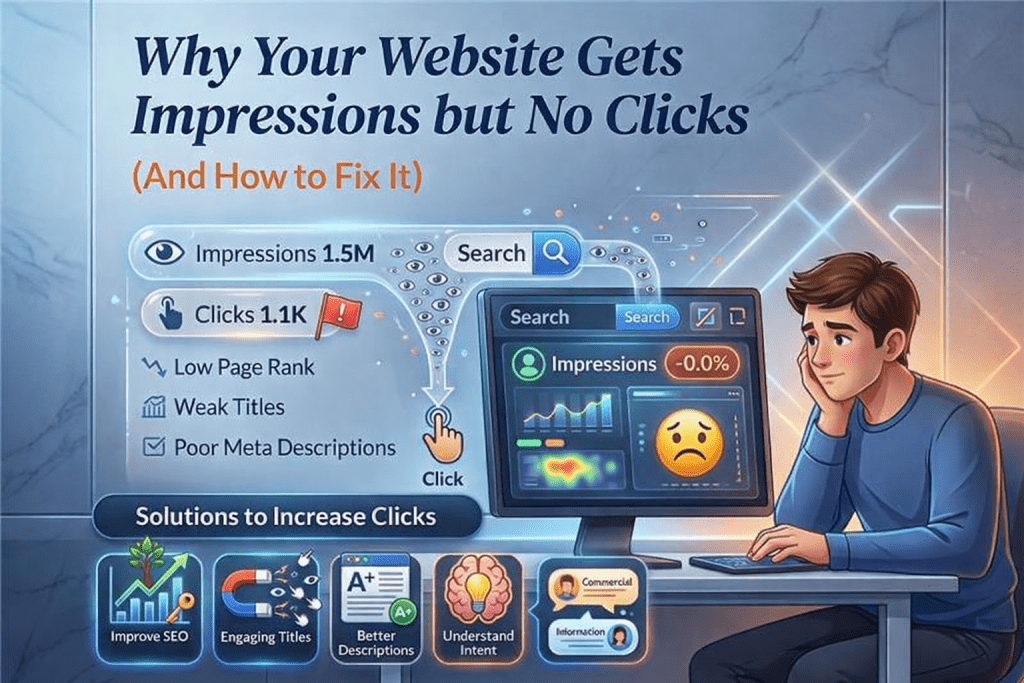

If you’ve ever reviewed your website’s performance in Google Search Console, you may have noticed a confusing trend: your pages receive thousands of impressions but very few clicks.
At first glance, this seems contradictory. After all, impressions indicate that your content is appearing in search results. Yet despite this visibility, users still choose not to visit your site.
This situation is surprisingly common. Many websites rank for hundreds or even thousands of keywords but struggle to convert those impressions into actual traffic. The issue is rarely random—it usually points to specific SEO problems such as low rankings, weak titles, mismatched search intent, or poor search-result visibility.
The good news is that this issue is highly fixable. With the right adjustments, websites can often increase click-through rates (CTR) by several times without publishing new content.
In this guide, we’ll explore the real reasons websites get impressions without clicks—and the proven strategies to fix it.
Understanding Impressions vs Clicks in Search Performance
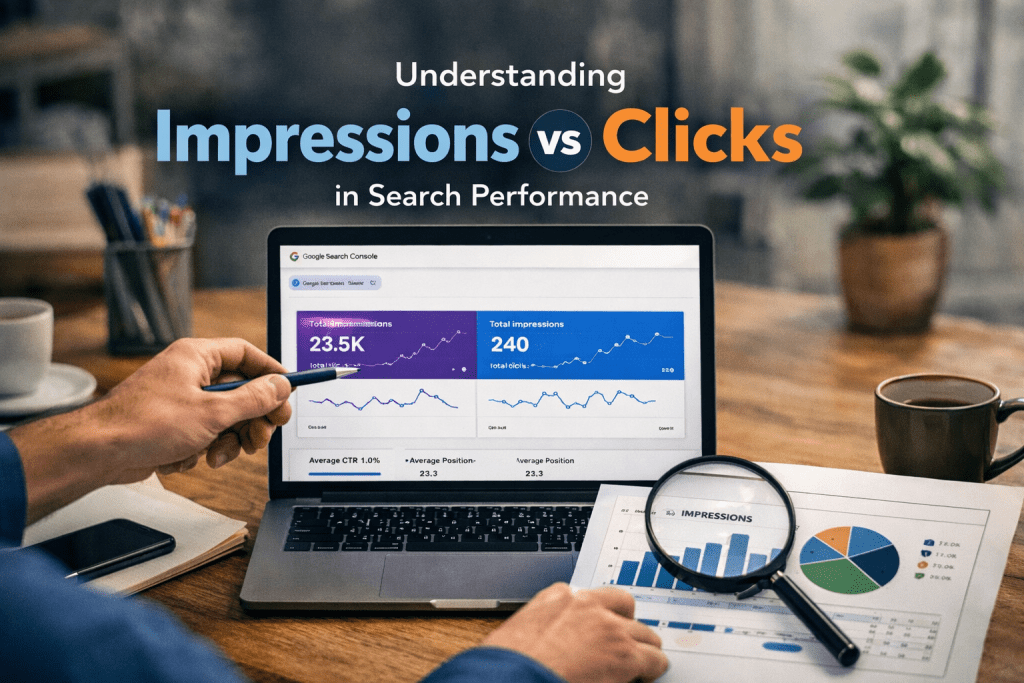
Before diagnosing the problem, it’s important to understand the difference between impressions and clicks.
What Is an Impression?
An impression occurs every time your page appears in a search result for a query—even if the user never interacts with it.
For example:
- If your page appears on page three of search results, it still counts as an impression.
- Even if the user scrolls past your result quickly, it still contributes to the total impression count.
This means impressions measure visibility, not engagement.
What Is a Click?
A click occurs when a user actually selects your result and visits your website.
Clicks indicate interest and relevance, meaning the user believed your page could answer their question or solve their problem.
Why the Difference Matters
Many websites have a large gap between impressions and clicks because their content is visible but not compelling enough to attract users.
According to research published by Backlinko, the first result in Google search receives roughly 27–30% of all clicks, while results beyond the first page receive less than 1% of clicks on average.
This explains why websites ranking lower in search results often accumulate impressions without meaningful traffic.
The Most Common Reasons Websites Get Impressions but No Clicks
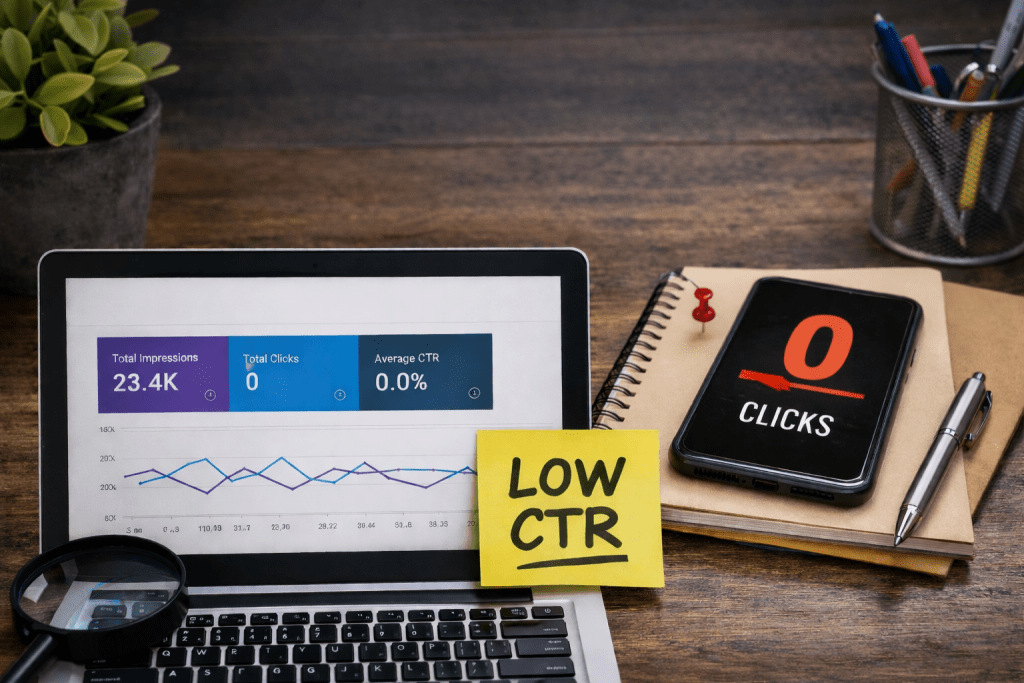
Several factors can cause this issue. Identifying which ones affect your website is essential to improving performance.
1. Your Pages Rank Too Low in Search Results
One of the most significant factors affecting clicks is ranking position.
Most users rarely scroll past the first page of results. Studies consistently show that over 90% of search traffic goes to page-one results, while pages beyond that receive minimal attention.
If your page ranks in positions 20–40, it may appear frequently in search results but still receive very few clicks.
Example Scenario
A page ranking:
- Position 28 may receive thousands of impressions
- But fewer than 10 clicks per month
This is not because the topic lacks interest—it simply means users never reach that result.
How to Improve Rankings
Improving rankings requires strengthening your page’s overall SEO quality.
Key actions include:
- Expanding the content with deeper explanations
- Targeting long-tail keywords with lower competition
- Improving internal linking across your website
- Updating outdated sections of your content
Even moving from position 18 to position 10 can dramatically increase traffic.
2. Your Title Tag Fails to Attract Attention
Your title tag is the most visible element in search results. It plays a major role in determining whether a user clicks your page or chooses a competitor’s result.
Generic titles often fail because they do not clearly communicate value.
Example
Weak title
Website Traffic Guide
Improved title
12 Proven Ways to Increase Website Traffic in 2026
The improved version works better because it:
- Clearly states the benefit
- Uses a number to add structure
- Includes the current year to signal freshness
According to studies by HubSpot, titles containing numbers and specific outcomes tend to generate higher engagement and click-through rates.
3. Poor or Missing Meta Descriptions
Meta descriptions appear below the title in search results and help users understand what the page offers.
Although meta descriptions do not directly influence rankings, they play an important role in encouraging clicks.
A weak description can make your result appear less informative than competing pages.
Example
Weak description
“Learn about SEO and website traffic.”
Better description
“Discover proven SEO strategies to increase website traffic, improve rankings, and attract more visitors to your site.”
The second version explains exactly what the reader will gain.
4. Your Content Doesn’t Match Search Intent
Search intent refers to the goal behind a user’s query.
For example:
A user searching for
“how to increase website traffic”
is likely expecting:
- actionable tips
- practical strategies
- step-by-step guidance
If the page only provides a general overview without solutions, users may skip it—even if it ranks well.
Types of Search Intent
Search queries generally fall into four categories:
- Informational – users want to learn something
- Navigational – users are looking for a specific website
- Transactional – users want to purchase something
- Commercial investigation – users are comparing options
Matching the correct intent dramatically increases both rankings and clicks.
5. Your Search Result Looks Similar to Competitors
In competitive search results, many listings appear nearly identical.
If your title and description look similar to others, users may not see any reason to choose your page.
For example, if several results say:
“SEO Guide for Beginners”
none of them stand out.
A more distinctive version could be:
“SEO for Beginners: A Step-by-Step Guide to Ranking on Google Faster”
Small improvements like this can make your result more noticeable.
6. Your Content Is Outdated
Search engines and users both prefer fresh, updated content.
Articles that haven’t been updated for several years may appear less trustworthy or relevant.
Search results that display recent years, updated statistics, or new insights often attract more clicks.
How to Update Content Effectively
Content updates may include:
- adding recent statistics
- expanding sections with deeper explanations
- improving readability and structure
- addressing new developments in the topic
Regular updates signal to search engines that your content remains relevant.
Practical Strategies to Increase Click-Through Rate
Once the causes of low clicks are identified, several proven strategies can improve your performance in search results.
Optimize Titles for Value and Clarity
Effective titles clearly communicate the benefit of clicking the page.
Strong titles often include:
- numbers
- clear outcomes
- updated information
- problem-solving language
For example:
Instead of
SEO Tips
Use
15 SEO Tips That Can Double Your Website Traffic
Use Structured Content for Better Readability
Well-structured pages are easier for both users and search engines to understand.
Use elements such as:
- clear headings
- bullet lists
- short paragraphs
- FAQ sections
These structures improve engagement and increase the likelihood that your page appears in enhanced search results.
Strengthen Internal Linking
Internal links help search engines understand the relationships between pages on your site.
They also guide visitors toward additional content, increasing overall engagement.
For example, linking related articles can help users explore multiple topics during a single visit.
Identify High-Opportunity Keywords
One of the most effective strategies is focusing on keywords where your site already receives impressions but ranks slightly outside the top results.
Performance data in Google Search Console can reveal queries where your site ranks between positions 10 and 30.
These keywords often provide the fastest opportunity for improvement because your page is already close to the first page of results.
Optimizing these pages can quickly increase traffic.
Final Thoughts
Getting impressions without clicks may seem discouraging, but it actually reveals an important opportunity.
Your website is already visible in search results, which means search engines recognize the relevance of your content. The challenge is simply convincing users to choose your result over competing pages.
By improving titles, refining meta descriptions, matching search intent, updating content, and strengthening SEO structure, websites can significantly increase click-through rates.
In many cases, even small adjustments can transform thousands of impressions into meaningful traffic and long-term growth.
The key is understanding how users evaluate search results—and making sure your pages provide the most compelling answer to their needs.
If your website receives impressions but very few clicks, it may indicate deeper SEO issues related to rankings, search intent, or page optimization. Experienced teams such as Webiators often help businesses analyze these problems and implement strategies that turn search visibility into real traffic growth.
FAQs
1. Why do impressions increase but clicks stay low?
Ans. This usually happens when pages rank on later pages of search results or when titles and descriptions fail to attract user attention.
2. What is a good click-through rate for SEO?
Ans. CTR varies by position, but pages ranking in the top results often achieve 5%–30% CTR, while lower positions may receive less than 1%.
3. How long does it take to improve CTR?
Ans. After updating titles or descriptions, improvements may appear within a few weeks, once search engines re-crawl and re-index the page.
4. Which tool helps analyze impressions and clicks?
Ans. Performance reports in Google Search Console are widely used to monitor search visibility, click-through rates, and keyword rankings.