
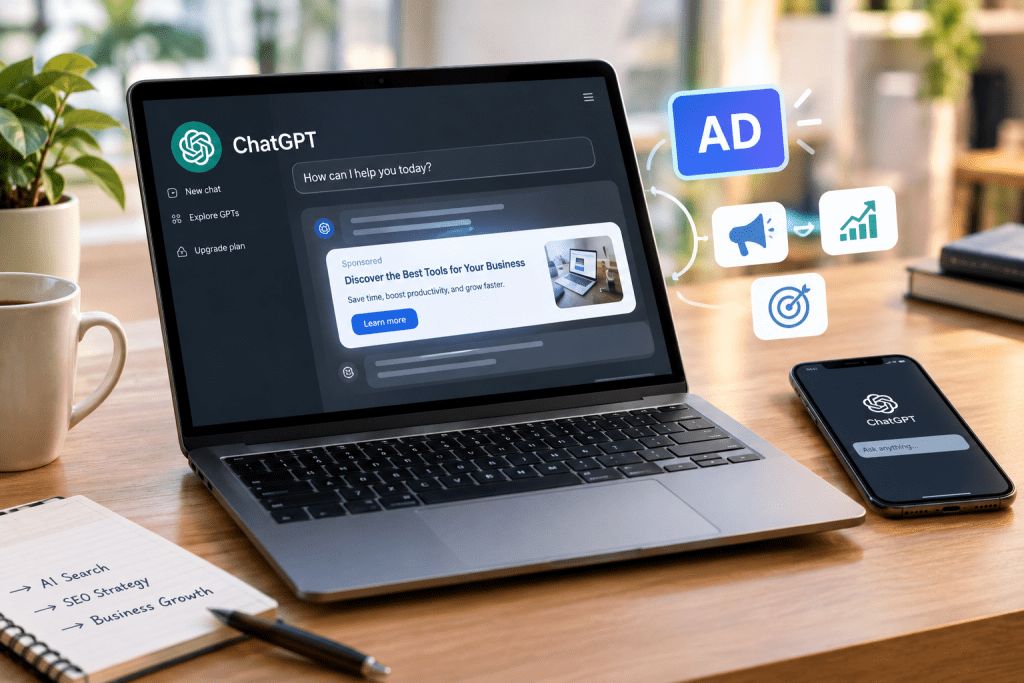

A customer opens ChatGPT and asks, “Which ecommerce platform is right for my business?”
Your competitor gets mentioned.
Your brand does not.
That scenario is becoming more relevant as AI moves deeper into product research, business discovery and purchase decisions. For companies that have spent years building Google rankings and paid search campaigns, there is a new question worth asking: are ads coming to ChatGPT?
They are already here.
OpenAI began testing ads in ChatGPT in the U.S. in February 2026. By August 31, 2026, OpenAI reported that ChatGPT Ads had reached a $1 billion annualized revenue run rate, with tens of thousands of advertisers using the platform. The company also announced expansion to India, Europe, the Middle East and North Africa.
That changes the conversation for ecommerce businesses, startups and SMEs.
ChatGPT is no longer just somewhere people ask questions. It is becoming another place where commercial decisions can begin.
ChatGPT Ads change the advertising landscape
Google gives you a search box.
ChatGPT gives you a conversation.
That difference is important.
A potential customer may not simply type “Shopify development agency.” They could explain their store size, sales goals, budget, technical problems and preferred platform before asking which agency they should consider.
The intent is wrapped in context.
OpenAI says ChatGPT ads are clearly identified as sponsored and visually separated from the organic response. Advertisers cannot pay to influence, rank or change ChatGPT’s answers.
For businesses, that creates two different routes to visibility:
Paid visibility: appear through ChatGPT’s advertising system when eligible users have relevant commercial conversations.
Organic visibility: build a credible digital presence that gives AI systems useful information about your company, expertise, products and services.
Those are not interchangeable.
AI Search Optimization now has a bigger role
Paying for an ad does not make ChatGPT recommend your business organically.
That distinction deserves attention.
AI Search Optimization is about improving how clearly your business can be understood and discovered across AI-driven search experiences. The work overlaps with strong SEO, but the focus goes beyond ranking for isolated keywords.
Consider an ecommerce agency.
A page saying “We provide innovative ecommerce solutions” sounds polished. It also says almost nothing.
A useful page would explain:
- Which platforms the agency works with
- Which businesses it serves
- What problems it solves
- How its process works
- What technologies it uses
- What evidence demonstrates its expertise
- What customers can realistically expect
Specificity gives your brand substance.
That matters when a potential customer, search engine or AI system is trying to work out what you actually do.
Your website needs to do more than generate clicks
An ad can win the first click.
Your website still has to win the customer.
This is where I would look closely at service pages, product pages, case studies and educational content. Are they genuinely answering buyer questions, or are they mostly repeating marketing phrases?
The difference is easy to spot.
“Best-in-class ecommerce solutions” is a claim.
“Shopify development for D2C brands, including migration, custom functionality, performance optimization and ongoing support” is information.
The second version gives a buyer something useful to evaluate.
It also gives your digital presence clearer context.
That is one reason Generative Engine Optimization is becoming an important part of modern search strategy.
What does this mean for PPC?
It does not mean businesses should abandon PPC Services.
Quite the opposite.
Paid campaigns can tell you which search terms attract qualified visitors, which offers generate leads and which messages encourage people to take action. Those insights can feed your content and AI search strategy.
Suppose your PPC data shows that “Shopify migration cost” attracts highly qualified prospects.
That is a signal.
Build a genuinely useful resource around Shopify migration pricing, technical considerations, timelines and common mistakes. Then connect it to the relevant service page.
Now your paid data is helping shape your organic content.
That is much smarter than running every marketing channel in its own little box.
What should businesses do before the market gets noisier?
Start with five practical checks.
Audit your AI visibility. Search your company, products and services across major AI platforms. Note which competitors appear and how your business is described.
Fix weak website content. Replace vague claims with specific information about services, industries, technologies, processes and outcomes.
Create content around decisions. Comparisons, alternatives, pricing questions, implementation guides and buyer FAQs can be far more valuable than generic keyword articles.
Strengthen trust signals. Use real case studies, reviews, expert authorship, credible references and consistent company information.
Connect marketing data. Use SEO and PPC insights to identify the questions that deserve better answers across your website.
The bigger opportunity is not the ad itself
ChatGPT Ads are important.
But the more interesting shift is happening underneath them.
OpenAI’s own research found that by July 2025, ChatGPT had approximately 700 million weekly users sending around 18 billion messages each week.
That is a huge amount of attention and an enormous number of questions.
Some of those questions are commercial.
Some are about products.
Some are about software providers, agencies, services and vendors.
Businesses need to prepare for that behaviour rather than waiting for AI search to become another line item on next year’s marketing plan.
The question has moved beyond “Are ads coming to ChatGPT?”
They have arrived.
The better question is:
“When customers ask AI what they should buy, will my brand be part of the answer?”
That is where AI Solutions, AI Search Optimization, Generative Engine Optimization, PPC and broader Digital Marketing Services can work together.
Buy visibility when it makes sense.
Earn credibility everywhere else.
That combination is likely to matter far more than any single advertising placement.
FAQs
1. Are ads already available on ChatGPT?
Yes. OpenAI began testing ChatGPT Ads in 2026 and has since expanded the program to additional international markets, including India.
2. Can businesses pay to influence ChatGPT’s organic answers?
No. OpenAI says advertisers cannot influence, rank or change ChatGPT’s organic responses through advertising.
3. Who sees ads on ChatGPT?
OpenAI says ads may appear for eligible Free and Go users. Plus, Pro, Business, Enterprise and Edu accounts do not have ads under the current policy.
4. Will ChatGPT Ads replace Google Ads?
There is no reason to treat them as direct replacements. They operate in different environments and can address different stages of customer discovery and decision-making.
5. How can businesses prepare for AI search?
Build authoritative content, make your website highly specific and useful, demonstrate real expertise, strengthen trust signals and combine AI Search Optimization with SEO and paid acquisition.
