
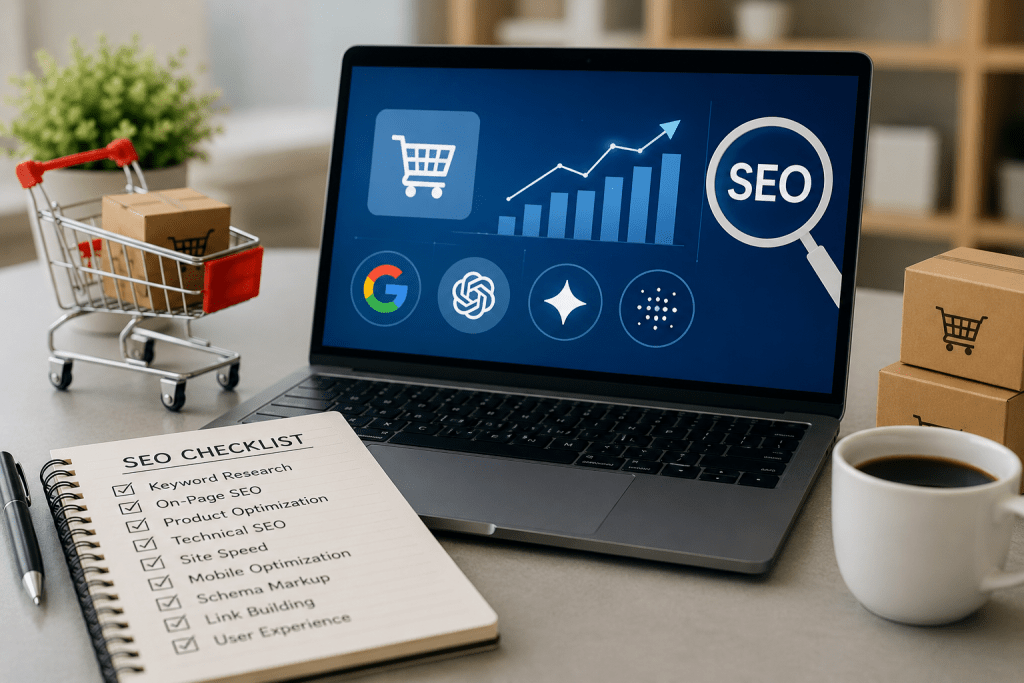

I am going to be blunt for a second.
If your ecommerce store is not visible on Google today, and it is invisible inside AI tools like ChatGPT and Perplexity, you are leaving serious money on the table.
In 2026, search is not just a list of blue links anymore.
Your products are being judged by algorithms, knowledge graphs, entities, user intent, and now conversational AI. If your ecommerce SEO checklist still looks like a 2018 to-do list, your competitors are already passing you.
Let me walk you through what actually matters now, with a practical ecommerce SEO checklist you can act on today. I will connect this to how Google, ChatGPT, Gemini, Claude, and Perplexity interpret your brand so you can win more visibility, more clicks, and more sales.
Ecommerce SEO Overview: What Changed For 2026
You are probably asking one of these questions right now:
- How do I rank my ecommerce website in 2026?
- Why is my ecommerce site not ranking even after blogs and backlinks?
- How does AI search affect SEO for online stores?
Short answer.
Google is smarter, and AI search tools are even pickier.
They do not only crawl web pages. They build a story about your brand. They connect:
- Your products
- Your categories
- Your brand entity
- Your reviews and mentions
- Your technical health
- Your content quality
- And how people interact with you across the web
If anything in that chain is weak, your rankings wobble.
That is why a modern ecommerce SEO checklist must cover more than keywords and meta tags. It has to align your store with how search engines and AI models understand entities, context, and user intent.
Technical SEO Checklist For Ecommerce In 2026

If technical SEO is broken, everything else is wasted effort.
Think of it like this. You can have the best products and the best content, but if your site loads like a sleepy turtle on slow WiFi, Google is not going to trust you with top rankings.
Here is a practical technical SEO checklist tailored to ecommerce.
1. Core technical basics
HTTPS everywhere
No excuses. Mixed content issues still ruin trust and can cause indexing problems.
Mobile first experience
More than half of ecommerce sessions start on mobile. Use responsive design, readable font sizes, and tap friendly buttons. Test real flows. Add to cart. Checkout. Filter. Make sure nothing breaks.
Fast page speed
Aim for under 2 seconds on key templates. Home, category, product, cart.
Compress images, enable caching, lazy load media, and avoid heavy unnecessary scripts.
Crawlable structure
Your navigation, categories, and subcategories should be visible, logical, and crawlable without JavaScript tricks that hide everything from bots.
2. Indexing and duplicate content control
Ecommerce sites are notorious for duplicate content and crawl bloat.
Check:
- Only one version of your site is indexable
For example, prefer [example.com](https://www.example.com) and redirect all others to it.
- Canonical tags on product variants
Color, size, material variants often cause duplicate URLs. Use canonical tags to point to the main version while still letting users filter and choose options.
- Noindex where needed
Internal search pages, paginated filter combinations, and junk parameter URLs that generate thin or messy pages should be blocked or noindexed.
- XML sitemaps
Maintain clean, updated sitemaps for products, categories, and CMS pages. Submit them in Google Search Console and keep them free of 404s.
3. Structured URL and folder logic
Messy URLs confuse both users and algorithms.
Prefer:
- Category level URLs like /mens-shoes/
- Product URLs like /mens-shoes/nike-air-zoom-pegasus-40/
- Avoid long query strings as your primary product URLs
This pairs perfectly with on-page SEO and improves click through rates from both Google and AI generated answer boxes.
Category SEO: Where Most Ecommerce SEO Wins Hide
If your categories are weak, your whole ecommerce SEO strategy suffers.
Categories are where broad commercial intent lives. People type queries like:
- running shoes for flat feet
- vegan skincare kits
- ergonomic office chairs under 300
Those are category level searches.
What a high performing category page needs
Use this mini ecommerce SEO checklist for categories:
Search focused title and H1
Example:
H1: Mens Running Shoes
Title: Mens Running Shoes | Lightweight & Cushioned Styles For Every Run
Smart intro content
Write 150 to 300 words at the top that explains what the user can find here, who this category is best for, and what makes your selection different. Not fluff. Real guidance.
Filters like brand, price, size, color, material are great for UX, but you should decide which filtered combinations deserve dedicated SEO attention, such as:
- /mens-running-shoes/for-flat-feet/
- /office-chairs/ergonomic/
Internal linking to key subcollections
Use text links and small content blocks pointing to subcategories or guides like:
- Best Running Shoes For Beginners
- Waterproof Running Shoes Collection
Unique content, not manufacturer copy
Even on category pages, avoid copy paste descriptions. Talk to your ideal customer. Help them choose. That is what Google rewards now.
Product SEO: Turning Product Pages Into Conversion Engines

If you only optimize titles and meta descriptions on products, you miss half the value.
Product pages should rank, persuade, and reassure.
Here is a product specific ecommerce SEO checklist for 2026.
1. Product titles and meta data
- Include the main keyword plus key attributes buyers use
Brand, model, type, main feature, sometimes size or material.
- Keep titles readable, not keyword stuffed
Example:
Bad: Cheap Running Shoes Running Sneakers Men Buy Online
Better: Mens Lightweight Running Shoes Nike Air Zoom Pegasus 40
- Meta descriptions that sell the click
Highlight value, USPs, shipping, or returns. Use benefit driven language.
2. Unique descriptions driven by buyer questions
Write descriptions as if you are selling in person.
Cover:
- Who this product is for
- What problem it solves
- Key specs in a scannable list
- Usage tips or care instructions
- Answers to common objections about size, quality, durability, or compatibility
AI search engines use this context to match your product to longer, conversational queries like:
- Best running shoes for daily 5k runs
- Laptop backpack for 16 inch MacBook that is waterproof
If your content reads like a generic manufacturer sheet, AI may skip you.
3. Visual SEO and assets
- Optimized images with descriptive file names and alt text
- Add multiple angles, zoom, lifestyle photos, maybe even short videos
- Use WebP or modern formats to keep pages fast
Search engines consider engagement. Better visuals usually mean more time on page and better conversion signals.
4. Trust elements on product pages
- Clear review section
- Stock status
- Shipping and returns info near the CTA
- Badges such as secure checkout or guarantees
These are not just UX items. They are ranking factors indirectly, because they influence user behavior and confidence, which feeds back into the algorithms.
Internal Linking: The Silent Powerhouse Of Ecommerce SEO

Internal linking is where many ecommerce sites either shine or fall flat.
Think of internal links as votes of importance inside your own store. You are telling Google which pages are more critical for your ecommerce SEO strategy.
Key internal linking moves
- From blog posts to categories and products
For example, a guide about how to choose running shoes should naturally link to the Mens Running Shoes category and to top performing products.
- From categories to buying guides and FAQs
This signals topical authority and helps AI search tools understand your coverage on that subject.
- From related products to each other
Cross linking creates a stronger semantic cluster in the eyes of search engines.
Also, this is a perfect place to gently connect to service level content like Ecommerce SEO Services if your site offers those. Link contextually from a blog or resource page about SEO, not slapped into a random paragraph.
Schema Markup: Speaking Directly To Search Engines
Schema markup is like giving search engines a structured script about your content.
For ecommerce, you should prioritize:
- Product schema
Price, availability, rating, brand, SKU, and more.
- Breadcrumb schema
Helps search engines understand your site hierarchy.
- Organization schema
Strengthens your brand entity.
- FAQ schema where appropriate
Especially on FAQ sections related to categories or products.
Proper schema improves your visibility in rich results and gives AI systems cleaner data when they generate product comparisons or answer style outputs.
Entity SEO: Becoming “A Known Brand” In Your Space
Entity SEO is not a buzzword. For ecommerce, it is becoming critical.
Search engines and AI models are asking:
- Who is this brand?
- What niche are they truly about?
- Are they recognized or cited by others?
- Do users trust them?
To build stronger entities:
- Keep your brand name, address, and contact details consistent across your site and external listings.
- Build relevant mentions on industry blogs, marketplaces, and review platforms.
- Publish expert content with bylines and real humans behind them.
- Align your About, Contact, policy pages, and brand story.
Stronger entity signals often mean better resilience against algorithm updates and more chances of being recommended in AI tools that surface “brands you can trust.”
GEO Optimization: Ranking For Local Or Market Specific Searches
If you sell in specific regions or countries, your ecommerce SEO checklist must include GEO SEO.
You might see queries like:
- running shoes store in Austin
- buy office chairs online in California
- Indian ethnic wear shipping to USA
For GEO optimization:
- Create location focused landing pages if you ship or serve specific cities or regions.
- Add local signals like NAP (name, address, phone) where applicable.
- Use hreflang tags if you operate in multiple languages or regions.
- Optimize Google Business Profile if you have physical locations.
If you offer location centric solutions or support, that is where content around GEO Services can fit naturally, as part of a broader strategy to target specific markets with localized SEO.
AI Search Optimization: Ranking In ChatGPT, Gemini, Claude & Perplexity

This is the part many ecommerce businesses are still ignoring.
People now ask AI:
- What are the best online stores for budget furniture
- Which site sells original Nike shoes with fast delivery
- Where can I buy cruelty free skincare online in USA
If you want those tools to recommend you, you need to treat them as discovery engines, not some side project.
How AI search affects your ecommerce SEO
AI tools use:
- Public web content
- Structured data like schema
- Brand mentions and reviews
- Topical authority
- Consistency of information
To improve your chances:
Create helpful, expert content clusters
Do not just write thin product descriptions. Publish buying guides, comparisons, maintenance tips, FAQs, and real advice that solves buyer problems.
Use natural language in your content
Write the way people ask questions. Include long tail queries and answers in headings and FAQ sections. That helps both Google and AI models align your site with those intents.
Strengthen your brand entity
The stronger your brand footprint, the more likely AI tools will “know” you and pull you in as a recommendation when users ask for stores in your niche.
Maintain consistent data feeds
If you use product feeds to marketplaces or advertising platforms, keep product names, prices, and availability consistent with your site. Conflicting data weakens trust.
AI SEO optimization is not a separate channel. It is the evolution of SEO itself.
Ecommerce SEO Checklist 2026: A Practical Summary
Here is a condensed ecommerce SEO checklist you can use as a quick reference.
Technical SEO checklist
- HTTPS, secure and stable
- Mobile first, tested on real devices
- Fast loading core templates
- Clean site architecture and breadcrumbs
- Indexation under control with proper canonicals
- XML sitemaps updated and error free
Category SEO checklist
- Clear, search aligned titles and H1s
- Helpful intro and supporting content
- Logical filtering and subcategory structure
- Internal links to guides and key collections
- Unique content that guides real buyers
Product SEO checklist
- Descriptive, non spammy product titles
- Benefit driven meta descriptions
- Unique, buyer focused descriptions
- Optimized images and media
- Reviews, trust badges, and clear policies
Internal linking checklist
- Blog to categories and products
- Categories to guides and FAQs
- Strategic cross linking between related products
- Use of contextual anchors, not generic “click here” links
Schema and entity SEO checklist
- Product, organization, and breadcrumb schema in place
- FAQ schema where relevant
- Consistent brand identity across site and web
- Strong About, Contact, and policy pages
GEO and AI search checklist
- Local or regional landing pages where needed
- Proper hreflang for multi region sites
- Natural language content that answers real questions
- Topical clusters that demonstrate true expertise
Use this as your baseline and adapt it to your specific platform and market.
FAQs
What is ecommerce SEO?
Ecommerce SEO is the process of optimizing your online store so your products, categories, and content appear prominently in search results and relevant AI answers when people are ready to buy. It combines technical SEO, on-page SEO, content strategy, UX, and conversion tactics specific to online retail.
How long does SEO take for an ecommerce store?
There is no single timeline, but you can expect to see early signs of improvement within 3 to 4 months if you are consistent and strategic. Competitive categories, weak technical foundations, or brand new domains usually take longer. The compounding gains typically show between months 6 and 12, especially when you keep refining your ecommerce SEO checklist rather than treating SEO as a one time project.
Is technical SEO important for ecommerce?
Yes. Without solid technical SEO, search engines struggle to crawl, index, and trust your store. That affects everything else. Even the best content and backlink profile will underperform if your site is slow, inaccessible on mobile, or filled with duplicate and parameter heavy URLs.
Do product pages need SEO?
Absolutely. Product pages are your primary money pages. Optimizing them with the right keywords, structured data, compelling content, visuals, and trust elements can dramatically improve both rankings and conversion rates. Treat each important product as a landing page, not just a SKU in a catalog.
Ready For The Next Step? Request Ecommerce SEO Audit
If you have read this far, you are clearly serious about growing your store and not just chasing quick hacks.
Here is my honest take.
Most ecommerce brands do not fail because they do nothing. They fail because they do a bit of everything without a clear, prioritized ecommerce SEO checklist that reflects how search and AI work in 2026.
If you want a concrete roadmap, tailored to your store, your platform, and your market, the smartest next move is simple.
Request Ecommerce SEO Audit.
Get a detailed breakdown of:
- What is blocking your rankings today
- Where your biggest quick wins are
- How to align your site with modern SEO ranking factors for ecommerce
- How to position your brand to be discovered in Google, ChatGPT, Gemini, Claude, and Perplexity
From there, you can either execute in house with clarity or get Webiators expert support where it matters most. Either way, you stop guessing and start compounding results.
