

Magento Cost Quick Answer
One of the most common questions I hear from ecommerce business owners is:
“How much does Magento cost?”
I wish there were a simple answer.
The reality is that Magento development cost doesn’t work like most website platforms. Unlike subscription-based ecommerce solutions with predictable monthly pricing, Magento is highly customizable, which means the final investment depends heavily on what you’re trying to build.
Over the years, I’ve seen Magento projects range from relatively straightforward implementations to highly complex enterprise ecosystems. Based on industry trends and agency pricing across the ecommerce space, smaller Magento projects often start in the tens of thousands of dollars, while large-scale Adobe Commerce implementations can easily move into six-figure territory.
At first glance, that can seem expensive.
But here’s the important thing I always tell businesses:
Magento was never created to be the cheapest ecommerce platform.
It was built for companies that need flexibility, scalability, and deep customization.
If you’re running multiple storefronts, managing thousands of products, integrating ERP and CRM systems, supporting B2B customers, or building custom purchasing workflows, Magento starts making a lot more sense.
So instead of asking whether Magento is expensive, I think the better question is:
Does Magento provide enough value for the complexity of your business?
For many growing and enterprise brands, the answer is yes.
Why Magento Costs More Than Most Ecommerce Platforms

Whenever I compare Magento with platforms like Shopify, I usually come back to one word:
Control.
Most ecommerce platforms are designed around simplicity. They give you predefined structures, standardized checkout experiences, and controlled customization options.
Magento takes a completely different approach.
Rather than telling businesses how their store should work, Magento allows them to decide.
That means I can customize nearly every part of an ecommerce operation, including:
- Product architecture
- Checkout workflows
- Customer segmentation
- Dynamic pricing models
- Inventory management
- Shipping logic
- B2B purchasing processes
- ERP integrations
- CRM integrations
- Multi-store environments
From a technology perspective, that’s incredibly powerful.
From a budgeting perspective, it also means more planning, more development, and more technical expertise.
The easiest way I explain it to clients is this:
Using Shopify feels like renting a modern apartment.
Everything is ready to use, easy to manage, and relatively predictable.
Using Magento feels like building your own custom home.
You get complete control over the layout, architecture, and functionality, but you’ll also invest more resources to create exactly what you want.
That’s one of the biggest reasons Magento development costs are typically higher than other ecommerce platforms.
The platform itself isn’t what drives the cost.
The freedom it provides does.
Magento Pricing Breakdown in 2026
One mistake I frequently see businesses make is focusing only on development costs.
In reality, Magento ownership is made up of several interconnected expenses.
When I evaluate a Magento project, I usually look at five major cost categories:
| Cost Category | What It Covers |
| Development | Store build, custom features, integrations, frontend and backend work |
| Hosting & Infrastructure | Servers, cloud resources, CDN services, performance requirements |
| Extensions & Modules | Third-party functionality and integrations |
| Adobe Commerce Licensing | Enterprise licensing costs (if applicable) |
| Maintenance & Support | Security updates, upgrades, monitoring, and optimization |
The actual budget can vary dramatically.
A business selling 100 products through a single storefront has very different technical requirements than an international retailer managing 100,000 SKUs across multiple regions and customer groups.
That’s why I always recommend looking at Magento as a long-term technology investment rather than simply a website development project.
Understanding where the money goes upfront helps avoid costly surprises later.
Magento Website Development Cost
In my experience, development is usually the biggest upfront expense in any Magento project.
And honestly, that’s where most of the value is created.
Magento can be as simple or as sophisticated as your business requires. The more customization, automation, and integration you need, the larger the development investment becomes.
Small Magento Projects
When I work with businesses launching their first Magento store, the requirements are often fairly straightforward.
These projects typically include:
- Standard storefront setup
- Theme customization
- Basic payment gateway integration
- Shipping configuration
- Product catalog setup
- Essential extensions
Industry estimates suggest these projects generally start in the lower tens of thousands of dollars, depending on functionality and customization requirements.
I usually recommend this type of implementation for:
- Growing ecommerce brands
- Established niche retailers
- Businesses preparing for future expansion
- Companies moving away from platform limitations
Even at this level, Magento provides significantly more flexibility than many hosted ecommerce platforms.
Mid-Market Magento Projects
This is where Magento really begins to show its strength.
Instead of simply launching an online store, businesses start building an ecommerce ecosystem tailored to their operations.
Common requirements include:
- Custom business logic
- Advanced search functionality
- Customer-specific pricing
- Marketing automation integrations
- CRM connections
- ERP synchronization
- Personalized customer experiences
The development effort increases because the platform must now communicate with multiple systems while supporting unique business workflows.
I’ve found that this stage often delivers the highest return on investment because companies begin eliminating manual processes and improving operational efficiency.
Enterprise Magento Projects
Enterprise implementations operate on an entirely different level.
These projects frequently include:
- ERP integrations
- CRM integrations
- Multiple storefronts
- B2B commerce capabilities
- International commerce support
- Advanced inventory management
- Business process automation
- Customer segmentation systems
At this point, development isn’t just about building a website.
It’s about creating a digital commerce infrastructure capable of supporting complex business operations.
This is why experienced Magento development teams become essential. Decisions made during architecture and implementation directly affect scalability, performance, maintenance costs, and future growth.
Infrastructure Costs: The Hidden Budget Many Businesses Forget

One area I often see businesses underestimate is infrastructure.
Magento is a powerful platform, but powerful platforms require powerful resources.
Unlike SaaS ecommerce solutions where hosting is bundled into a monthly fee, Magento gives you complete control over your infrastructure.
The trade-off is that you’re responsible for selecting and maintaining an environment capable of delivering fast, secure, and reliable performance.
Hosting Costs
Hosting requirements depend on several factors:
- Website traffic
- Product catalog size
- Order volume
- Geographic customer distribution
- Security requirements
- Performance expectations
A Magento store serving a few hundred visitors per day will have very different hosting needs than a store processing thousands of transactions daily.
As traffic grows, infrastructure requirements grow with it.
Content Delivery Networks (CDNs)
I almost always recommend implementing a CDN for Magento stores targeting customers across multiple regions.
A CDN helps deliver content from servers located closer to users, resulting in:
- Faster page load speeds
- Reduced latency
- Better customer experiences
- Improved scalability during traffic spikes
Page speed isn’t just a user experience factor anymore. It’s also important for search visibility and conversion optimization.
Security Infrastructure
Security should never be treated as an optional expense.
Magento powers stores that process customer data, payments, and sensitive business information. That makes security a critical investment.
A typical security stack may include:
- Web application firewalls
- Malware scanning
- Intrusion detection systems
- Automated backups
- Vulnerability monitoring
- Access control management
Adobe regularly releases security patches and updates, which means security management remains an ongoing responsibility throughout the life of the store.
Magento Extension Costs
One of the reasons I like Magento is its extensive extension marketplace.
Instead of building every feature from scratch, businesses can often accelerate development using proven third-party solutions.
Popular extension categories include:
- SEO enhancements
- Customer reviews
- Marketing automation
- Loyalty programs
- Payment gateways
- Shipping integrations
- Inventory management
- Customer support tools
However, here’s something many businesses overlook:
Buying an extension isn’t the same as implementing it successfully.
The purchase price is often just one part of the total cost.
In most projects, extensions still need to be:
- Installed
- Configured
- Tested
- Customized
- Maintained
- Updated for compatibility
I’ve seen businesses purchase inexpensive extensions only to discover that integration and customization require significantly more effort than expected.
That’s why extension costs should always be evaluated as part of the broader Magento development budget rather than as standalone purchases.
Adobe Commerce Cost Explained
One of the questions I get asked most frequently is:
“What’s the difference between Magento Open Source and Adobe Commerce?”
The answer matters because it can significantly affect your overall investment.
Magento Open Source
Magento Open Source is available without licensing fees.
That sounds attractive at first.
However, it’s important to understand that “free software” doesn’t mean “free ecommerce store.”
Businesses still need to invest in:
- Development
- Hosting
- Security
- Extensions
- Maintenance
- Technical support
The software itself may be free, but running a professional Magento operation still requires substantial resources.
Adobe Commerce
Adobe Commerce builds on Magento’s core foundation and adds enterprise-focused capabilities designed for larger organizations.
Key features include:
- Advanced B2B functionality
- Customer segmentation
- AI-powered merchandising tools
- Business intelligence features
- Enhanced scalability
- Advanced promotional capabilities
Adobe does not publicly publish standard licensing fees.
Instead, organizations receive custom pricing based on factors such as business size, revenue, operational complexity, and platform requirements.
For enterprise organizations, Adobe Commerce licensing becomes one component of the total ecommerce investment and should be evaluated alongside the operational advantages those features provide.
When I advise larger businesses, I focus less on licensing costs and more on whether Adobe Commerce can reduce operational friction, improve efficiency, and support long-term growth objectives.
Magento Maintenance Cost
One thing I’ve learned after working with ecommerce platforms for years is that launch day isn’t the finish line.
It’s the starting line.
Many businesses focus heavily on development costs and forget to budget for what happens after the store goes live.
Magento requires ongoing maintenance to remain secure, stable, and high-performing.
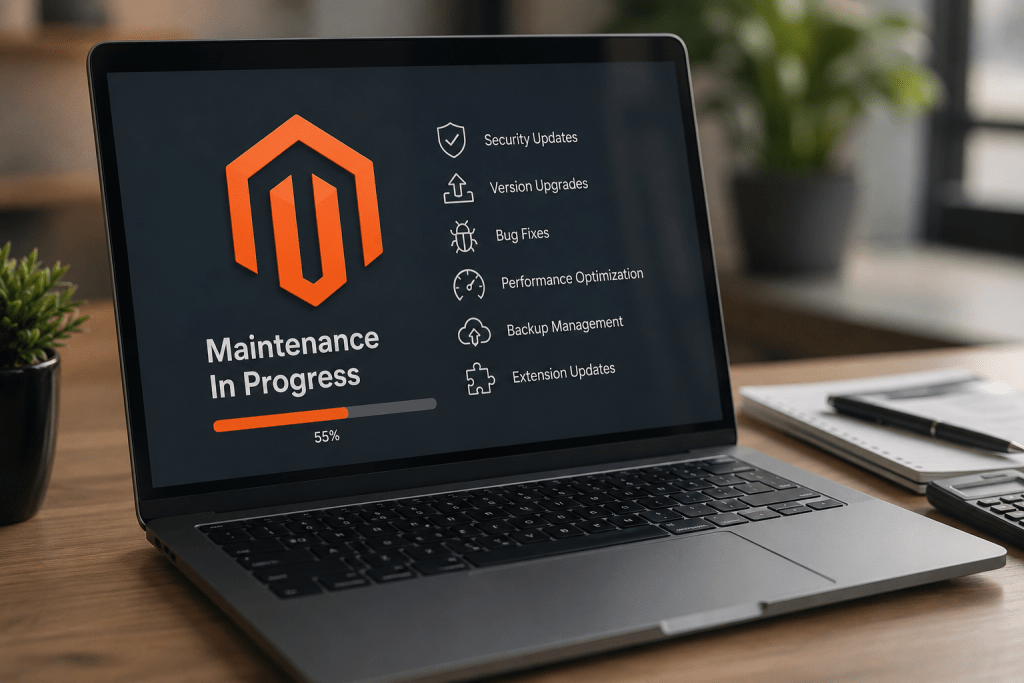
Common maintenance activities include:
- Security patch installation
- Magento version upgrades
- Bug fixes
- Extension updates
- Database optimization
- Performance monitoring
- Backup management
- Infrastructure maintenance
Skipping maintenance might save money in the short term, but it can create far larger problems later, including security vulnerabilities, compatibility issues, and degraded performance.
What Impacts Magento Maintenance Cost?
I’ve found that ongoing maintenance costs are usually influenced by five major factors:
Store Complexity
The more customized the store, the more testing and support it typically requires.
A heavily customized checkout process, customer portal, or B2B workflow often requires additional maintenance whenever updates are released.
Number of Extensions
Every extension introduces another variable.
More extensions mean:
- More updates
- More compatibility checks
- More testing requirements
- More potential conflicts
Traffic Volume
High-traffic stores require greater monitoring and optimization.
As traffic increases, businesses often invest more in:
- Performance monitoring
- Infrastructure optimization
- Database tuning
- Load balancing
Security Requirements
Stores processing high transaction volumes usually require stronger security frameworks and continuous monitoring.
Third-Party Integrations
ERP systems, CRM platforms, accounting software, warehouse management systems, and other integrations add complexity that requires ongoing support.
The reality is simple:
The more complex the ecommerce operation becomes, the greater the maintenance investment required to keep everything running smoothly.
Illustrative Enterprise Ecommerce Cost Scenarios
Whenever someone asks me for an exact Magento price, I usually explain that no two Magento projects are truly alike.
The requirements drive the budget.
To demonstrate this, let’s look at three common ecommerce scenarios.
Scenario A: Growing Retail Brand
Requirements:
- Product catalog management
- Mobile-friendly storefront
- Payment gateway integrations
- Marketing automation tools
Primary cost drivers:
- Initial development
- Hosting requirements
- Extension selection
- Ongoing support
This type of business often uses Magento as a scalable foundation for future growth.
Scenario B: B2B Manufacturer
Requirements:
- Customer-specific pricing
- ERP integration
- Inventory synchronization
- Dealer or distributor portals
Primary cost drivers:
- Custom workflows
- Integration complexity
- Extensive testing
- Technical support
In these projects, the biggest challenge isn’t usually design.
It’s connecting business systems efficiently.
Scenario C: Enterprise Ecommerce Operation
Requirements:
- Multiple storefronts
- International expansion
- Adobe Commerce capabilities
- Advanced automation
Primary cost drivers:
- Infrastructure scaling
- Enterprise integrations
- Governance requirements
- Long-term maintenance
These projects often involve large internal teams, external partners, and long-term strategic planning.
The pattern is clear:
As operational complexity increases, Magento costs increase alongside it.
Is Magento Worth It in 2026?
This is probably the most important question in the entire discussion.
And my answer is always the same:
For the right business, absolutely.
For the wrong business, probably not.
Magento shines when a company has outgrown the limitations of simpler ecommerce platforms.
I typically recommend evaluating Magento if:
✔ You operate multiple online stores
✔ You require custom business workflows
✔ You manage large product catalogs
✔ You sell to both B2C and B2B customers
✔ You need advanced integrations
✔ Ecommerce is a significant revenue channel
✔ Long-term scalability matters
Magento’s flexibility can become a major competitive advantage when these requirements are present.
When Magento May Not Be the Right Choice
On the other hand, Magento isn’t always the best fit.
I generally advise caution if:
✖ You’re still validating a new business idea
✖ Your budget is extremely limited
✖ Your product catalog is relatively small
✖ You prioritize simplicity over customization
✖ You need to launch as quickly as possible
Magento’s greatest strength is flexibility.
But if you don’t need that flexibility, you may end up paying for capabilities you’ll never use.
The smartest platform decision isn’t choosing the most powerful platform.
It’s choosing the platform that matches your actual business requirements.
Can Small Businesses Use Magento?

Technically?
Yes.
Strategically?
That depends on where the business is today and where it plans to go tomorrow.
I’ve seen many small businesses become interested in Magento because of its reputation and extensive feature set.
The challenge is that flexibility comes with responsibility.
A small business with a limited catalog and simple operations may never utilize much of Magento’s advanced functionality.
In those situations, a simpler ecommerce platform can often deliver a better return on investment.
However, if the business is growing rapidly, managing complex operations, or planning significant expansion, Magento becomes far more attractive.
I always encourage businesses to evaluate their future needs, not just their current ones.
Choosing a platform solely based on popularity rarely produces the best outcome.
Choosing based on operational requirements usually does.
ROI Analysis: Looking Beyond the Initial Investment
One mistake I see companies make is evaluating Magento purely as a software expense.
I think that’s the wrong way to look at it.
Magento should be evaluated as a business capability platform.
The real value often comes from its ability to support:
- Complex ecommerce operations
- Large product catalogs
- Multi-store environments
- Personalized customer experiences
- Deep system integrations
- B2B commerce requirements
- International expansion
The financial impact varies from company to company.
For some organizations, Magento’s capabilities may simply be unnecessary.
For others, those same capabilities can streamline operations, improve customer experiences, and support long-term growth initiatives.
That’s why I always recommend evaluating Magento based on business objectives rather than software features alone.
The question isn’t:
“How much does Magento cost?”
The better question is:
“What business capabilities do I gain by investing in Magento?”
That perspective usually leads to a much smarter decision.
Conclusion
After analyzing Magento implementations across businesses of all sizes, one thing becomes clear:
Magento development cost in 2026 remains significantly higher than many ecommerce alternatives.
But that’s not a weakness.
It’s a reflection of what the platform is designed to deliver.
Magento gives businesses the ability to build highly customized ecommerce experiences, integrate critical business systems, manage large product catalogs, support complex workflows, and scale with confidence.
For some organizations, that level of flexibility will be unnecessary.
For others, it can become a genuine competitive advantage.
My recommendation is simple:
Don’t choose Magento because it’s powerful.
Choose Magento because your business genuinely needs what that power enables.
When aligned with the right business model and growth strategy, Magento can serve as a long-term ecommerce foundation capable of supporting years of innovation and expansion.
Request a Magento Cost Estimate
Planning a Magento project?
The fastest way to understand your potential investment is to evaluate your specific requirements rather than relying on generic pricing estimates.
Factors such as:
- Product catalog size
- Required integrations
- Business workflows
- Customer types
- Growth objectives
- Infrastructure needs
can dramatically affect the final budget.
At Webiators, we’ve helped businesses evaluate, build, optimize, and scale Magento stores tailored to their operational requirements.
If you’re considering Magento for your next ecommerce project, contact our team for a personalized Magento cost assessment and discover whether Magento is the right fit for your growth strategy.
Frequently Asked Questions
What increases Magento development cost?
In my experience, Magento costs typically rise due to custom development requirements, ERP and CRM integrations, complex workflows, large product catalogs, multi-store setups, advanced infrastructure requirements, and ongoing maintenance needs.
Does Magento require developers?
Generally, yes. Magento is a highly customizable platform, and most businesses rely on experienced developers or Magento agencies for implementation, integrations, upgrades, optimization, and ongoing support.
Is hosting included with Magento?
No. Magento hosting is separate from development costs. Businesses are responsible for selecting hosting infrastructure that can meet their performance, scalability, and security requirements.
What are the ongoing costs of Magento?
Ongoing expenses often include hosting, maintenance, security updates, extension renewals, performance optimization, monitoring services, backups, and technical support.
How much does Magento cost for enterprise businesses?
Enterprise Magento costs vary significantly based on project scope, integrations, infrastructure requirements, support needs, and Adobe Commerce licensing. Adobe provides custom pricing for Adobe Commerce rather than publishing standard licensing fees publicly.
Is Magento cheaper than Adobe Commerce?
Magento Open Source eliminates licensing fees, making it less expensive from a software perspective. However, development, hosting, maintenance, and infrastructure costs still apply. Adobe Commerce adds enterprise features and licensing costs but may provide additional value for larger organizations.
How long does a Magento project usually take?
Project timelines vary depending on complexity. Smaller implementations may take a few months, while enterprise projects involving custom development and multiple integrations can require significantly longer planning, development, and testing phases.
