

There’s a moment in almost every Direct-to-Consumer brand’s journey when things stop going upward. You hit $3–5M in annual recurring revenue (ARR), your CAC starts creeping up, and suddenly your tech feels… fragile. Not slow, not quirky — just broken. You’re not alone. This is where a lot of promising D2C brands get stuck, and the culprit isn’t marketing or products alone — it’s the D2C tech stack under the hood.
Before we dive deeper, here’s a sobering statistic you can reference in your content:
According to the 2nd Annual D2C Trends Report, nearly half of brands struggle with data insights, high customer acquisition costs, and lack strategic tech focus — all roadblocks to scaling D2C operations.
When Good Tech Stops Being Good Enough
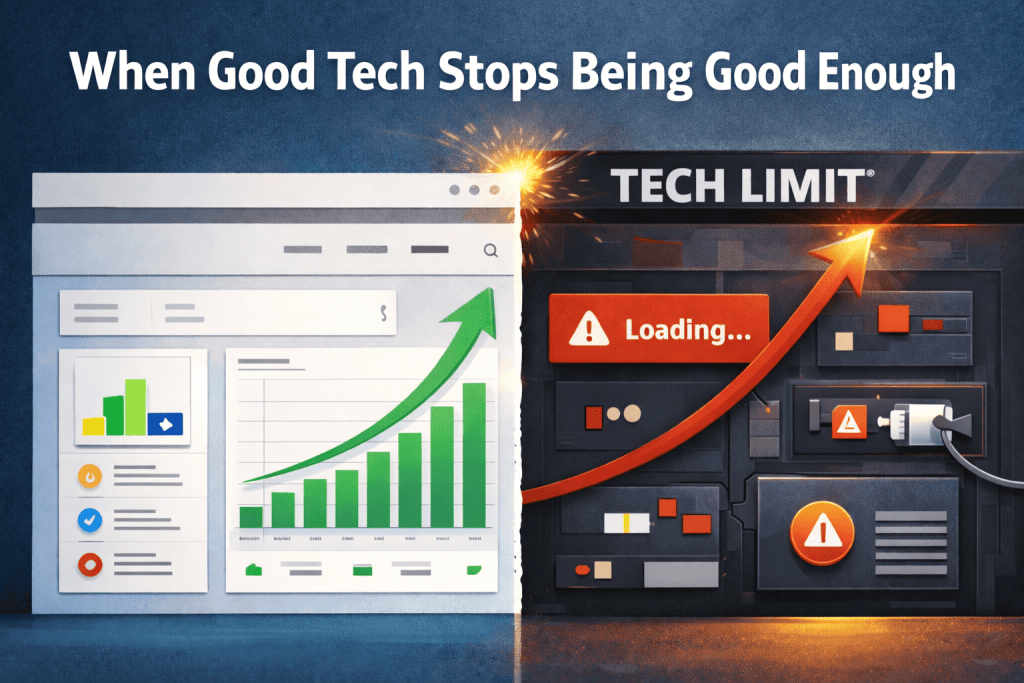
You launched with a simple Shopify or WooCommerce setup, maybe some plug-ins for inventory and marketing automation. At first, growth is exhilarating. But around the $3–5M ARR mark, two things kick in:
1. Traffic and orders grow faster than your backend logic can handle it. Suddenly promotions break checkout paths, inventory updates lag, and real-time customer data is nowhere to be seen.
2. Data silos emerge. Marketing sees numbers. Operations sees another set. Support is in a different spreadsheet altogether — this is where your smooth “D2C tech” turns into tangled spaghetti.
Sounds familiar?
That’s because most early tech stacks are built for marketing scale, not long-term operational stability.
Root Causes of D2C Tech Stack Failures
Understanding why tech stacks fail at this stage is the first step to fixing them. Here are the most common breakdown points.
Tech Investments That Don’t Stretch Far Enough
Many D2C brands pour budget into paid ads without parallel investment in reliable infrastructure. As customer acquisition costs rise, the backend struggles to keep up with demand — loading slowly or failing entirely under load.
Fragmented Tools That Don’t Talk to Each Other
Separate systems for CRM, order management, inventory, and analytics might be easy to plug in at the start — but they won’t scale together. If you can’t see real-time insight across customer journeys, you’re flying blind.
Tech Isn’t Aligned With Customer Life Cycles
Here’s the subtle part: D2C isn’t just about selling once. It’s about repeat purchase, driven by personalized experiences. Most traditional stacks were never built for that — they handle transactions well, not relationship building.
Designing a D2C Tech Stack That Actually Scales
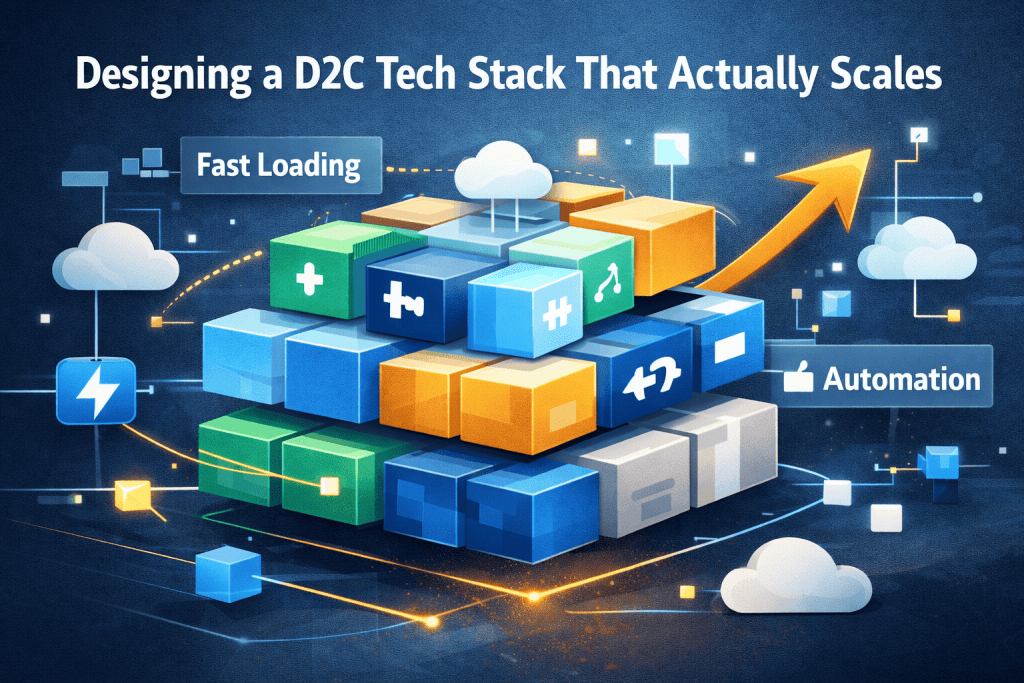
So what makes a tech stack that survives and thrives beyond that $5M ARR barrier? It’s not magic. It’s architecture and strategy — thoughtfully chosen tools working together, not in isolation.
1. Structural Foundations: Composable & Headless Architecture
Traditional monolithic platforms can’t keep up as you expand channels, personalize experiences, or experiment with new touch points. A composable commerce architecture allows you to build only what you need — and swap pieces out as you grow.
This approach brings speed without fragility — meaning your checkout can scale even when your marketing spikes traffic overnight.
Core takeaway: Design your stack around component flexibility and API-first integration instead of a rigid “all-in-one” platform.
2. Unify Customer Data With a Single Source of Truth
Nothing exposes weakness faster than siloed customer data. When your CRM, order system, support queue, and analytics platform don’t sync, you lose insight into:
- Repeat purchase patterns
- Return reasons
- Segmented lifetime value
- Predictive churn signals
This isn’t just internal housekeeping — it’s the pulse of your brand.
Pro tip: Use a unified customer data platform (CDP) that serves all departments in real time.
3. Plan for Operational Velocity, Not Just Traffic
Scalability isn’t only about how many visitors you can handle — it’s about how quickly your business can:
- Update inventory across channels
- Respond to returns and refunds
- Sync fulfillment partners
- Personalize experiences without developer bottlenecks
If your current stack requires developer intervention for day-to-day operations, you’re behind the curve.
What Happens When You Don’t Fix It?

Here’s what typically unfolds:
- Marketing becomes expensive and unpredictable
- Customer experience suffers (slow pages, poor personalization)
- Operations cost increases faster than revenue
- Tech debt accumulates, making future innovation harder
One D2C founder told me once, “We had traffic, we had volume — but we didn’t have stability. Every sale felt like a stress test.” That feeling is all too common — and avoidable.
Webiators’ Role in Building a Scalable Tech Stack
At Webiators, we architect D2C solutions that combine smart tech with flexible infrastructure. Whether you need D2C Ecommerce Services, Ecommerce development services, or Ecommerce Marketing services, we build stacks that grow with you.
We don’t just launch sites; we future-proof them.
Conclusion
If you’re hovering around $3–5M ARR and feeling like something has to give, ask yourself this: Is your tech stack built to scale, or built to catch up?
A scalable D2C tech stack doesn’t just support your business. It propels it — enabling deeper customer connections, smoother operations, and broader growth.
Ready to break past the barrier? Let’s build a D2C tech foundation that lasts.
FAQs
1. Why do most D2C brands struggle at $3–5M ARR?
Ans. Because early tech stacks aren’t designed for data unification, operational scale, and customer lifecycle depth — they were built for initial traction.
2. What is a composable commerce architecture?
Ans. It’s a modular setup that lets brands select best-in-class tools and connect them via APIs, enabling flexibility and faster innovation.
3. How does headless commerce help D2C brands?
Ans. It decouples the frontend from backend logic, which improves performance, personalization, and multi-channel experiences.
4. What’s the biggest tech mistake D2C brands make early on?
Ans. Focusing too much on ads and not enough on operational stability, unified customer data, and scalable infrastructure.
5. Can Webiators help improve my current D2C tech stack?
Ans. Yes — Webiators offers tailored solutions from infrastructure design to full D2C Ecommerce Services and Ecommerce development services, ensuring your technology supports growth.
