
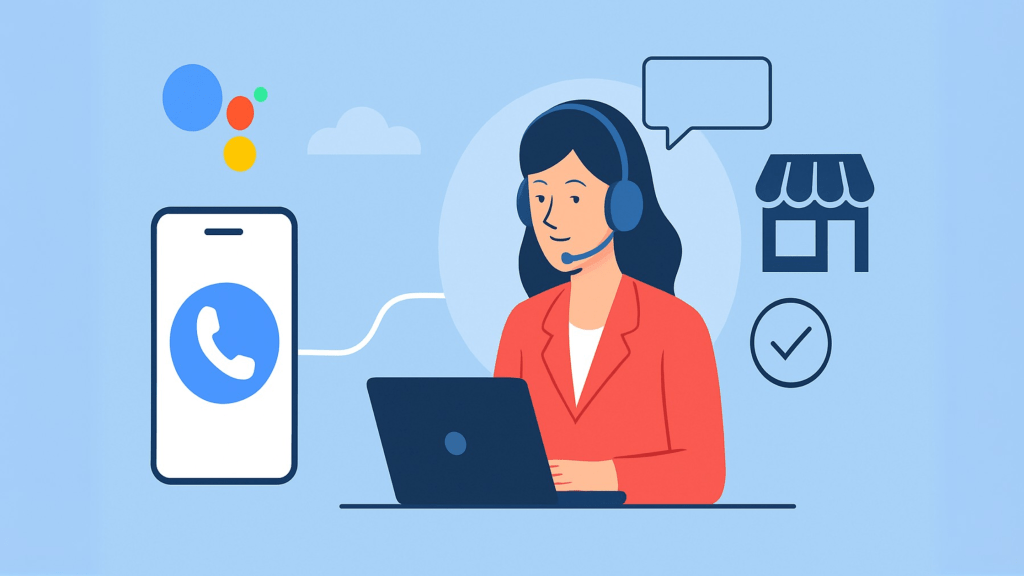

What if your customers never had to pick up the phone to ask about store hours, confirm availability, or book a service? What if Google’s AI did it for them—accurately, politely, and fast?
That’s not a future concept. It’s happening now. With a new feature called Ask for Me, Google is testing a powerful shift in how people interact with businesses. Instead of calling themselves, users can ask AI to make the call, gather the information, and report back—all without leaving the search page.
For online retailers and service-based businesses in the US, this isn’t just cool tech. It’s a new layer of customer service. And it might be the most frictionless one yet.
So, What Is ‘Ask for Me?’
Ask for Me is currently available through Google Search’s AI Mode (via Search Labs in the US). When users look up local businesses—like a salon or a car repair shop—they might see an option that says something like Have AI check pricing or Let AI call the business.
From there, Google’s AI asks a few quick questions about what the user needs. Then, the AI places a call on their behalf, talks to a human, gathers the details, and shares a clean summary—usually within half an hour.
All of this runs on the backbone of Google Duplex, the same technology that first made headlines for making hair appointment calls that sounded eerily human. But now, it’s upgraded with Gemini, Google’s newer AI system that handles more complex reasoning, better conversations, and faster information delivery.
It’s still early, but this kind of automation opens up big opportunities for eCommerce and retail businesses.
Why It Matters for Online Stores
Online stores already spend time and money handling customer inquiries—some simple, some time-consuming. Now, imagine an AI assistant doing the easy ones for you. A customer wants to know if your local store has a product in stock. Google can call and ask. Someone needs to confirm the pickup time? AI takes care of it.
This reduces the number of calls your staff need to handle. It gives customers answers without delay. And it keeps your team focused on higher-priority work.
For service-based retailers—like appliance repair, wellness, grooming, or installations—it could mean a major cut in back-and-forth calls for scheduling or availability checks.
What’s Powering These Calls?
The tech under the hood is deceptively simple on the surface, but there’s a lot happening in the background.
Google uses Duplex to place the actual calls. This isn’t a chatbot—it sounds human, knows when to pause, and handles responses with nuance. It says things like “um” or “let me check” just like a real person. But it’s not pretending to be human. Every call clearly identifies itself as AI, and the business on the other end knows it’s automated.
Gemini 2.5, Google’s latest AI model, does the reasoning and context handling. It understands service categories, knows how to interpret vague questions, and processes multiple calls at once to find the best option. This blend of realism and speed makes it feel seamless for the customer.
And importantly, businesses can opt out if they don’t want to receive these calls. They’re not forced to engage. Google gives them control through Business Profile settings.
Real Use Cases That Actually Help
Let’s say a customer is searching for a local bike repair shop that offers same-day service. Instead of clicking through ten websites or calling one-by-one, they use Ask for Me. Google’s AI calls each shop, asks about availability, and returns with a summary of who’s open, when, and what they charge.
Or maybe someone wants to check if a particular product is available for pickup at a retail store. Instead of calling, they ask Google, and the AI confirms stock status with the nearest locations.
Now extend this to service inquiries—installations, equipment rentals, spa bookings, or anything else that involves scheduling. It cuts out all the delay that often costs you a sale.
For businesses, this means fewer missed opportunities and smoother operations. It also means customers who are more likely to convert, because they got what they needed, fast.
The Benefits Stack Up
Here’s what this means for retailers who lean in early:
- Lower support volume: When Google handles basic calls, your team gets breathing room.
- Better customer experience: People love speed and clarity. They’ll remember if your store made things easy.
- Scalability: During peak seasons, you can’t always afford more staff. AI doesn’t get overwhelmed.
- Modern brand image: Using AI to improve service shows you’re forward-thinking, and customers notice.
Plus, the summaries that customers receive are clean, clear, and helpful. There’s no “he said, she said” miscommunication. Just direct answers they can act on.
What to Keep in Mind
Yes, this tech is impressive, but it’s not perfect. Here’s where businesses need to stay sharp.
- Transparency matters. Let customers know when they’re getting help from an AI. Be clear, not sneaky.
- Accuracy isn’t guaranteed. AI can misunderstand complex instructions or return slightly off info. Always have a human fallback where needed.
- Privacy laws apply. In the US, you can’t record calls or share AI transcripts without permission in certain states. Know the rules before you automate.
- Not all calls are ideal for AI. If your business depends on nuance—like legal advice or complex quotes—you might prefer to keep some calls human-led.
And don’t worry: you’re not forced into this. You can opt out anytime by updating your Google Business Profile.
How Online Stores Can Get Ready
If you want to make the most of this shift, start preparing your store now.
Keep your business details up to date—especially phone numbers and store hours. AI can’t guess.
Make sure your call handlers are trained to recognize and respond to Google’s AI. It’s usually polite and to the point.
Structure your services clearly. If you run a salon, for instance, have consistent menus and appointment types so AI can navigate easily.
Monitor results. Ask customers how their experience was. Look for AI calls in your logs. Adjust where needed.
This isn’t about replacing your team. It’s about making them more effective by outsourcing the busywork to tech that handles it well.
Looking Ahead
What Google is doing now with calls might just be the start. Expect Generative AI to start helping with live chat, email replies, CRM updates, and more. Voice commerce—where people shop entirely through spoken interaction—is closer than it seems.
If your store is already optimized for online sales, this is the next frontier. It’s not about having flashier tech. It’s about making every interaction faster, smarter, and easier for your customer.
Wrapping It Up
Google’s AI isn’t some sci-fi dream anymore. It’s already making phone calls, answering questions, and saving people time.
For online store owners, this is your chance to meet customers where they are—before your competitors do. Whether you’re running one storefront or managing an entire chain, getting ahead of this trend will make your business stand out in a crowded market.
Want to stay ahead? Keep an eye on this tech. Test it, learn from it, and make your customer experience unbeatable—one AI-assisted interaction at a time.
Also, don’t forget to explore our e-commerce website development services by visiting our site at Webiators.
FAQs
Ans: Google’s Ask for Me is an AI-powered tool that can make phone calls to businesses on a user’s behalf. It gathers information like store hours, service availability, and pricing, then summarizes the results within Google Search. It’s currently being tested through Search Labs in the US.
Ans: Google AI can reduce support call volume by handling common customer inquiries such as product availability, appointment scheduling, or pricing. This frees up your team to focus on complex requests and improves response time for customers.
Ans: Yes, businesses can opt out of AI-generated calls through their Google Business Profile settings. Every call identifies itself as AI-driven, and businesses are given the option to decline or block these calls if they prefer.
Ans: Currently, Google’s AI calling feature is being rolled out for select service-based businesses such as auto repair shops, salons, and pet groomers in specific US locations. Wider adoption across industries is expected in the near future.
Ans: To prepare, ensure your Google Business Profile is accurate with updated contact info and business hours. Train your staff to recognize and respond to AI calls, and streamline your service menus so the AI can handle interactions more effectively.
