
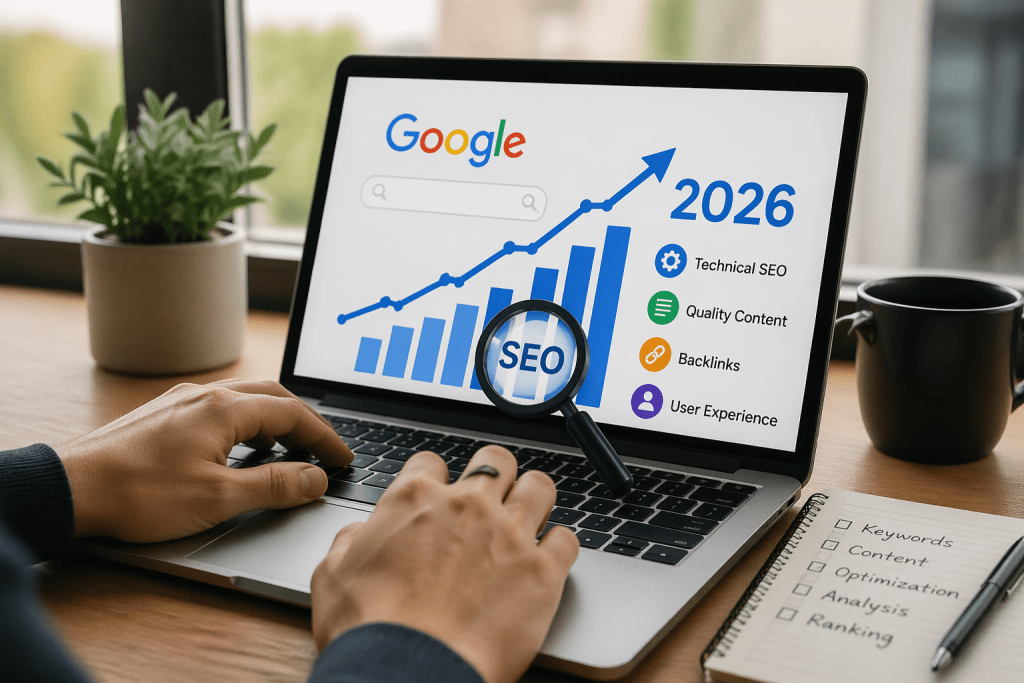

With the full integration of AI Overviews and answer engine optimization shaping search behaviors, securing traditional top organic rankings requires a shift from basic keyword matching to advanced semantic intent optimization. For B2B firms and scaling D2C brands, visibility on Google is no longer just about driving clicks—it is about establishing absolute topical authority. This guide breaks down the advanced technical, on-page, and structural SEO strategies required to dominate Google’s 2026 search landscape. So get ready to climb the search engine result page (SERPs) and understand how to improve a website’s Google ranking.
How Google’s Ranking System Work?
How to improve a website’s Google ranking? To get the answer to this you must know that Google’s algorithms prioritize relevance, authority, and user experience when ranking websites. From matching user intent to assessing technical aspects, Google evaluates over 200 factors to determine where a site appears on the SERP.
Google values updated content that provides accurate information. And we all know that Google’s algorithms are constantly evolving, that’s why staying updated is important. You should always focus on staying updated on new requirements and maintain visibility.
Common Misconceptions
- The Rise of AI Search Engines Has Killed Traditional SEO: While traditional blue-link click-through dynamics have shifted due to Google’s AI-driven layouts, SEO is far from dead; it has evolved into Answer Engine Optimization (AEO). Modern search strategies require optimizing your data structures so AI models can synthesize and reference your website as the primary source for complex, conversational queries..
And let me tell you that this repeats every year and nothing changes. We all know that SEO keeps on evolving, but its importance remains steadfast.
- Keyword Stuffing: Now another misconception you might have heard about is; “Stuffing keywords will make you rank easily”.
But let me tell you that’s not how it works. It’s true that Google values keywords for ranking but it’s not like you should stuff keywords wherever you want.
Balancing and relevancy are the keys to that keyword stuffing.
Google penalizes over-optimization, so balance and relevance are key. Core Strategies to Improve Website Google Ranking.
Core Strategies to Improve Website Google Ranking
The wait is finally over. Here is an answer to your question “How to improve a website’s Google ranking” Let’s look at some core strategies to improve a website’s Google ranking.
1. Optimizing On-Page SEO
Keyword Research and Placement
Effective keyword research is foundational to SEO. Use tools like Ahrefs, SEMrush, or Google Keyword Planner to identify relevant, high-volume, low-competition keywords. Strategically place these keywords in your:
- Title tags
- Headers (H1, H2, etc.)
- URL structure
- Body content (without overstuffing)
Crafting Quality Content
Google prioritizes high-quality content aligned with E-E-A-T (Experience, Expertise, Authoritativeness, Trustworthiness). Ensure your content is:
- Informative and actionable
- Tailored to user intent
- Regularly updated to remain relevant
Meta Tags and Descriptions
Write compelling meta titles and descriptions that:
- Contain target keywords
- Are concise (under 160 characters for descriptions)
- Encourage clicks by highlighting benefits or solutions
Internal Linking
An effective internal linking strategy improves site navigation and helps search engines understand content relationships. Use descriptive anchor text and link to relevant pages within your site.
2. Building a Strong Backlink Profile
The Role of Backlinks in Rankings
Backlinks are among the top-ranking factors. They signal to Google that your site is authoritative and trustworthy.
Quality Over Quantity
Focus on acquiring links from:
- High-authority websites
- Relevant niche-related sources
- Contextually meaningful placements
Strategies for Building Backlinks
- Guest Posting: Collaborate with reputable blogs to publish high-quality content.
- Broken Link Building: Identify broken links on authoritative sites and suggest your content as a replacement.
- Content Marketing: Create shareable assets like infographics or in-depth guides to naturally attract links.
3. Improving Website Speed and Core Web Vitals
Page Speed’s Impact on Rankings
Google considers fast-loading pages crucial for both rankings and user experience. A slow website can increase bounce rates and hurt your ranking.
Core Web Vitals
Google evaluates core user experience through strict technical metrics. To maintain top rankings, your site architecture must meet the following thresholds:
- Largest Contentful Paint (LCP): Measures perceived loading speed. Needs to occur within 2.5 seconds of page initiation.
- Interaction to Next Paint (INP): Officially replacing FID, INP assesses overall site responsiveness by measuring the latency of all user interactions. Aim for a response time under 200 milliseconds.
- Cumulative Layout Shift (CLS): Measures visual stability. Must maintain a score under 0.1 to avoid sudden layout jumps during rendering..
Tools for Speed Optimization
- Google PageSpeed Insights
- NitroPack
- GTmetrix
4. Enhancing Mobile-Friendliness
Every single user consumes most of the content through mobile phones, that’s why mobile optimization matters.
Google’s mobile-first indexing means your site’s mobile version is the primary factor for rankings. A poor mobile experience can negatively affect your visibility.
- Best Practices
- Use responsive web design
- Ensure fast loading speeds on mobile
- Optimize navigation for smaller screens
5. Leveraging Technical SEO
Many people forget that site architecture and URL structure are also important. That’s why you should organize your site into a logical hierarchy and use clean, descriptive URLs.
Crawlability and Indexability
Ensure Google can easily crawl your site by:
- Submitting an XML sitemap
- Using a robots.txt file to guide crawlers
Fixing Common Errors
- Resolve 404 errors
- Implement 301 redirects for outdated pages
- Avoid duplicate content issues
Content Strategies for Better Rankings
Now comes the most important part of SEO. Google values content that provides quality to its audience. Here 3 common strategies that will help you to understand how to improve your website’s Google ranking:
- Creating Evergreen Content
Focus on content that remains relevant over time, such as how-to guides, tutorials, and industry insights. These pieces can drive consistent traffic.
- Multimedia Integration
Engage users with videos, infographics, and images that enhance content value and shareability.
- User Intent Matching
Understand user queries and provide content that meets their informational, navigational, or transactional needs.
Harnessing User Experience for SEO
- Importance of Dwell Time: Engaging users with valuable content keeps them on your site longer, signaling quality to Google.
- Improving Navigation: Simplify navigation with clear menus, breadcrumbs, and CTAs that guide users effectively.
- Using Structured Data: Schema markup helps search engines understand your content, enabling rich results like FAQs or product ratings.
Monitoring and Measuring Progress
SEO Analytics Tools
Use tools like Google Analytics and Search Console to track performance.
Tracking Key Metrics
You should focus on Monitoring:
- Organic traffic
- Click-through rates (CTR)
- Bounce rates
- Keyword rankings
Adapting to Data Insights
Refine your strategies based on analytics. For example, update underperforming content or focus on trending keywords.
Future-Proofing Your SEO Strategy
Staying Ahead of Trends: Anticipate the rise of AI, voice search, and visual search in shaping future SEO practices.
Continuous Learning: Stay updated on Google’s algorithm changes and emerging tools to maintain your competitive edge.
Are You Searching for The Best SEO- Marketing Agency?
Navigating the complexities of algorithm updates, technical code deprecations, and AI search integrations requires more than standard optimization—it demands dedicated engineering and marketing alignment. At Webiators Technologies, we specialize in building fast, scalable, and high-converting architectures for enterprise platforms and scaling D2C brands. Contact our digital strategy team today to schedule an SEO audit and future-proof your search visibility.
Not only in SEO, but we also have team experts helping your brand to excel on social platforms with social media optimization services. You can browse our website and book an appointment today for better services.
Conclusion
It will take a combination of technical strategic planning, and constant adaptability to get the answer to the question “How to improve website Google ranking” in 2026.
And by adopting best practices you can achieve long-term growth in search rankings by improving user experience, developing high-quality backlinks, optimizing on-page SEO, and staying ahead of trends.
Take the first step toward controlling the SERPs by putting these tactics into practice right now. And most importantly always keep in mind that SEO is a marathon, not a sprint, and that long-term success depends on consistency and flexibility.
FAQ’s
Ans: Focus on optimizing on-page SEO, building quality backlinks, improving user experience, and ensuring your site is mobile-friendly.
Ans: High-quality content, backlinks, and a fast, mobile-friendly website.
Ans: Google\u2019s algorithm evaluates relevance, authority, and user experience using over 200 factors.
Ans: No, Google\u2019s organic rankings cannot be bought. Paid ads are separate and do not influence organic search rankings.
Ans: Conduct keyword research, optimize content, improve site speed, and implement a solid backlink strategy.
