
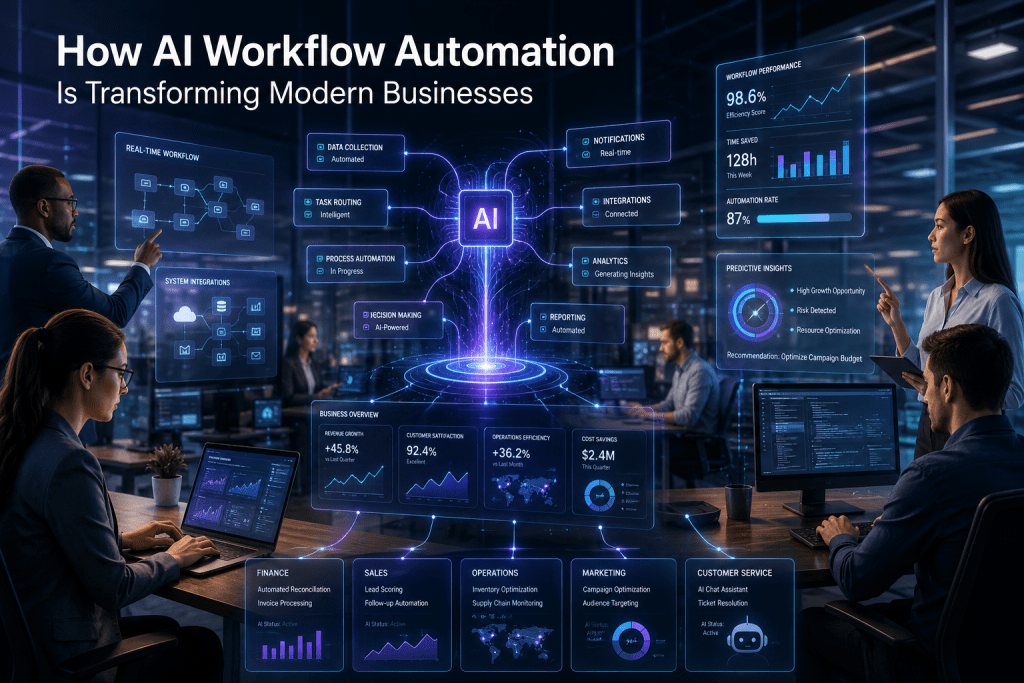

Running a business today often feels like chasing a moving train while trying to rebuild the tracks underneath. Deadlines close in, emails multiply, meetings expand like vines. You blink, and somehow it’s 6 p.m. and your to-do list has only grown longer.
Now imagine this: the chaos slows. Tasks start managing themselves. Processes run smoother than ever. Your team isn’t scrambling—they’re strategizing. That shift? It’s called AI workflow automation, and it’s quietly rewriting how modern businesses work.
So, What Exactly Is AI Workflow Automation?
At its core, AI workflow automation goes beyond traditional, rule-based software. It integrates Large Language Models (LLMs) and machine learning directly into your business logic, allowing software to analyze context, make decisions, and execute multi-step processes dynamically. It isn’t just about pressing ‘auto’ on a static script; it’s about deploying intelligent systems that adapt and self-correct as new data flows into your enterprise tech stack.
Picture this: you run an eCommerce store. Each day, hundreds of customer queries pour in. Instead of manually sorting and replying, AI filters messages, prioritizes urgent issues, and even drafts responses. By the time you sip your first coffee, half the work’s already done.
That’s not cold automation—that’s intelligence with rhythm.
Why Businesses Are Leaning Into AI Business Automation
Because the old way simply can’t keep up.
Modern work moves fast. Teams juggle multiple digital transformation tools, platforms, and clients at once. AI business automation steps in to stitch it all together—quietly turning the frantic into the fluid.
Here’s what it does better than any human alone could:
- Saves time. Hours of manual data entry shrink into seconds.
- Reduces errors. The “oops” moments drop dramatically.
- Connects everything. Sales, marketing, operations—all talking to each other in real time.
- Boosts focus. Your team gets their creative energy back.
It’s not just about cutting costs. It’s about creating momentum. When AI handles the grind, your people finally have the space to innovate.
How AI Workflow Optimization Feels in Action
You know that tangled web of spreadsheets, emails, and approvals? That’s where efficiency goes to die.
AI workflow Optimization untangles it. It doesn’t just automate tasks—it studies your processes, spots what’s broken, and rebuilds it better. Like an architect who doesn’t need blueprints, AI maps how work flows across departments, predicting slowdowns before they even happen.
- In marketing, AI tests campaigns automatically and reallocates budgets to what’s actually working.
- In HR, it scans resumes and shortlists top candidates based on skills and company culture.
- In logistics, it predicts supply delays and suggests alternate routes—before anyone even asks.
Think of it as giving your business a sixth sense.
The eCommerce Advantage: Smarter, Faster, Personal
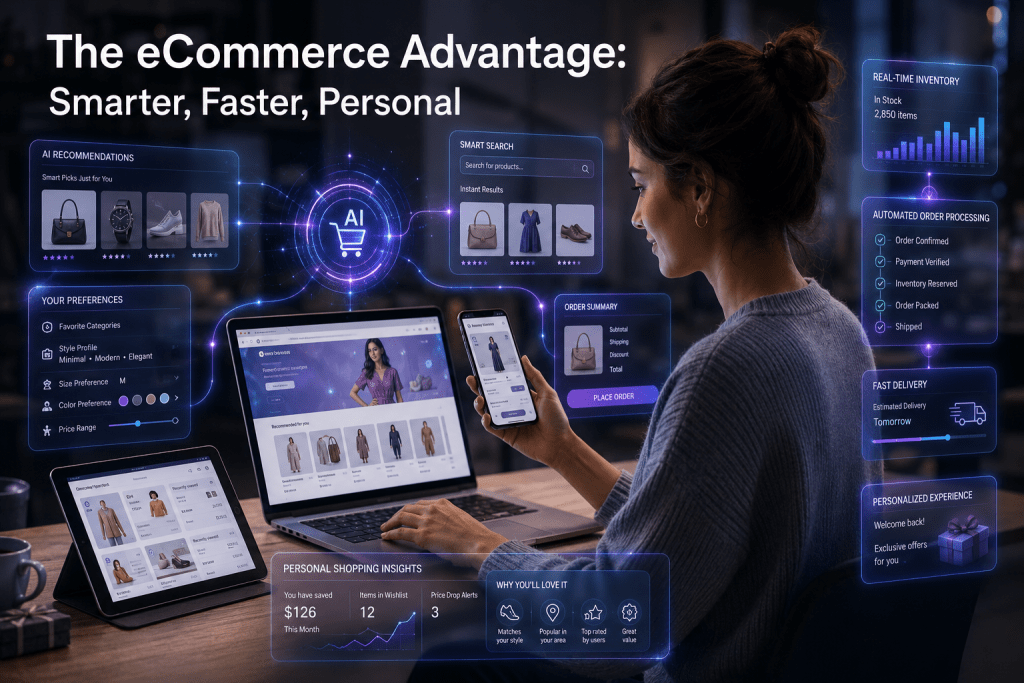
Nowhere is this shift more visible than in eCommerce. The pace is brutal. Customer expectations are sky-high. Miss a beat, and your competition wins.
That’s why so many online brands are turning to AI workflow automation through smart integrations like eCommerce development services and eCommerce marketing services from Webiators.
Here’s what happens when AI gets involved:
- Chatbots that sound less robotic, more real.
- Product recommendations that feel like they came from a best friend.
- Predictive insights that sense demand before it peaks.
- Automated campaigns that adapt on the fly.
In short—AI doesn’t just help you sell. It helps you connect.
The Human Truth About Automation
Here’s a thought: people don’t actually fear AI. They fear losing purpose.
The truth? AI doesn’t take that away—it gives it back. It removes the clutter so you can focus on the things that make you, well, human. Strategy. Empathy. Vision.
When routine tasks disappear, creativity blooms. Teams stop firefighting and start problem-solving. Leaders stop micromanaging and start imagining.
The irony? The more we automate, the more human our work becomes.
How to Get Started Without Getting Overwhelmed
Introducing AI into your business doesn’t have to feel like a moon landing. You start small, observe closely, and expand wisely.
Here’s how to begin:
- Find the friction. Where are tasks constantly getting stuck?
- Start small. Choose one process—billing, customer service, or analytics.
- Pick smart tools. Look for solutions that grow and learn with your business.
- Train your team. People don’t resist change—they resist confusion.
- Iterate constantly. The best automation systems evolve as you do.
The goal isn’t perfection on day one. It’s momentum. Once you start, things naturally begin to flow.
Intelligent Process Automation: The Next Leap
Modern enterprise efficiency relies on Intelligent Process Automation (IPA). By combining Robotic Process Automation (RPA) with cognitive AI and predictive analytics, IPA changes business processes from reactive to predictive. Instead of waiting for a human trigger, an automated pipeline can identify high-churn risk segments, run automated retention campaigns via your marketing platforms, and modify live product pricing based on real-time market data.
Read Also:- AI Search Optimization: How to Optimize Your Website for AI Search in 2026
Understanding the Shift: What Is AI Agent Workflow Automation?
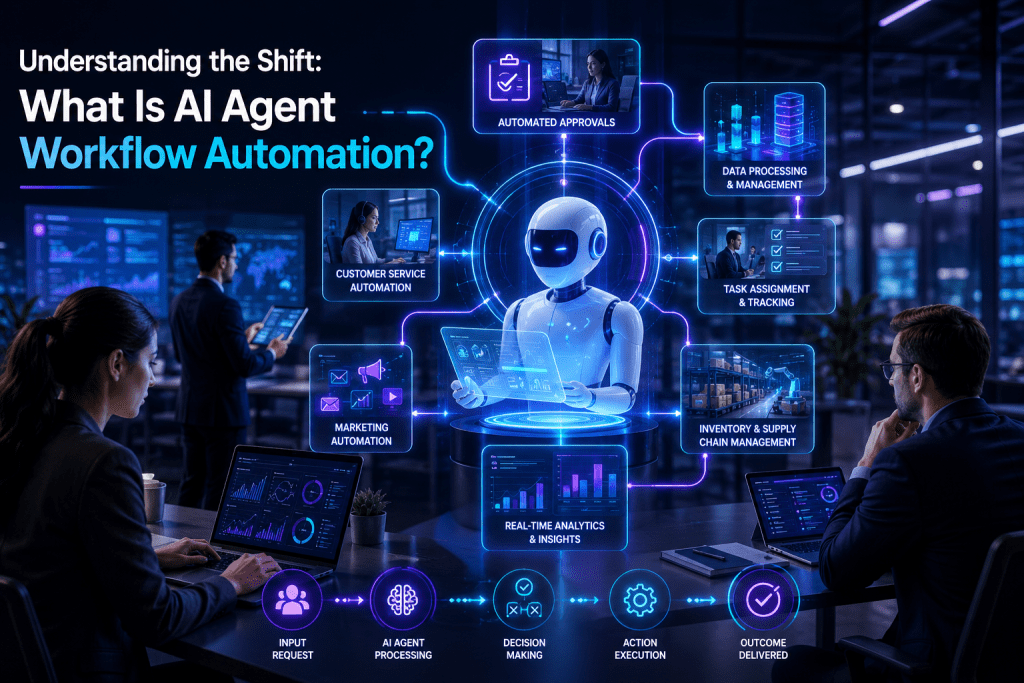
As technology progresses, standard workflow automation is shifting toward more autonomous systems. To stay competitive, it’s essential to understand what is ai agent workflow automation and how it differs from traditional automation setups. This evolution is reshaping the ai automation workflow business landscape, enabling organizations to streamline operations and make smarter decisions with minimal manual intervention.
While classic AI automation relies on pre-configured paths and manual prompts to move data from point A to point B, AI agent workflow automation deploys independent digital entities (AI Agents) that are given an end goal rather than a strict set of rules. These agents can reason, split a massive goal into smaller operational steps, select the appropriate tools (like querying an Adobe Commerce database or scraping competitor prices), execute the tasks, and audit their own output for errors.
For instance, instead of just sending an automated stock notification, an AI agent can detect a supply shortage, analyze vendor pricing across multiple APIs, draft a purchase order for approval, and update your Shopify or Magento inventory levels completely on its own. It shifts your workflow from a series of connected tasks to a fully autonomous, self-managing operation.
The Bottom Line
AI Future of workflow automation isn’t about replacing humans. It’s about removing the repetitive noise that drowns out human potential.
When machines handle the predictable, people finally get to focus on the meaningful. And that’s where true innovation begins.
So, the next time you catch yourself buried in routine, ask: What if I didn’t have to do this anymore?
Because the answer—AI—has already arrived.
FAQs
1. What does AI workflow automation actually do?
Ans. It uses artificial intelligence to automate repetitive business tasks, reducing effort and increasing accuracy.
2. How does it improve workflow optimization?
Ans. AI spots bottlenecks, predicts issues, and streamlines processes for faster, more efficient operations.
3. Is AI automation expensive?
Ans. Not necessarily. Many modern AI tools are subscription-based and affordable for startups and enterprises alike.
4. Can it really help eCommerce businesses?
Ans. Yes. From automated marketing to customer support, AI helps eCommerce stores grow faster and smarter.
5. How does Webiators fit into all this?
Ans. Webiators provides eCommerce development services and eCommerce marketing services that integrate AI-driven automation to help businesses scale with confidence.
6. What is the difference between standard automation and AI agent workflow automation?
Ans: Standard automation follows strict “If/Then” rules created by humans. AI agent workflow automation utilizes autonomous agents that understand an end goal, figure out the necessary steps themselves, and use varied digital tools to complete complex business processes independently.
