
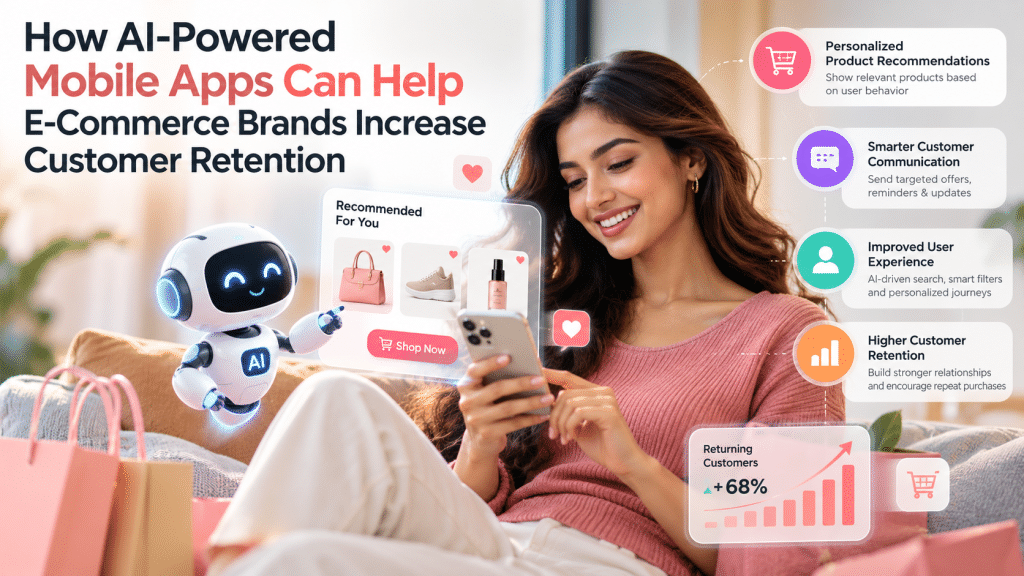

Getting someone to download your shopping app is great. Getting them to open it again next week is much harder. E-commerce brands spend plenty of time and money attracting new customers. However, the real value often comes from turning those first-time shoppers into repeat buyers. That is where customer retention enters the picture.
Mobile apps already give brands a direct connection with their customers. Add artificial intelligence. Thus, that connection can become much more personal. AI can help businesses understand what customers like, predict what they might need next, and communicate with them at the right moment. Here are the ways AI-powered mobile apps can help turn occasional shoppers into loyal customers.

#1 — Give Customers Better Product Recommendations
We’ve all encountered those “You might be interested in these” lists with items we couldn’t possibly want. AI can make those recommendations a lot smarter. An AI-powered app can use more than just broad categories or bestselling products; it can analyze browsing history, past purchases, search history, saved products, and how the user interacted with various products.
Suppose someone were constantly looking through running gear. The app could instead give them a recommendation for a shirt, pair of pants, or socks to match shoes they just bought or a jacket for products they have seen. Helpful tips make shopping easier. Customers do not have to waste a lot of time looking and are more likely to find something they actually want.
#2 — Create a More Personal Loyalty Experience
Traditional loyalty programs often follow a simple formula: spend money, collect points, get a reward. AI can make the experience much more interesting. An app could personalize rewards based on what customers actually value. A frequent shopper might receive early access to a product launch. Another customer gets a special offer in their favorite category. Brands can also use AI to suggest challenges, rewards, or milestones based on individual behavior.
For businesses exploring these capabilities, the development of AI-powered mobile applications can go beyond simply adding an AI chatbot to an existing app. AI features can be built into recommendations, loyalty programs, customer support, search, and other parts of the shopping journey. When these features work together, the app can feel more responsive to each customer rather than providing exactly the same experience to everyone.
#3 — Make Offers Feel Personal
Discounts can bring customers back. However, sending the same promotion to everyone is not always the best strategy. One shopper might respond to 10% off their favorite product category. Another might be more interested in free shipping. Someone else may not need a discount at all but would appreciate early access to a new collection.
AI can help brands identify these differences and create more relevant offers. That does not mean every customer needs a completely unique promotion. Instead, AI can help segment users according to their interests, purchase patterns, engagement, and other behaviors.
#4 — Send Smarter Notifications
Push notifications are effective because they deliver the message to the recipient’s phone. They can also be easily overdone. Excessive irrelevant alerts can lead to customers opting out of alerts. AI can not only determine the content of messages to send, but when to send them. An app can use past engagement habits to decide at what time to send a particular customer a push notification, rather than sending it to all at the same time at 10 a.m.
Notifications can also be set to fire on actions. If somebody left a product in their shopping cart, they may receive a reminder. If a customer is purchasing the same product every other month, they may receive a notification that it is likely they need to reorder.
#5 — Spot Customers Who Might Be About to Leave
Sometimes the most useful thing AI can tell you is not what a customer wants to buy. It is that they may be losing interest. Maybe someone who used to shop every month has not opened the app recently. Perhaps they are browsing but no longer purchasing. Or their engagement with emails, offers, and notifications has gradually dropped. These behaviors can signal that a customer is at risk of leaving.
AI models can analyze patterns across large numbers of users and identify customers whose behavior resembles people who previously became inactive. Brands can then respond before those customers disappear completely. That might mean offering a personalized incentive, recommending relevant new products, reminding them about loyalty rewards, or simply adjusting how frequently the brand communicates with them.
Retention Is About Relevance
Users don’t use an eCommerce app just because its tech is the most complex. They come back when it is convenient, relevant, and valuable. AI can help brands move towards that goal. They can suggest more effective products, customize offers, make more effective notifications, design more intelligent experiences to retain customers, and identify non-responsive customers sooner. AI can help make shopping more automated but only when used correctly. In fact, it can make it feel more like home and provide additional reasons for customers to return.
