
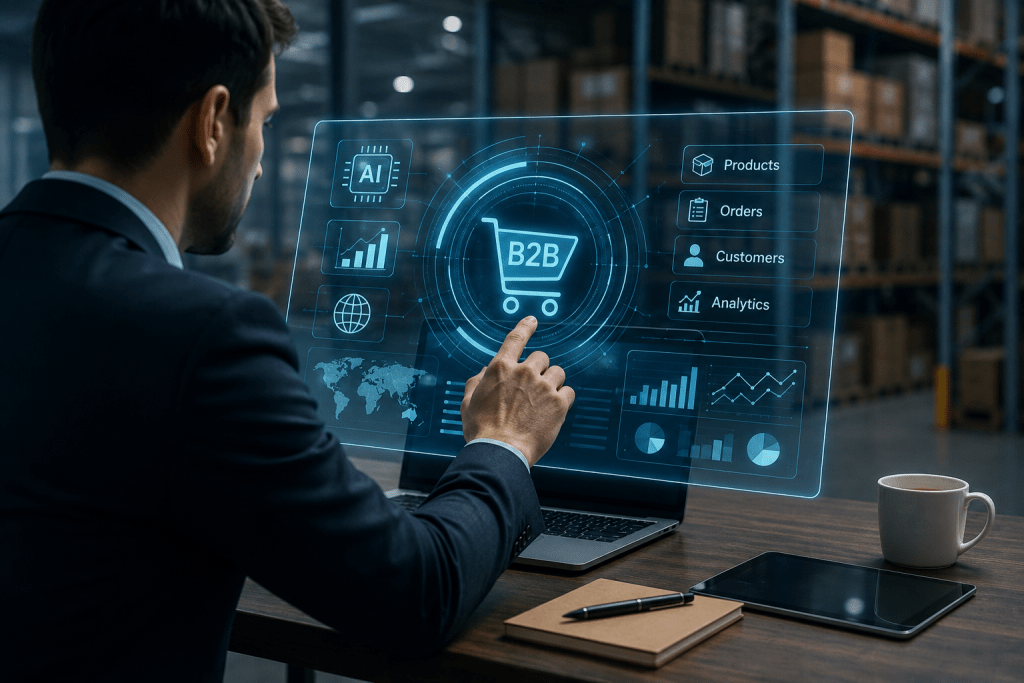

A B2B buyer used to search a catalog, contact a salesperson, request a quote, compare suppliers, and place an order.
That journey is getting shorter.
Today, buyers can describe what they need in natural language, compare products with AI, ask technical questions, receive recommendations, and research suppliers without following the traditional sales path.
The shift is already measurable. McKinsey’s 2026 Global B2B Pulse Survey found that 71% of B2B companies now offer ecommerce, while roughly one-third of revenue among those businesses comes through digital channels. Buyers also use an average of ten channels during their purchasing journey.
That is why AI in B2B ecommerce is no longer something businesses can treat as a futuristic experiment. It is becoming part of how companies attract buyers, sell products, provide support, and retain customers.
What Is AI in B2B Ecommerce?
AI in B2B ecommerce means applying artificial intelligence to practical parts of the buying and selling process, including product discovery, personalization, recommendations, customer support, sales assistance, forecasting, and reordering.
The technology matters.
The data behind it matters even more.
AI works best when it can connect reliable product information with customer accounts, order history, inventory, pricing rules, CRM data, and other ecommerce systems.
Without that foundation, adding AI to a website can feel impressive while solving very little.
5 Ways AI Is Transforming B2B Ecommerce Sales
1. AI Is Making Product Discovery More Conversational
B2B catalogs can become complicated quickly.
Thousands of SKUs. Similar specifications. Technical terminology. Compatibility requirements. Account-specific products.
Traditional filters do not always make this easy.
AI-powered search can let a buyer describe the requirement instead of knowing exactly which filters to select.
For example:
“I need a corrosion-resistant pump for continuous chemical processing and high-temperature operation.”
An intelligent search experience can interpret those requirements, identify relevant product attributes, and narrow the catalog.
That reduces friction.
It also gets the buyer closer to a purchasing decision without forcing them through a maze of filters.
2. AI Can Personalize the B2B Buying Experience
A first-time buyer and a long-term wholesale customer should not necessarily see the same ecommerce experience.
Their purchasing history, product requirements, pricing arrangements, and reorder patterns may be completely different.
AI can help personalize experiences using appropriate customer and behavioral data.
Useful applications include:
- Account-specific product recommendations
- Personalized merchandising
- Purchase-history-based search
- Reorder suggestions
- Relevant content recommendations
- Lead prioritization
- Customer segmentation
The objective should not be personalization for its own sake.
It should make buying easier.
3. AI Tools for Upselling and Cross-Selling Can Increase Relevance
B2B upselling is more complicated than displaying “You may also like.”
A customer buying industrial machinery might need compatible components, replacement parts, consumables, installation products, or maintenance supplies.
AI tools for upselling and cross-selling in B2B ecommerce can analyze product relationships, purchasing patterns, customer history, and contextual signals to identify more relevant opportunities.
Consider a customer who purchases the same component every six months.
Instead of waiting for the customer to search again, an ecommerce system could surface a timely reorder recommendation.
That helps both sides.
The buyer saves time. The seller creates another opportunity to serve an existing customer.
4. AI Chatbots Can Support Buyers Without Replacing Sales Teams
B2B buyers ask practical questions all day:
“Is this compatible with our existing equipment?”
“What is the minimum order quantity?”
“Can I reorder the same configuration?”
“Where is the technical documentation?”
“Which product replaces the discontinued model?”
AI chatbot solutions in B2B ecommerce can handle routine questions, guide product discovery, summarize available information, and route complex requests to the appropriate sales or support employee.
There is one important condition.
AI should not guess.
If pricing, availability, specifications, contractual terms, or compatibility cannot be verified, the system should say so and escalate the request.
A confident wrong answer can cost considerably more than a delayed answer.
5. AI Can Help Predict What Customers Need Next
B2B ecommerce has a valuable advantage: recurring purchasing behavior.
Many customers buy the same products on predictable schedules.
AI can identify those patterns and help businesses anticipate demand.
That can support:
- Replenishment reminders
- Demand forecasting
- Inventory planning
- Customer retention
- Sales prioritization
- Account monitoring
Instead of waiting for a customer to realize they need something, businesses can use historical behavior to become more proactive.
AI Search Is Changing How B2B Brands Get Discovered
There is another major shift happening before the buyer even reaches an ecommerce website.
A prospect might ask an AI search system:
“Which supplier is best for industrial filtration equipment?”
Or:
“What is the best ecommerce platform for a complex B2B catalog?”
The answer may combine information from multiple sources instead of simply displaying traditional search results.
Google’s current guidance is particularly important here. Google says AI Overviews and AI Mode do not require special AI-only technical requirements. Its guidance continues to emphasize crawlability, indexing, strong SEO fundamentals, helpful content, and valuable information.
Google’s official guide to optimizing for generative AI features
So, how can brands appear in AI search engines?
Start by becoming genuinely useful.
Publish:
- Detailed product pages
- Technical guides
- Product comparisons
- Industry use cases
- Integration documentation
- Buyer-focused FAQs
- Case studies
- Original research
- Expert commentary
- Clear company and service information
Google’s 2026 guidance specifically emphasizes valuable, non-commodity content and warns against simply producing large quantities of generic pages designed around search variations.
That is an important distinction for businesses asking how to increase brand visibility in AI search results.
There is no magic GEO shortcut.
Strong content and strong SEO foundations still matter.
AI-Native Commerce Is Becoming Real
The most interesting development in 2026 may be where product discovery happens.
OpenAI announced in March 2026 that ChatGPT was expanding product discovery through the Agentic Commerce Protocol, enabling richer product information, visual browsing, comparisons, and merchant connections inside ChatGPT. OpenAI also says Shopify product data is integrated into ChatGPT through Shopify Catalog.
OpenAI: Powering Product Discovery in ChatGPT
This changes the traditional ecommerce journey.
The buyer does not necessarily have to search Google, open five supplier websites, compare specifications manually, and then return to a store.
AI can increasingly become part of the discovery layer.
For B2B businesses, that makes accurate product information even more important.
Your specifications, descriptions, product relationships, availability, policies, and business information need to be clear and consistent.
AI cannot reliably recommend information that it cannot understand.
Your Ecommerce Architecture Still Matters
AI cannot repair a broken ecommerce foundation.
If your ERP contains different product information from your website, customer-specific pricing is unreliable, inventory data is outdated, or your catalog structure is poor, adding AI will not magically solve those problems.
It may simply expose them faster.
That is why the technology underneath the storefront matters.
Businesses managing complex catalogs, integrations, customer accounts, and B2B workflows can explore Webiators’ B2B Ecommerce Development capabilities.
For businesses using Magento or Adobe Commerce, Magento Development Services can support complex catalogs, integrations, migrations, and customized ecommerce functionality.
Brands that require greater flexibility can consider Custom Ecommerce Development to connect their storefront with the systems powering customer, product, and sales data.
Shopify businesses can also explore Shopify Development Services when building or improving an ecommerce experience around evolving buyer expectations.
What Should B2B Businesses Do With AI in 2026?
Do not begin with:
“Where can we add AI?”
Start with:
“Where are our buyers wasting time?”
Review your customer-service questions, site searches, abandoned carts, repeat purchases, quote requests, product discovery problems, and sales handoffs.
Then choose one commercially meaningful problem.
A practical approach is:
- Find the friction. Identify a repetitive or expensive buyer problem.
- Clean the data. Make product, customer, inventory, order, and pricing information dependable.
- Choose one use case. Start with search, recommendations, support, or replenishment.
- Keep human oversight. Escalate sensitive or high-value decisions.
- Measure revenue impact. Track conversion, average order value, repeat purchases, qualified leads, and support efficiency.
That is a better strategy than adding several AI features simply because competitors are talking about them.
The Future of AI in B2B Ecommerce
The future is not just another chatbot sitting on a product page.
It is a connected system.
Ecommerce + product data + CRM + ERP + AI search + sales workflows.
McKinsey’s 2026 B2B research shows that leading companies are moving toward AI-enabled commercial models rather than treating AI as isolated experiments.
At the same time, Google is actively expanding visibility reporting for generative AI features. In June 2026, Google announced new Search Console reports designed to show impressions and pages appearing in AI Overviews, AI Mode, and other generative AI experiences.
Google Search Central: Search Generative AI performance reports
That gives marketers something increasingly valuable: a way to monitor visibility rather than simply speculate about it.
The B2B ecommerce website is becoming more than a digital catalog.
It can become a product expert, sales assistant, recommendation engine, customer-service layer, and discovery surface for AI-powered buying journeys.
The businesses that prepare their data, content, technology, and ecommerce architecture now will be better positioned for that shift.
FAQs
What is AI in B2B ecommerce?
AI in B2B ecommerce uses artificial intelligence to improve product discovery, personalization, recommendations, customer support, forecasting, sales assistance, and retention.
How does AI help B2B ecommerce businesses?
AI can reduce repetitive work, personalize buying experiences, improve product search, identify sales opportunities, support customers, and predict recurring purchasing needs.
Can AI automate B2B ecommerce sales?
Yes. AI can automate product recommendations, routine customer questions, lead qualification, reorder reminders, and certain follow-ups. Complex negotiations and sensitive decisions still benefit from human involvement.
How does AI improve the B2B buying experience?
AI can help buyers find relevant products faster, understand technical information, receive personalized recommendations, get immediate answers, and complete routine purchasing tasks with less friction.
What is the future of AI in B2B ecommerce?
The direction is toward conversational product discovery, predictive selling, personalized commerce, AI-assisted sales workflows, and agentic buying experiences connected to ecommerce, CRM, ERP, and product data.
