
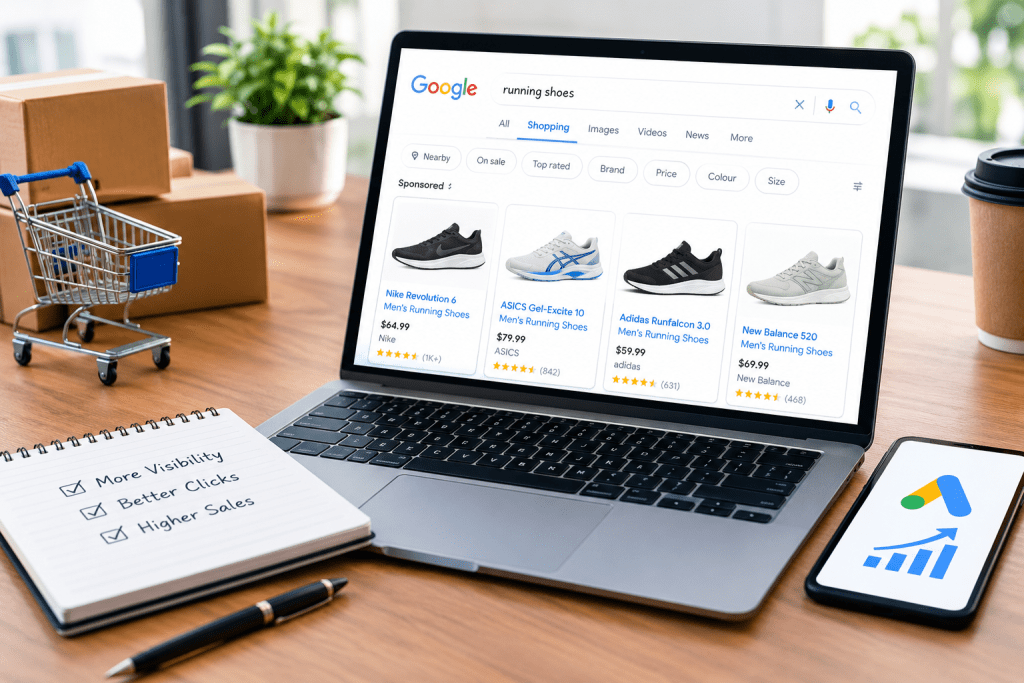

Your Google Ads account can look busy without being profitable.
There may be thousands of impressions. Plenty of clicks. A healthy-looking ROAS sitting on the screen.
And yet, when you check the actual numbers, ecommerce growth feels strangely flat.
That is the trap.
Increasing the budget does not automatically create more profitable sales. If the wrong products are being promoted, conversion tracking is unreliable, or Google is working with poor product data, you can simply spend more money on the same problems.
A Google Shopping Ads agency should help solve that problem before asking you to spend another dollar.
The Shopping Game Has Changed
Google Shopping is no longer just about matching a product to a short keyword.
People are asking longer, messier questions.
“Best waterproof hiking jacket for summer.”
“Affordable office chair for someone with lower back support needs.”
“Running shoes for wide feet under $150.”
Those searches contain context. A lot of it.
Google is responding to this shift with AI-powered shopping experiences. Its 2026 Merchant Center AI performance insights are designed to show how products are discovered through AI Mode, AI Overviews, and the Gemini app. The report can surface shopping stages, popular product terms, search intents, and product attributes.
That has a practical implication for ecommerce brands:
Your product data needs to be useful enough for machines to understand and useful enough for shoppers to trust.
A product called “Premium Jacket 2026” tells Google very little.
A product listing that clearly communicates the product type, material, fit, intended use, size, color, and relevant features gives Google’s systems much more to work with.
Your feed is not housekeeping.
It is part of your advertising strategy.
Before Scaling Ads, Fix What Google Sees
I often start with the Merchant Center feed before touching the bidding strategy.
Why?
Because Shopping ads are generated from your product information. Google specifically notes that ad performance is closely connected to the accuracy and completeness of data such as price, availability, shipping information, and product identifiers.
That means we need to look beyond whether products are technically approved.
We need to ask better questions:
- Are product titles written around genuine shopper intent?
- Are important attributes missing?
- Are prices and availability synchronised?
- Are images doing enough selling?
- Are products landing on relevant pages?
- Are disapproved products quietly limiting revenue?
- Are high-margin products receiving enough attention?
A feed can be technically valid and commercially weak.
Those are very different things.
Stop Treating Every Product Like a Star
This is another common ecommerce mistake.
A store has 2,000 products, so the advertising strategy tries to give all 2,000 products roughly equal importance.
That makes little business sense.
Your best-selling product may have excellent margins and repeat-purchase potential. Another product may generate clicks but barely make money after shipping, discounts, returns, and acquisition costs.
They should not receive identical treatment.
I prefer looking at products through a commercial lens:
Revenue. Margin. Conversion rate. Demand. Inventory. Customer value.
Then the campaign strategy can reflect what the business actually needs.
Sometimes the answer is to scale.
Sometimes it is to cut spend.
That second answer can be just as valuable.
Where Performance Max Earns Its Place
Performance Max is particularly relevant to ecommerce because it can reach Google’s inventory across Search, Shopping, YouTube, Display, Discover, Gmail, and Maps. Google positions it as an AI-powered campaign type designed to optimise bidding, targeting, creative, and attribution toward business goals.
But there is a catch.
You cannot throw a weak feed and poor conversion data into an automated campaign and expect magic.
Automation needs useful signals.
Google recommends rich product information, accurate pricing and availability, approved products, meaningful conversion data, and sufficient campaign time for learning. Its current guidance recommends running Performance Max campaigns for at least six weeks to allow the system to gather enough data.
That last point matters.
Changing everything every few days because the dashboard looks uncomfortable is not optimisation.
Sometimes it is simply impatience wearing a business suit.
Google Is Giving Shopping More AI Muscle
There is another development worth watching in 2026.
Google’s AI Max for Shopping is currently a beta suite designed to help Shopping campaigns respond to complex, conversational searches. It can use AI to customise product titles and expand final URLs to relevant commercial pages on a website.
Google reports that advertisers activating AI Max for Shopping typically see 5% more conversions or conversion value at a similar CPA or ROAS, based on Google’s internal global retail data from 2026. That is Google’s own data, not an independent industry benchmark, so I would treat the figure as directional rather than a guarantee.
That distinction matters.
Good marketing does not turn a vendor’s internal performance claim into a promise.
Instead, test it against your own account.
What Should You Actually Measure?
If your weekly PPC meeting starts and ends with clicks, you have a problem.
For an ecommerce business, I want a clearer picture.
| Metric | Why it matters |
| Conversion value | Shows the revenue or value generated |
| ROAS | Measures return against advertising spend |
| CPA | Shows acquisition efficiency |
| Conversion rate | Reveals how well traffic becomes customers |
| Average order value | Helps understand transaction economics |
| Product-level performance | Shows where revenue is really coming from |
| Profitability | Connects advertising performance with business reality |
There is another useful development here.
Since June 2026, Google has expanded product reporting so retailers can see product performance across additional campaign types and networks, giving advertisers a broader view of product-level results.
That is useful because “the campaign is performing” is often too vague.
Which products?
Which categories?
Which ones are consuming budget without contributing enough value?
Those are the questions worth answering.
Where an Agency Can Actually Make a Difference
Hiring an agency should not mean handing over your Google Ads login and receiving a pretty monthly PDF.
The value should be in the thinking behind the account.
A strong Google Ads Management process should connect campaign performance with your products, margins, website experience, and sales goals.
That can include:
Google Shopping Ads: Product-led campaigns designed around commercial search behaviour.
PPC Services: Broader paid acquisition, testing, optimisation, and performance analysis.
Performance Max: AI-powered reach across Google’s wider advertising ecosystem.
Ecommerce Marketing Services: A wider growth strategy connecting paid advertising with SEO, CRO, content, remarketing, and other acquisition channels.
The objective is not complicated.
Spend where the opportunity is strongest.
Cut where the economics do not work.
Keep testing.
Keep learning.
Should You Increase the Budget Yet?
Maybe.
But first, prove that the account deserves more money.
Check your product feed.
Check your conversion tracking.
Review your best and worst products.
Look at margins.
Audit your landing pages.
Study search and product-level performance.
Then decide where additional spend has a reasonable chance of producing additional value.
That is especially important now that Google’s systems are increasingly dependent on product information and conversion signals. Google’s own Performance Max guidance recommends providing the AI with useful business information and strong product data to improve campaign performance.
More budget is not a strategy.
It is an amplifier.
If the underlying system works, it can accelerate growth.
If it does not, it can accelerate waste.
The Real Ecommerce Advantage in 2026
AI has not made ecommerce advertising effortless.
It has made good inputs more valuable.
Your catalogue matters.
Your website matters.
Your conversion data matters.
Your margins matter.
Your product information matters.
And someone still needs to look at the numbers and ask the uncomfortable question:
“Are we actually making more money from this?”
That is the conversation we bring to ecommerce PPC at Webiators.
If your Google Shopping campaigns are generating activity but not the level of profitable growth you expected, the answer may not be another budget increase.
It may be time to rethink what happens before, during, and after the click.
FAQs
1. What does a Google Shopping Ads agency do?
A Google Shopping Ads agency can manage product feeds, campaign setup, bidding, Performance Max, conversion tracking, reporting, testing, and ongoing optimisation with the aim of improving ecommerce sales efficiency.
2. Is Google Shopping still worth using in 2026?
Yes. Google continues to develop Shopping across traditional search and newer AI-powered shopping experiences. In 2026, Merchant Center also introduced AI performance insights for eligible accounts in markets including the United States and India.
3. Should I use Performance Max for my ecommerce store?
Performance Max can be useful when your store has reliable conversion tracking, quality product data, approved products, and clear sales goals. It can access multiple Google channels rather than relying solely on traditional Shopping placements.
4. How much should I spend on Google Shopping Ads?
There is no sensible universal budget. Your starting point should consider margins, average order value, conversion rate, customer acquisition cost, inventory, and available demand.
5. How can I improve Shopping Ads without increasing my budget?
Start with the basics that are easiest to overlook: improve product information, fix tracking, identify inefficient products, refine landing pages, remove wasted spend, and put more attention on products that can generate profitable revenue.
