
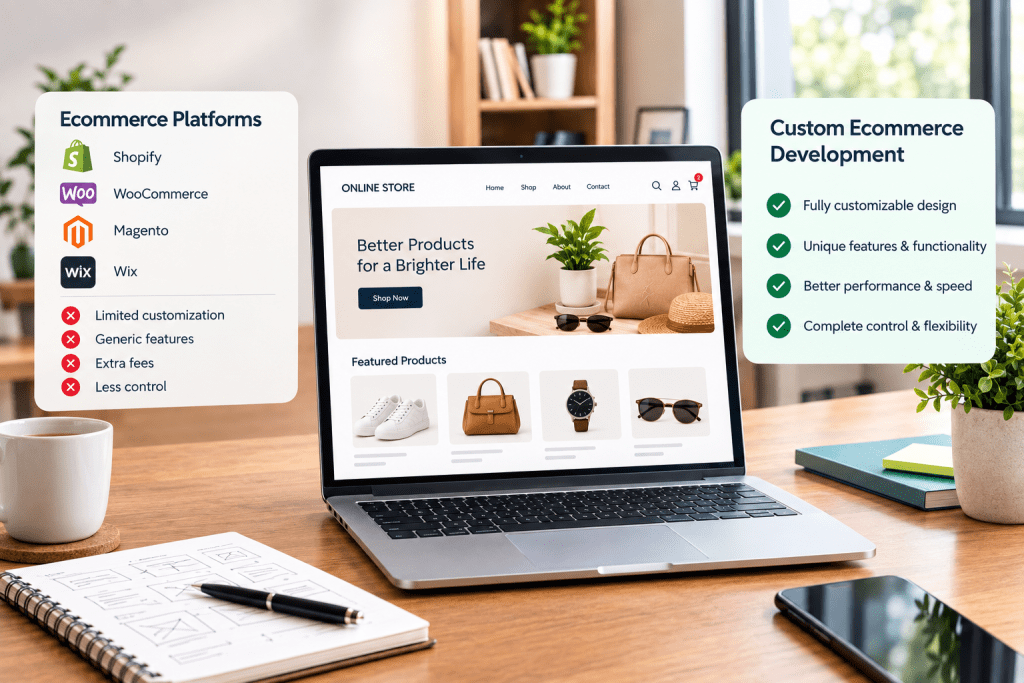

There is a point in ecommerce growth when adding another app stops solving the problem.
It creates one.
Your store needs customer-specific pricing, so you install an extension. Then your ERP needs a different data structure, so another integration gets added. Your B2B customers want approval-based ordering, which means another workaround.
Everything still works.
Sort of.
The store becomes slower to maintain, developers spend more time keeping integrations alive, and your team starts asking whether the business process itself needs to change.
It doesn’t.
The technology does.
That is where Custom Ecommerce Web Development becomes worth considering. Not because having a custom website sounds impressive, but because your business may have reached a point where generic ecommerce software is getting in the way of how you actually sell.
The Moment a Platform Starts Saying “You Can’t”
I have seen this happen in different forms.
A manufacturer wants buyers to configure a machine before receiving a price.
A wholesaler wants different customers to see different products and prices.
A retailer wants returning customers to rebuild a previous order with one click.
A distributor wants sales representatives to create orders on behalf of customers without exposing the entire retail storefront.
None of these requirements is unusual from a business perspective.
They are unusual from the perspective of a standard ecommerce checkout.
Platforms are designed to serve large numbers of businesses using broadly similar processes. That is their strength. You get proven functionality without paying to reinvent it.
But the same standardisation becomes restrictive when your competitive advantage comes from doing something differently.
A Real Ecommerce Store Does More Than Take Payments
This is an easy distinction to miss.
Most people think of ecommerce as the storefront customers see.
For a growing business, the real system is much larger.
A customer places an order. That order may trigger inventory updates, accounting entries, warehouse instructions, shipping calculations, CRM activity, sales notifications and customer communication.
Now add negotiated pricing.
Then add multiple warehouses.
Then add wholesale accounts.
Then add product configuration.
Suddenly, the website is not just a website. It is part of the company’s operating system.
Custom Ecommerce Development can connect those processes according to your rules instead of relying entirely on whatever workflow an extension happens to provide.
That can be especially valuable with B2B Ecommerce Development, where a buyer might have purchasing limits, negotiated rates, multiple users, approval requirements and specific payment terms.
Here’s Where Customisation Gets Interesting
Forget flashy animations for a moment.
The most valuable custom feature on your website might be something customers barely notice.
For example, a repeat buyer could log in and see:
“Reorder your usual shipment.”
One click.
The system already knows the products, quantities, pricing and delivery information.
Another business might let customers enter their requirements and receive a dynamically configured product recommendation.
A manufacturer could prevent incompatible components from being purchased together.
A distributor might allow a sales representative to create a customer order from an internal dashboard while the customer never has to navigate the public storefront.
These are small moments.
They can remove enormous amounts of friction.
That is the real case for custom development.
What Happens When Your Apps Start Running the Business?
There is nothing wrong with ecommerce apps.
They are useful. Sometimes they are exactly the right answer.
The problem is dependency.
Your store might eventually rely on separate tools for subscriptions, reviews, search, bundles, pricing, shipping, customer accounts, analytics and automation.
Now change one thing.
An update breaks an integration.
A developer has to investigate.
Another service changes its API.
Someone needs to fix the connection.
A feature that looked inexpensive when purchased separately can become expensive when you consider the time required to maintain the whole ecosystem.
A custom system does not eliminate maintenance. No technology does.
It can, however, let you decide where the business logic lives and how different systems communicate.
That distinction becomes increasingly important as the business gets larger.
You Do Not Have to Throw Away Your Existing Platform
This is probably the biggest misconception around custom ecommerce.
Going custom does not necessarily mean abandoning Shopify, WooCommerce, BigCommerce or another established commerce platform.
Sometimes the smartest architecture is a combination.
Keep the reliable commerce infrastructure.
Custom-build the experience that needs to be different.
For example, a business could retain its existing commerce backend while creating a custom product configurator, customer portal or B2B ordering interface.
A headless setup can take this idea further by separating the storefront from the commerce backend, giving developers more freedom over the customer-facing experience.
That is useful when the backend works perfectly well but the frontend has become the bottleneck.
Your Website Should Reflect How Customers Buy
Here is a question worth asking your sales team:
“Where do customers get stuck?”
Not, “Which website feature should we build?”
Where do they get stuck?
Maybe they call sales because they cannot find the right product.
Maybe they abandon orders because the shipping calculation is confusing.
Maybe wholesale customers email spreadsheets because the online ordering process is too restrictive.
Maybe existing customers repeatedly enter information your business already has.
Those answers tell you far more about what your ecommerce website needs than a competitor’s homepage ever will.
This is also where Web Design Services become more than visual design. The interface should make complicated purchasing decisions feel straightforward.
Good ecommerce design often hides complexity rather than displaying it.
Custom Development Can Be an SEO Decision Too
There is another piece businesses often overlook.
Changing your ecommerce architecture can affect organic search.
A poorly planned custom build can create indexation problems, messy URLs, duplicate pages, slow rendering or weak internal linking.
A properly planned build can give your team much more control over those areas.
Technical SEO should therefore be considered while the architecture is being designed, not after the developers announce that the site is ready.
Think about category structures, faceted navigation, structured data, canonical URLs, rendering, page speed and crawlability before thousands of product pages exist.
Fixing an architectural mistake after launch is rarely the fun part.
But Should You Actually Go Custom?
Sometimes, absolutely not.
If your store sells standard products, has a straightforward checkout and does not depend on unusual workflows, a ready-made ecommerce platform can be a fantastic choice.
You get speed.
You get an established ecosystem.
You get less infrastructure to manage.
There is no prize for spending more money on technology than your business needs.
I would start considering custom development when the following conversation keeps happening inside your company:
“The platform doesn’t support that.”
If you hear it once, find a solution.
If you hear it every month, investigate.
If your team has built an entire collection of workarounds around it, stop adding patches and examine the architecture.
You may have outgrown the original setup.
A Simple Way to Make the Decision
Take your current ecommerce operation and divide its requirements into three groups.
Keep:
Things the existing platform already does well.
Extend:
Things that need some additional functionality or integration.
Rebuild:
Processes where the existing technology is actively creating friction, cost or lost sales.
That exercise is often more useful than immediately asking for a quote for a “fully custom ecommerce website.”
It keeps the investment focused.
Your objective is not to own more code.
Your objective is to create a better business system.
The Competitive Advantage Is Not the Custom Code
Customers do not care that your website was custom-built.
They care that it works.
They care that they can find what they need, understand the product, get an accurate price, complete an order without unnecessary steps and return later without starting from zero.
Your sales team cares about fewer manual tasks.
Your operations team cares about accurate data.
Your marketing team cares about a fast, crawlable website.
Your leadership team cares about revenue and scalability.
That is the standard custom ecommerce development should be held against.
If the custom build does not improve one of those outcomes, question why you are building it.
If it does, you may have found a genuine competitive advantage.
FAQs
1. When does a business need custom ecommerce development?
Usually when its buying process, integrations or customer experience no longer fit comfortably within a standard platform’s capabilities.
2. Is custom ecommerce development better than Shopify or WooCommerce?
Not automatically. Standard platforms are often the smarter choice for simple and moderately complex stores. Custom development becomes valuable when business-specific requirements justify greater control.
3. Can custom ecommerce development help B2B companies?
Yes. It can support customer-specific pricing, account permissions, quote workflows, bulk ordering, approval processes and integrations that are common in complex B2B sales.
4. Will a custom ecommerce website be better for SEO?
It can provide greater technical control, but only if SEO is considered during development. Custom code alone does not improve rankings.
5. Can I keep my existing ecommerce platform and still use custom development?
Yes. A hybrid or headless approach can retain existing commerce infrastructure while customising the parts of the storefront or buying journey that require greater flexibility.
