
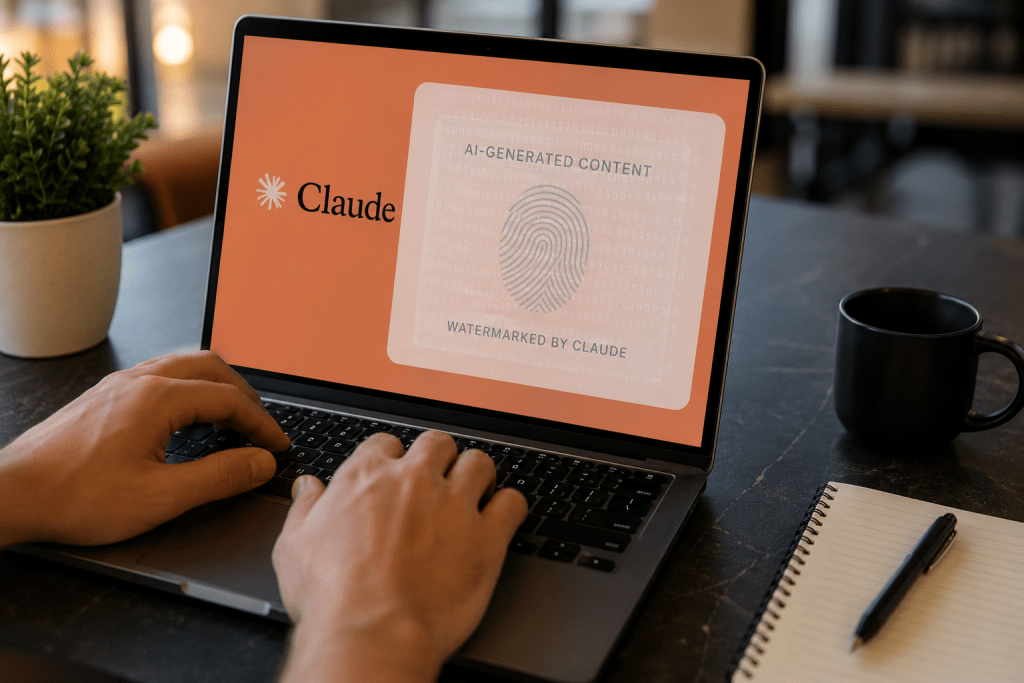

AI-generated content has a new layer of provenance.
Anthropic has introduced an invisible text watermarking system for Claude that is designed to help determine whether Claude was involved in producing or processing a piece of text. The watermark is not a visible label, hidden character, or piece of metadata attached to a document. Instead, it is embedded statistically through the model’s word-selection process.
For businesses using Claude to write articles, edit marketing copy, translate documents, generate code comments, or support other content workflows, the change raises a more important question than simply “Can AI-generated text be detected?”
It is:
What does AI provenance mean when a human and an AI system work on the same piece of content?
That distinction matters for content teams, marketers, publishers, developers, and anyone building an AI-assisted workflow.
What Is Claude’s Text Watermark?
Claude’s text watermark is an imperceptible statistical signal embedded into generated text.
Anthropic explains that large language models repeatedly make choices between plausible next words. In a sentence where several words would communicate essentially the same meaning, the model has some flexibility in which one it selects.
Claude’s watermarking system uses those lower-stakes choices to create a detectable pattern.
The important part is what isn’t happening.
The watermark does not add a visible symbol to the page. It does not insert hidden Unicode characters. It does not add extra tokens, and Anthropic says it does not contain information that identifies a particular user, organization, or conversation.
Instead, the pattern is created through how Claude makes certain word-selection decisions.
Anthropic says the system is based on the SynthID-Text approach published by Google DeepMind and is designed so that readers cannot distinguish watermarked text from unwatermarked text.
How Does Claude’s Invisible Watermark Work?
Think of Claude as having several reasonable ways to complete a sentence.
For example:
“The weather today was cold and…”
Several words could plausibly follow.
The watermarking system does not force Claude to choose an obviously unusual word. Instead, it changes the source of the randomness used when Claude makes certain choices.
Anthropic describes the process as using a secret key and preceding words to determine how those choices are made. Looking at enough text, a compatible detector can then test whether the sequence is statistically consistent with Claude’s watermark.
That means the watermark is fundamentally different from a digital tag attached to a file.
There is no obvious “Claude marker” sitting inside the text waiting to be found.
The signal is distributed through the wording itself.
This also explains why detection is probabilistic rather than absolute.
Anthropic says the system can estimate the likelihood that Claude was involved. It does not provide a definitive declaration that Claude wrote every word.
Does a Claude Watermark Prove AI Authorship?
No.
This is probably the most important distinction businesses should understand.
A watermark can indicate that Claude was likely involved in producing or processing the content. It cannot, by itself, establish who authored the underlying work.
Consider three different situations.
AI-generated
A marketing manager asks Claude to write a 1,500-word article from a brief. Claude produces the substantive content.
Here, Claude played a major role in generating the text, so a watermark may provide evidence of Claude’s involvement.
AI-assisted
A marketing manager writes the article independently, then asks Claude to reorganize several sections, improve transitions, and suggest alternative headlines.
Now the human created much of the substance, while Claude contributed to the final version.
A watermark does not change that history into “Claude authored the article.”
AI-processed
A company submits an existing document to Claude for translation, proofreading, analysis, or another transformation.
Again, Claude may have processed the material without being the original author.
Anthropic explicitly says its watermark cannot distinguish between “Claude wrote this” and “Claude heavily edited this.”
That is why AI involvement and AI authorship should not be treated as interchangeable terms.
For businesses, this distinction could become increasingly important when internal policies, client agreements, academic rules, publishing standards, or disclosure requirements ask how AI was used.
Can Editing or Rewriting Remove the Claude Watermark?
The answer depends on how much the text changes.
Because the signal is tied to Claude’s word-selection decisions, copying and pasting the text does not inherently remove it.
Anthropic says light editing may leave enough of the watermark intact for detection, while a complete rewrite in which the words are replaced can remove the signal.
This is an important distinction.
A statistical watermark is not a permanent forensic tag that survives every possible transformation.
It works only where the original watermark-bearing word choices remain sufficiently intact.
The same limitation appears when Claude performs limited proofreading.
If a human supplies an article and Claude changes only a handful of grammatical or punctuation errors, there may not be enough Claude-selected language for the watermark to register reliably. Anthropic specifically notes that watermarking is weaker when there are fewer meaningful word choices available.
So businesses should avoid thinking of watermark detection as a binary test that works equally well on every piece of text.
Is Claude Watermarking the Same as an AI Detector?
No.
The two technologies answer different questions.
An AI detector generally attempts to infer whether text looks AI-generated by examining characteristics or patterns in the writing.
A watermark detector, by contrast, looks for a signal intentionally embedded by the generating system.
That difference is significant.
A third-party AI detector may try to identify AI-generated writing even when the model did not intentionally watermark it.
Claude’s watermark system is narrower. Anthropic says a compatible detector can test whether text is statistically consistent with Claude’s specific watermark. It cannot establish that another AI system produced the text, and an absence of the watermark does not prove that humans wrote the content.
So:
AI detector: “Does this text appear likely to be AI-generated?”
Claude watermark: “Is this text statistically consistent with Claude having been involved?”
Those are not the same claim.
Does Claude Watermarking Affect Content Quality?
Anthropic says it does not.
The company reports that its internal testing found no impact on the content, creativity, or readability of Claude’s text. Anthropic also points to research behind SynthID-Text in which human ratings found no statistically significant quality difference between watermarked and unwatermarked outputs.
The underlying reason is straightforward.
Claude’s watermark is designed to operate mainly on choices where multiple outputs are already reasonable.
It is not supposed to make the model select an obviously inferior word simply to preserve a watermark.
There are also situations where watermarking becomes weaker by design.
If the answer requires an exact factual token, there may be little flexibility for the watermark to act on. Anthropic gives examples involving mathematical answers and notes that code generally contains less watermarking because many programming decisions need to be exact.
So the effect is not necessarily uniform across every kind of content.
What Claude Watermarking Means for Businesses

For businesses, the biggest change is not that Claude suddenly makes content “detectable.”
It is that AI provenance is becoming part of the content workflow.
Companies using generative AI should start documenting how AI contributes to important content rather than relying solely on a final detector result.
For example, an editorial workflow could record:
- Who created the original material
- Whether Claude generated new content
- Whether Claude edited or translated existing content
- How extensively the output was modified
- Who reviewed the final version
- Who approved the content for publication
That approach is more useful than treating a watermark as a simple authorship verdict.
A watermark can provide evidence that Claude was involved. A workflow record can explain how Claude was involved.
For client-facing agencies and marketing teams, that distinction can become particularly valuable when contracts or brand policies require disclosure of AI use.
What It Means for SEO, AEO and GEO
Claude’s watermark does not fundamentally change what makes content valuable in search.
There is no basis in Anthropic’s announcement for concluding that Google Search uses Claude’s watermark as a ranking or spam signal. The announcement is about provenance and transparency, not search rankings.
That means businesses should not respond by obsessing over whether content carries a watermark.
The better question is whether the content deserves to be found.
For traditional SEO and AI-powered search alike, strong content still benefits from:
- Original research and first-hand information
- Genuine subject-matter expertise
- Accurate and verifiable claims
- Clear sourcing
- Useful examples
- Strong entity relationships
- Direct answers to real user questions
- Meaningful analysis rather than generic summaries
- Human editorial review
This matters even more as AI systems increasingly become part of the information ecosystem.
A watermark can help identify the involvement of a model.
It cannot create expertise that was never present in the content.
It cannot turn weak research into strong research.
And it cannot make generic information genuinely original.
For businesses investing in SEO, AEO and GEO, the strategic takeaway is therefore not “avoid watermarked content.”
It is:
Use AI where it improves the workflow, while making the final content genuinely useful, accurate, original and accountable to a human expert or editorial process.
Claude Watermarking and the EU AI Act
Anthropic says it is implementing text watermarking to comply with the EU AI Act and notes that it signed the EU Code of Practice on Transparency of AI-Generated Content in July 2026. Anthropic has chosen to apply the watermark globally rather than restrict it only to the EU.
The regulatory picture, however, is more nuanced than saying “the EU now requires every AI article to have a watermark.”
Article 50(2) of the AI Act requires providers of AI systems, including general-purpose AI systems, that generate synthetic audio, image, video or text content to ensure that outputs are marked in a machine-readable format and detectable as artificially generated or manipulated, subject to the regulation’s conditions and technical feasibility.
There is also a transition period.
Under the current consolidated text, providers of AI systems generating synthetic audio, image, video or text content that were placed on the market before August 2, 2026 have until December 2, 2026 to take the necessary steps to comply with Article 50(2).
The regulation also contains an important nuance around AI-generated or manipulated text published to inform the public about matters of public interest. The relevant transparency provision does not apply where the content has undergone human review or editorial control and a natural or legal person holds editorial responsibility for the publication.
That makes human editorial responsibility particularly important.
The broader regulatory direction is clear: AI-generated content is moving toward greater transparency and provenance.
But the exact legal obligation depends on the type of AI system, content, provider, use case and applicable provisions.
What Businesses Should Do Now
Businesses using Claude do not need to panic about the watermark.
They should improve their AI-content governance.
1. Document AI involvement
Record whether Claude generated, edited, translated, summarized, or otherwise processed important content.
2. Keep human editorial responsibility
Assign a person who is responsible for reviewing and approving externally published material.
A watermark can indicate Claude involvement. It cannot establish the complete history of who wrote the content.
4. Review client and internal policies
If your company has rules around AI-assisted work, update them to distinguish between generating, editing, proofreading, translating and processing content.
5. Prioritize original value
Don’t build a content strategy around trying to make AI involvement invisible.
Build it around information that is worth publishing.
6. Watch regulatory developments
The EU AI Act is evolving through implementation measures, codes of practice and amendments. Businesses serving European users should monitor the official requirements rather than relying on simplified summaries of the law.
Read Also:- Best Claude SEO Analysis Tools for US Businesses in 2026
Final Takeaway
Claude’s text watermark changes how AI-generated content can be identified, but it does not change the fundamental definition of valuable content.
The more important shift is toward AI provenance.
A piece of content may be written entirely by a person, generated largely by AI, lightly edited with AI, translated by AI, or produced through a combination of all four. A useful content-governance system needs to recognize those differences rather than reducing everything to “human” or “AI.”
Claude’s watermark can signal that Claude was likely involved.
It cannot manufacture expertise, experience, originality or trust.
For businesses, that is the real lesson.
Use AI where it genuinely improves the work. Keep humans accountable for the final result. And make the content valuable enough that its usefulness does not depend on whether a machine helped produce it.
FAQs
Does Claude watermark every piece of text?
Anthropic says future Claude models will generate watermarked text, while models launched before August 2, 2026 are being retrofitted during the EU transition period.
Can Claude’s watermark prove that Claude wrote an article?
No. It can indicate that Claude was likely involved, but it cannot distinguish between Claude generating the content and Claude heavily editing or processing it.
Can copying and pasting remove the Claude watermark?
Not inherently. Because the watermark is embedded through word-selection patterns, copying the text does not automatically strip it. However, substantial rewriting can disrupt or remove the signal.
Is Claude’s watermark the same as an AI content detector?
No. Claude’s watermark is an intentional signal embedded by the model. AI detection software generally attempts to infer AI involvement from characteristics of the text.
Can Google detect Claude’s watermark?
Anthropic’s announcement does not establish that Google Search uses Claude’s watermark as a ranking or spam signal. Businesses should not assume that a Claude watermark affects search rankings.
Does Claude’s watermark contain personal information?
Anthropic says it does not. The company states that the watermark cannot be used to recover information about a user’s identity, organization or conversations.