
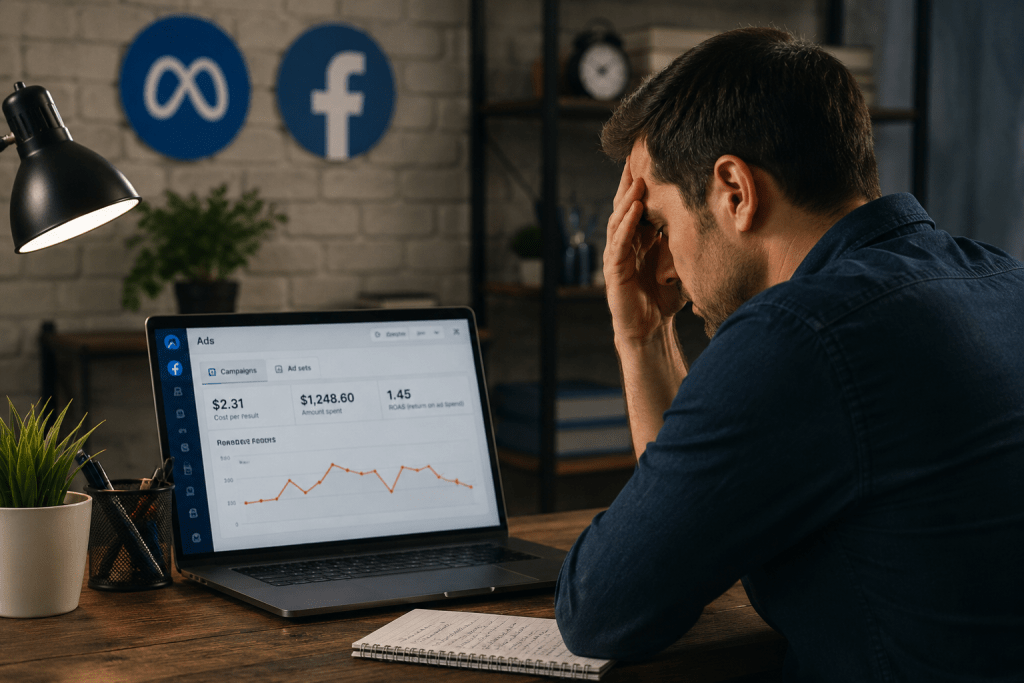

A store owner recently told me something I hear almost every week:
“We doubled our Facebook ad budget. Sales barely moved.”
That wasn’t surprising.
Five years ago, launching a Facebook campaign with decent creative and basic audience targeting often produced respectable results. Today? The same approach can drain thousands of dollars before you even realize what’s happening.
Here’s the interesting part. Meta’s advertising business continues to grow, and millions of businesses still rely on its platforms to acquire customers. The problem isn’t that Facebook or Instagram ads have stopped working. The way many brands use them hasn’t kept pace with how the platform has changed.
Meta’s advertising ecosystem now leans heavily on artificial intelligence, automation, first party data, creative quality, and user experience after the click. Businesses still chasing old tactics are paying more for less.
If your Meta Ads ROI has slipped over the past year, you’re not fighting a broken platform. You’re fighting an outdated strategy.
Let’s unpack why that happens and, more importantly, what successful ecommerce brands are doing differently in 2026.
Why Are Facebook Ads Failing for So Many Businesses?
The question isn’t whether Facebook ads work.
The better question is:
Why do they work brilliantly for some brands while others struggle to break even?
After reviewing hundreds of ecommerce campaigns over the years, I keep seeing the same patterns.
1. Creative Has Become the Biggest Performance Driver
Meta’s machine learning has become remarkably good at finding the right audience. What it cannot fix is uninspiring creative.
Many advertisers still rely on polished product photos, generic discount banners, or videos that look like traditional advertisements.
Consumers scroll past those in seconds.
Winning campaigns today often feature:
- Creator-style videos
- Authentic customer demonstrations
- Before and after comparisons
- Honest product reviews
- Short educational clips
- User-generated content
People respond to content that feels natural, not manufactured.
If your ad looks like an advertisement, you’ve already lost valuable attention.
2. Rising Competition Is Driving Up Costs
Every year, more businesses invest in social advertising.
That means:
- Higher competition
- More expensive impressions
- Increased cost per click
- Higher customer acquisition costs
Simply increasing your budget rarely solves the problem.
It often accelerates the losses.
The brands seeing stronger Facebook ads performance aren’t necessarily spending more. They’re spending smarter by improving relevance, creative quality, and conversion rates.
3. Privacy Changes Reduced Tracking Accuracy
Privacy updates over the past few years fundamentally changed digital advertising.
Less tracking means advertisers receive fewer behavioral signals than they once did.
Instead of relying solely on browser tracking, successful brands now combine:
- Meta Pixel
- Conversion API
- First party customer data
- CRM integrations
- Email marketing signals
Businesses that still depend on outdated tracking setups often struggle to optimize campaigns accurately.
4. Weak Landing Pages Destroy Good Campaigns
Here’s a mistake I see constantly.
An ad generates qualified traffic.
Visitors click.
Then they land on a slow website, confusing product page, or complicated checkout.
The ad gets blamed.
The website was actually responsible.
No advertising platform can compensate for poor user experience after the click.
That’s one reason many ecommerce businesses improve advertising profitability after investing in PPC Optimization Services alongside landing page improvements. Better traffic deserves an equally strong destination.
Meta’s AI Has Changed the Rules
Many advertisers still believe success comes from building dozens of narrowly targeted audiences.
That strategy made sense years ago.
Today, Meta’s AI performs much of that optimization automatically.
Campaigns increasingly succeed because of:
- Better creative inputs
- Stronger conversion signals
- Larger learning datasets
- Consistent testing
- Quality customer data
Instead of trying to outsmart the algorithm, successful advertisers feed it better information.
It’s a subtle shift, but an incredibly important one.
Stop Chasing Cheap Clicks. Start Measuring Business Results.
One metric has quietly caused more poor decisions than almost any other.
Cost per click.
A low CPC feels satisfying.
It also means very little if those visitors never become customers.
The businesses seeing healthier Meta Ads ROI focus on metrics that directly impact revenue, including:
| Better KPI | Why It Matters |
| Return on Ad Spend (ROAS) | Measures advertising profitability |
| Customer Acquisition Cost | Shows what each customer actually costs |
| Conversion Rate | Indicates website effectiveness |
| Average Order Value | Improves profitability without raising traffic |
| Customer Lifetime Value | Helps justify acquisition costs |
Notice what’s missing.
Clicks.
Traffic alone doesn’t pay the bills. Customers do.
What Actually Works to Improve Meta Ads ROI in 2026
Here’s where the conversation gets more interesting.
The brands consistently generating profitable campaigns aren’t relying on secret hacks or hidden Meta settings. They’ve simply adapted to how the platform works today.
If I had to summarize the biggest shift in one sentence, it would be this:
Meta now rewards businesses that help its AI make better decisions.
That means giving it stronger creative, cleaner conversion data, better customer experiences, and enough room to learn.
Let’s break down what that looks like in practice.
Prioritize Creative Testing Over Audience Testing
A few years ago, marketers spent hours building dozens of audience combinations.
Now, creative testing often delivers a much bigger lift than endlessly tweaking targeting.
Instead of running one ad for months, high-performing ecommerce brands continuously test:
- Different hooks in the first three seconds
- Product demonstrations
- Founder stories
- Customer testimonials
- Lifestyle imagery
- User-generated content
- Short educational videos
One small change can completely alter campaign performance.
For example, swapping a polished product video for a customer-filmed demonstration often increases engagement because it feels more authentic. People trust people more than perfectly edited advertisements.
The takeaway?
Don’t assume your offer is the problem until you’ve tested multiple creative angles.
Build Your Campaign Around Customer Intent
Not everyone scrolling through Facebook or Instagram is ready to buy.
Some are discovering your brand for the first time.
Others are comparing options.
A smaller group already knows exactly what they want.
Treating all three audiences the same usually wastes budget.
Instead, structure campaigns around intent.
| Customer Stage | Best Approach |
| New audiences | Educational and problem-solving content |
| Interested visitors | Product comparisons, reviews, testimonials |
| Ready-to-buy shoppers | Offers, urgency, social proof, guarantees |
This simple adjustment often improves both conversion rates and Meta Ads ROI because every message matches where the customer is in their buying journey.
Don’t Ignore Your Landing Page
I’ve seen brands obsess over a 2% improvement in click-through rate while sending visitors to a page that loads slowly, lacks trust signals, and makes checkout unnecessarily difficult.
That’s like inviting customers into a beautiful store with the lights turned off.
A high-performing landing page should answer the questions buyers naturally ask:
- Is this product right for me?
- Can I trust this brand?
- What makes it different?
- How quickly can I receive it?
- What happens if I’m not satisfied?
The smoother the experience after the click, the easier it becomes to improve Facebook ads performance without increasing ad spend.
If you’re investing in paid advertising, your website deserves the same level of attention. Resources like a Shopify CRO Guide can uncover friction points that quietly reduce conversions.
Retargeting Still Works. It Just Needs Better Timing.
Some marketers claim retargeting ads are losing effectiveness.
I don’t agree.
Poor retargeting is losing effectiveness.
There’s a big difference.
Consumers are exposed to hundreds of ads every day. Showing someone the exact same product image ten times rarely changes their mind.
Modern retargeting focuses on relevance instead of repetition.
Try varying your message based on customer behaviour:
- Visited a product page? Share customer reviews or FAQs.
- Added items to cart? Highlight shipping, returns, or limited stock.
- Previous customer? Recommend complementary products instead of repeating the original purchase.
The goal isn’t to remind people that your brand exists.
It’s to remove the hesitation that stopped them buying the first time.
Are Instagram Ads Still Effective?
Yes. Very much so.
The catch is that Instagram rewards content that feels native to the platform.
Highly polished promotional graphics often struggle compared to videos that resemble creator content.
Brands seeing stronger Instagram ads ROI usually focus on:
- Reels with quick product demonstrations
- Behind-the-scenes content
- Customer-generated videos
- Influencer collaborations
- Educational tips
- Lifestyle storytelling
People don’t open Instagram looking for advertisements.
They open it looking for interesting content.
The closer your creative matches that experience, the better your campaigns tend to perform.
Use First Party Data as a Competitive Advantage
One of the smartest moves ecommerce brands are making is collecting more first-party customer data.
Every email signup, loyalty member, quiz response, and repeat purchase gives Meta stronger signals about who your ideal customer really is.
Instead of relying entirely on platform algorithms, you’re helping them learn from your own business data.
That creates a feedback loop where campaign optimization becomes increasingly accurate over time.
It’s also a core part of any long-term Ecommerce PPC Strategy, especially as privacy regulations continue to evolve.
Social Ads Optimization Is Now a Continuous Process
Many advertisers launch campaigns, check results after a week, make a few adjustments, and hope for the best.
That’s rarely enough.
Effective social ads optimization looks more like ongoing refinement.
Successful teams regularly review:
- Creative fatigue
- Audience overlap
- Conversion rates
- Product page engagement
- Checkout abandonment
- Customer feedback
- Offer performance
- Seasonal buying behaviour
Small improvements across several areas often outperform one dramatic campaign change.
Think of it as tuning a high-performance engine. Every adjustment matters, even if the difference seems minor on its own.
What Is a Good ROAS for Meta Ads?
This is one of the most searched questions in ecommerce, and the answer isn’t as straightforward as many marketing blogs suggest.
You’ll often hear that a 4:1 ROAS is the gold standard. That might be true for one business and completely unrealistic for another.
A healthy Return on Ad Spend depends on several factors:
- Your profit margins
- Average order value
- Customer Lifetime Value (CLV)
- Repeat purchase rate
- Operating costs
- Business growth stage
For example, a subscription skincare brand can afford a lower initial ROAS because many customers return every few months. On the other hand, a business selling one-time purchases with thin margins usually needs a much higher ROAS to remain profitable.
Here’s a practical way to look at it:
| ROAS | What It Usually Means |
| Below 2x | Campaign needs immediate optimisation unless you’re intentionally investing in customer acquisition. |
| 2x to 3x | Acceptable for businesses with strong repeat purchases or high customer lifetime value. |
| 3x to 5x | Healthy for many ecommerce brands when profit margins support it. |
| Above 5x | Excellent performance, provided the business can continue scaling without sharply increasing acquisition costs. |
The smarter question isn’t, “What ROAS should I aim for?”
It’s, “Is my advertising producing profitable customers?”
That shift in thinking leads to better long-term decisions.
Common Mistakes That Hurt Meta Ads ROI
Sometimes, improving results isn’t about adding something new. It’s about stopping habits that quietly waste budget.
Here are the mistakes I encounter most often.
Chasing Every New Feature
Meta introduces new tools regularly, and it’s tempting to test everything.
Successful advertisers don’t adopt features because they’re new.
They adopt them because they solve a specific business problem.
Scaling Too Quickly
A campaign performs well for three days.
The budget suddenly doubles.
Performance drops.
Sound familiar?
Rapid budget increases can push campaigns back into the learning phase and expose ads to audiences that aren’t as likely to convert.
Steady, measured scaling usually delivers better long-term stability.
Ignoring Creative Fatigue
Even high-performing ads lose effectiveness over time.
If you’ve been showing the same creative for weeks, your audience has probably stopped noticing it.
Refreshing visuals, headlines, hooks, or video openings before performance declines can help maintain momentum.
Optimising for Clicks Instead of Sales
Traffic is exciting.
Revenue is better.
Some campaigns generate thousands of website visits while producing very few purchases.
Always evaluate campaigns based on business outcomes, not vanity metrics.
Treating Advertising and Website Optimisation as Separate Projects
Your ads don’t operate in isolation.
A fantastic campaign can underperform because of:
- Slow page speed
- Weak product descriptions
- Complicated navigation
- Limited payment options
- Poor mobile experience
Advertising and conversion optimisation should work together, not compete for attention.
A Simple Framework That Actually Improves Meta Ads ROI
If I were launching a new ecommerce campaign today, I’d follow a process that looks something like this:
Step 1: Build Better Creative
Create several variations with different hooks, messaging, and formats.
Avoid relying on one “perfect” advertisement.
Step 2: Strengthen Tracking
Ensure your Meta Pixel, Conversion API, and analytics are configured correctly so campaign decisions are based on reliable data.
Step 3: Improve the Website Experience
Make every click count by reducing friction after visitors land on your site.
Fast loading pages, clear product information, trust badges, customer reviews, and simple checkout flows often improve conversions more than increasing ad spend.
Step 4: Use Retargeting Strategically
Rather than repeatedly showing the same advertisement, personalise follow-up messaging based on where customers left the buying journey.
Step 5: Optimise Every Week
Review performance regularly.
Keep testing.
Keep learning.
Small improvements made consistently often outperform dramatic changes made occasionally.
Read Also:- Technical SEO Audit for Ecommerce: Fix These Hidden Issues Killing Your Rankings
Final Thoughts
Meta advertising isn’t broken.
It’s simply more sophisticated than it used to be.
Businesses that continue relying on outdated targeting methods, generic creatives, and weak landing pages often conclude that Facebook ads no longer work. In reality, the platform has evolved while their strategy has stayed the same.
The brands achieving consistent Meta Ads ROI treat advertising as part of a complete ecommerce growth system. They combine compelling creatives, accurate tracking, thoughtful audience segmentation, continuous testing, and conversion-focused websites to turn ad spend into sustainable revenue.
If your campaigns aren’t delivering the returns you expected, resist the urge to increase your budget immediately. Start by examining your creative, customer journey, website experience, and data quality. Small improvements across these areas can produce significant gains over time.
At Webiators, we help ecommerce businesses build profitable paid advertising strategies that go beyond generating clicks. From campaign optimisation to conversion-focused ecommerce experiences, our team focuses on measurable business growth, not just advertising metrics.
If you’re ready to improve your Meta advertising performance, explore our PPC Optimization Services and discover how a data-driven strategy can help you generate better results with the budget you already have.
FAQs
1. What is Meta Ads ROI?
Meta Ads ROI measures the return you earn from advertising on Facebook and Instagram compared to the amount you spend. While Return on Ad Spend (ROAS) focuses only on advertising revenue, ROI considers overall profitability by accounting for additional business costs.
2. Which platform is better: Google or Meta?
Neither platform is universally better. Google Ads capture users who are actively searching for products or services, while Meta Ads help businesses generate demand through highly visual, interest-based advertising. Many successful ecommerce brands use both platforms as part of a balanced digital marketing strategy.
3. What is retargeting?
Retargeting is a digital advertising strategy that reconnects with people who have previously interacted with your website, app, or products but didn’t complete a purchase. Well-timed retargeting ads can improve conversions by addressing customer hesitation with relevant messaging.
4. How do I scale Facebook ads without hurting performance?
Scale gradually by increasing budgets in controlled increments, introducing fresh creatives regularly, maintaining accurate conversion tracking, and monitoring key metrics such as ROAS, acquisition cost, and conversion rate. Rapid budget increases can disrupt campaign learning and reduce efficiency.
5. How can I improve Meta Ads ROI without increasing my budget?
Focus on improving creative quality, optimising landing pages, strengthening tracking with the Meta Pixel and Conversion API, refining audience signals, and testing different offers. In many cases, these improvements deliver a greater impact than simply spending more on ads.
