

Choosing an ecommerce platform isn’t just a technical decision. It’s a business decision that affects your growth, operating costs, customer experience, and even how quickly your team can adapt to market changes.
Here’s something I often see. Many businesses compare Magento vs Adobe Commerce by looking at feature lists alone. That approach misses the bigger picture. Both platforms share the same foundation, yet they serve very different business needs. One offers unmatched flexibility for businesses that want complete control. The other is designed to reduce complexity for enterprises operating at scale.
If you’re wondering whether Magento is still free, what actually changed after Adobe acquired Magento, or whether Adobe Commerce is worth the investment, this guide answers those questions with verified facts instead of marketing claims.
Magento Open Source Overview
Magento Open Source is the free edition of Magento and continues to be actively maintained by Adobe. Contrary to what some outdated articles suggest, Magento was never discontinued. Only its commercial edition was rebranded as Adobe Commerce.
Magento Open Source gives businesses complete ownership of their ecommerce store. You can download the platform for free, host it with your preferred provider, customize every aspect of the storefront, and extend functionality through thousands of available extensions or custom development.
This flexibility has made Magento one of the most trusted ecommerce platforms for businesses that need more than a template-based solution.
Key advantages include:
- No software licensing fees
- Complete access to the source code
- Unlimited design and functionality customization
- Multi-store, multi-language, and multi-currency support
- Strong API framework for third-party integrations
- Large global developer ecosystem
Of course, “free” doesn’t mean there are no costs. Businesses are responsible for hosting, security updates, maintenance, backups, and development. Those expenses vary depending on the complexity of your store and the expertise of your development team.
If your business requires extensive customization, investing in professional Magento Development Services often delivers better long-term value than relying solely on pre-built extensions.
Adobe Commerce Overview

Adobe Commerce is the enterprise edition built on the same Magento foundation. Instead of replacing Magento Open Source, it expands upon it with features that large organizations typically need as they scale.
The core ecommerce engine remains familiar, but Adobe Commerce introduces enterprise-grade capabilities that would otherwise require multiple third-party extensions or custom development.
These include:
- Native B2B functionality
- AI-powered product recommendations
- Adobe Live Search
- Customer segmentation
- Content staging
- Visual merchandising
- Business intelligence dashboards
- Premium technical support
- Integration with Adobe Experience Cloud
Adobe Commerce is available as both a cloud-hosted solution and an on-premises deployment, giving enterprises flexibility based on their infrastructure and compliance requirements.
For organizations managing multiple brands, international storefronts, or high transaction volumes, these built-in capabilities can significantly reduce operational complexity.
Is Magento the Same as Adobe Commerce?
Not exactly.
This question appears frequently because both platforms use the same underlying architecture.
A simple way to think about it is this:
Magento Open Source is the foundation.
Adobe Commerce builds on that foundation with enterprise tools, advanced automation, premium services, and native business features.
The relationship is similar to software editions where a professional or enterprise version includes additional capabilities while sharing the same core technology.
So, when someone asks, “Is Magento same as Adobe Commerce?” the correct answer is no, but they do share the same codebase and development framework.
What Changed From Magento to Adobe Commerce?
This is another area where misinformation is common.
When Adobe acquired Magento, the commercial edition eventually became Adobe Commerce. The free version remained Magento Open Source.
The rebranding did not replace Magento Open Source or eliminate its development community.
Instead, Adobe continued investing in enterprise innovation while maintaining the open-source platform for merchants and developers.
Understanding this distinction is essential when making an Ecommerce Platform Comparison, especially if your business plans to scale over the next several years.
Magento vs Adobe Commerce Cost Comparison
Pricing is often the first thing businesses compare, but looking only at the software cost can be misleading.
| Factor | Magento Open Source | Adobe Commerce |
| Software License | Free | Commercial license required |
| Hosting | Self-managed | Cloud or On-premises options |
| Maintenance | Merchant responsibility | Enterprise support available |
| Security | Managed by merchant | Additional enterprise support |
| Updates | Self-managed | Supported by Adobe |
| Technical Support | Community | Adobe technical support |
One important clarification deserves attention.
Adobe does not publish fixed licensing prices. Licensing is quote-based and typically depends on factors such as annual gross merchandise value (GMV), deployment model, and business requirements.
That means businesses shouldn’t compare the platforms based solely on licensing fees. The real comparison should include development costs, infrastructure, maintenance, integrations, internal resources, and long-term operational efficiency.
For some growing brands, Magento Open Source delivers outstanding value because they only pay for the services they actually need. For larger enterprises with complex operations, Adobe Commerce often reduces ongoing management overhead through its built-in enterprise capabilities.
Features Comparison: Where the Real Difference Begins
On paper, Magento Open Source and Adobe Commerce look remarkably similar. Both are built on the same core platform, support modern ecommerce functionality, and offer extensive customization.
The difference becomes obvious once your business starts growing.
Magento Open Source gives you the flexibility to build almost anything, but many advanced capabilities require third-party extensions or custom development. Adobe Commerce, on the other hand, includes many of these features out of the box, reducing implementation time and ongoing maintenance.
Here’s a side-by-side comparison.
| Feature | Magento Open Source | Adobe Commerce |
| Product Catalog Management | ✔ | ✔ |
| Multi-store Support | ✔ | ✔ |
| Multi-language & Multi-currency | ✔ | ✔ |
| REST & GraphQL APIs | ✔ | ✔ |
| Custom Extensions | ✔ | ✔ |
| Customer Segmentation | Extension Required | Built-in |
| Content Staging | ✖ | ✔ |
| Visual Merchandiser | ✖ | ✔ |
| Live Search | Third-party | Adobe Live Search |
| AI Product Recommendations | Third-party | Built-in |
| Business Intelligence | Limited | Advanced Analytics |
| Premium Technical Support | ✖ | ✔ |
This comparison highlights an important point. The platforms don’t differ because one is technically better than the other. They differ because they are designed for different business stages.
A startup launching its first online store may never need enterprise-grade merchandising tools. A global retailer managing thousands of products across multiple regions almost certainly will.
If you’re evaluating platforms for long-term growth, don’t just compare today’s requirements. Consider where your business will be in three or five years.
B2B Comparison
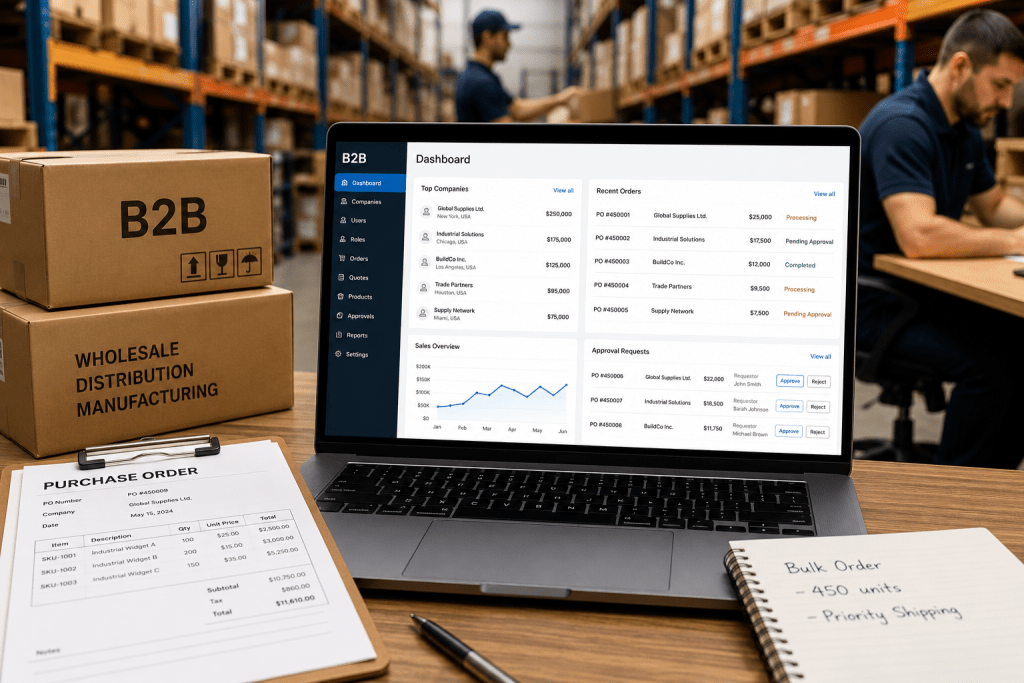
B2B ecommerce introduces challenges that traditional online stores rarely face.
Think about company accounts, negotiated pricing, approval workflows, bulk purchasing, purchase orders, and multiple buyers under one organization. Building these workflows from scratch takes time and ongoing maintenance.
This is where Adobe Commerce has a clear advantage.
It includes a native B2B suite with features such as:
- Company accounts with multiple users
- Custom buyer roles and permissions
- Purchase approval workflows
- Shared catalogs
- Negotiated pricing
- Company credit
- Requisition lists
- Quick Order for bulk purchases
Magento Open Source can support many of these capabilities, but they typically require paid extensions or custom development.
For manufacturers, wholesalers, distributors, and enterprise suppliers, Adobe Commerce often delivers a faster path to launching sophisticated B2B experiences.
If your roadmap includes complex B2B operations, investing in Adobe Commerce Development can significantly reduce implementation complexity while ensuring the platform is built around your business processes.
AI & Personalization Features
Customers expect online stores to understand what they want before they start searching.
Adobe Commerce addresses this through built-in AI-powered capabilities that improve product discovery and increase conversion opportunities.
Native features include:
- Adobe Live Search
- AI-powered Product Recommendations
- Intelligent merchandising
- Personalized shopping experiences
- Customer segmentation
- Dynamic promotional campaigns
These capabilities are powered by Adobe technologies and are designed to help merchants deliver more relevant experiences without relying heavily on manual merchandising.
Magento Open Source doesn’t include these tools by default.
That doesn’t mean AI is off the table. Businesses can integrate third-party recommendation engines, AI search solutions, chatbots, and personalization platforms. The difference is that implementation and ongoing management become part of your development strategy rather than being included as native functionality.
Scalability Comparison
A common misconception is that Magento Open Source cannot handle enterprise traffic.
That’s simply not true.
Both Magento Open Source and Adobe Commerce share the same architectural foundation, meaning both can scale effectively when supported by the right infrastructure, optimized code, and experienced developers.
The real difference lies in operational efficiency.
Magento Open Source requires businesses to manage infrastructure, security, performance tuning, updates, and scaling strategies themselves or through their technology partner.
Adobe Commerce simplifies much of this process by providing enterprise-focused tools, premium support, and deeper integration with Adobe’s ecosystem.
Here’s a simple way to compare them.
Magento Open Source is ideal if you want maximum flexibility and full control.
Adobe Commerce is ideal if you want enterprise capabilities with less operational overhead.
Which Platform Fits Which Business?
There’s no universal winner in the Magento vs Adobe Commerce debate because every business has different priorities.
Choose Magento Open Source if you:
- Are launching a startup or growing business
- Want complete control over customization
- Have an experienced development team
- Prefer investing in development rather than licensing
- Need flexibility without enterprise licensing costs
Choose Adobe Commerce if you:
- Operate at enterprise scale
- Manage multiple brands or storefronts
- Sell to both B2C and B2B customers
- Need advanced merchandising and personalization
- Want native enterprise features instead of managing multiple extensions
- Plan to integrate with Adobe Experience Cloud products
The right choice depends less on your current revenue and more on the complexity of your operations, growth strategy, and internal resources.
Final Thoughts
The biggest takeaway isn’t that one platform is superior. It’s that they’re built for different business journeys.
Magento Open Source remains one of the most flexible ecommerce platforms available today. It gives businesses the freedom to build exactly what they need while controlling infrastructure and development costs.
Adobe Commerce takes that same foundation and adds enterprise-grade capabilities that help larger organizations simplify operations, improve customer experiences, and scale with confidence.
If you’re still asking, “Is Magento still free?” the answer is yes. If you’re asking “Which is better for enterprise?” Adobe Commerce is generally the stronger choice because of its native B2B features, AI-powered merchandising, premium support, and enterprise ecosystem.
Rather than choosing based on feature checklists, evaluate your long-term business goals, operational complexity, and expected growth. The platform that fits those requirements today is far more likely to support your success tomorrow.
Talk To Magento Experts
Choosing between Magento Open Source and Adobe Commerce doesn’t have to be overwhelming. At Webiators, we help businesses evaluate their requirements, build scalable ecommerce solutions, and implement platforms that align with long-term growth goals.
Whether you’re planning a new store, migrating from another platform, or exploring enterprise capabilities, our team is here to guide you through every stage of the journey.
Talk To Magento Experts today and discover which solution is the right fit for your business.
FAQs
1. Is Adobe Commerce paid?
Yes. Adobe Commerce is a licensed enterprise ecommerce platform. Licensing costs are quote-based and depend on factors such as business size, annual gross merchandise value (GMV), and deployment requirements.
2. Which is more scalable?
Both platforms are highly scalable. Magento Open Source and Adobe Commerce share the same core architecture, but Adobe Commerce includes enterprise tools and support that simplify scaling for large businesses.
3. Do Magento Open Source and Adobe Commerce use the same codebase?
Yes. Adobe Commerce is built on Magento Open Source and shares the same underlying codebase. Adobe Commerce extends the platform with additional enterprise features and services.
4. Which platform is easier to manage?
Adobe Commerce is generally easier for enterprise organizations because many advanced capabilities are built in and backed by Adobe support. Magento Open Source offers greater flexibility but requires more hands-on management.
5. What changed from Magento to Adobe Commerce?
After Adobe acquired Magento, the commercial edition was rebranded as Adobe Commerce. Magento Open Source remained the free, open-source edition and continues to be actively maintained by Adobe.
