


Your ecommerce business is growing. Orders are up, traffic is climbing, and your team is adding features faster than ever.
So why does the website feel harder to change?
A developer touches checkout and suddenly needs to test inventory. A new payment integration affects order logic. A traffic spike on product pages pushes the entire application harder than necessary. Even a seemingly harmless deployment starts with someone asking, “What else could this break?”
That question tells you something.
Your ecommerce architecture may be becoming a business constraint.
This is where ecommerce microservices enter the conversation. Not as the latest technology buzzword, but as one possible answer to a very practical problem: how do you keep a complex online store flexible when everything inside it is growing at different speeds?
Your Store Has Changed. Has Your Architecture?
Most ecommerce platforms do not begin with a grand architectural strategy.
They begin with a product catalogue.
Then comes a cart. Then payments. Then customer accounts. Then shipping. Then an ERP integration. Then a mobile app. Then marketplace integration. Then personalised pricing.
Nobody wakes up one morning and decides, “Today, I shall create a tightly coupled legacy system.”
It happens gradually.
A monolithic application can actually be a sensible starting point because everything lives together. A small team can understand it, deploy it, and troubleshoot it without maintaining a complicated network of services.
The problem comes later.
As the business grows, different parts of the platform develop different needs.
Search may need to handle enormous traffic. Inventory may need real-time updates. Checkout needs reliability. Marketing wants frequent changes to promotions. The ERP needs constant synchronisation.
Yet they may still depend on the same application.
That is when the architecture starts fighting the business.
So, What Exactly Is Ecommerce Microservices Architecture?

The basic idea is surprisingly simple.
Instead of building one large application that handles almost everything, you divide the platform into smaller services based on business capabilities.
You could have separate services for:
- Product catalogue
- Search
- Cart
- Checkout
- Payments
- Inventory
- Orders
- Customer accounts
- Pricing
- Promotions
- Shipping
Each service performs a defined job and communicates with other services through APIs or messaging.
Now consider a real situation.
Your search traffic triples during a major sale.
With a monolithic system, you may need to scale the application broadly because search is sharing infrastructure with other functions. With microservices, the search capability can potentially be scaled independently.
That is one of the strongest arguments for the architecture.
But scalability is only half the story.
The Bigger Advantage? Changing One Thing Without Touching Everything
Ask an ecommerce developer what makes a growing platform frustrating, and the answer may have little to do with traffic.
It is dependency.
You want to change one thing, but five other things are connected to it.
Microservices can reduce that coupling by giving business capabilities clearer boundaries.
Suppose your company wants to introduce a new recommendation engine.
It does not necessarily need to become part of the core checkout application.
Want to improve product search?
Work on the search service.
Need a different inventory integration?
Change the inventory capability.
Need to introduce another payment provider?
Modify the payment layer and its integrations without rebuilding unrelated parts of the store.
This independence can make development and deployment more manageable as ecommerce organisations become larger.
And that is where microservices become commercially interesting.
The architecture starts supporting the speed of the business instead of slowing it down.
But Here Is the Catch Nobody Should Ignore
Microservices can solve one kind of complexity by introducing another.
You no longer have one big application to understand.
Now you have multiple services communicating across a network.
That means your engineering team has more questions to answer.
What happens if one service is unavailable?
What happens when a request takes too long?
How do you trace a failed checkout across five services?
How do you authenticate every service?
What happens when payment succeeds but the inventory update fails?
That last question is particularly important.
In a monolithic application, several operations may occur within one database transaction. With distributed services, maintaining consistency across separate components becomes more complicated.
You may need patterns such as asynchronous processing, retries, idempotency, compensating actions, or Saga-based workflows.
In other words, microservices are not a shortcut around engineering complexity.
They are a different way of managing it.
Microservices vs Monolithic Architecture: Which One Wins?
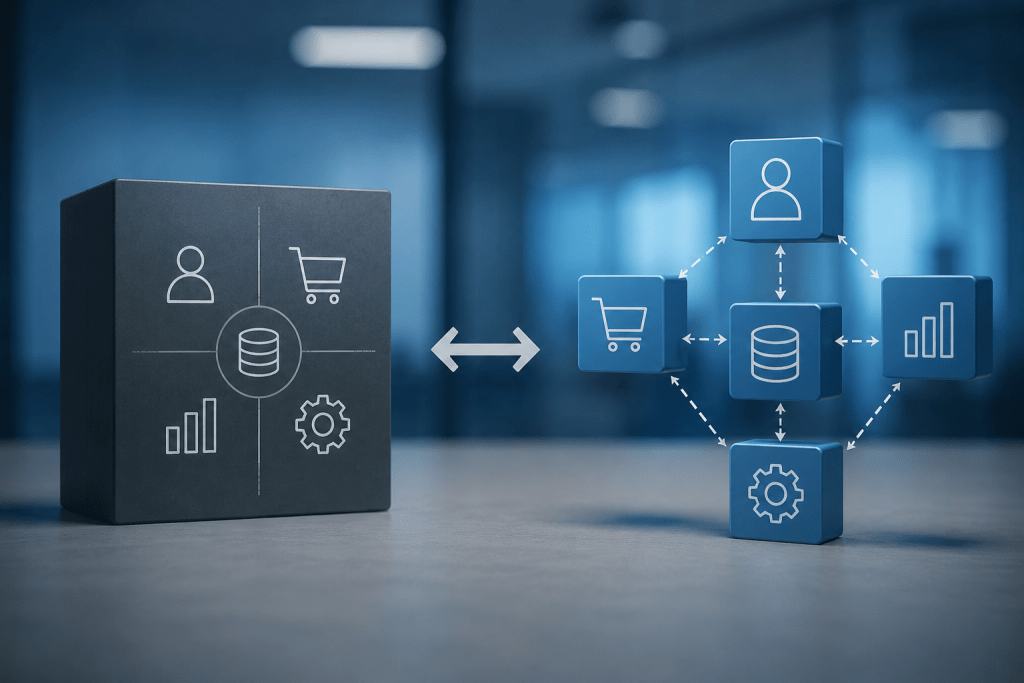
Neither.
That might sound like an unsatisfying answer, but it is the honest one.
| Situation | Better starting point |
| Small store with limited integrations | Monolith may be sufficient |
| Small engineering team | Simpler architecture often makes sense |
| Rapidly growing platform | Evaluate modularisation |
| Many independent development teams | Microservices can help |
| Highly variable workloads | Independent scaling can help |
| Complex integrations | Service boundaries may reduce coupling |
| Mature engineering organisation | Better positioned for microservices |
A company should not introduce microservices because a competitor has them.
That is like buying a commercial kitchen because you made dinner for eight people last weekend.
Architecture should solve an actual problem.
If your monolith is stable, inexpensive, easy to deploy, and handling your workload comfortably, there may be little reason to dismantle it.
What About Migrating an Existing Ecommerce Platform?
This is where I would be particularly careful.
A complete rewrite sounds attractive when the existing codebase is frustrating. It also sounds attractive until you remember that the existing system is processing real orders from real customers.
You cannot simply switch it off.
A more controlled approach is to identify one capability that has a clear boundary and a measurable reason to separate it.
Search could be one candidate.
Inventory might be another.
Pricing, recommendations, customer identity, or order processing could also make sense depending on how the platform is structured.
The existing application can continue handling the remaining functionality while the selected capability is extracted.
Then measure the outcome.
Did deployment become easier?
Did scaling improve?
Did incidents decrease?
Did development become faster?
If the answer is yes, you have evidence for the next stage.
If not, you have avoided spending months rebuilding the entire platform for very little gain.
That is a much healthier migration strategy.
Where Do AI Search and SEO Fit Into This?
Here is another conversation ecommerce leaders increasingly need to have.
Customers are not relying exclusively on traditional search results. They are asking conversational platforms questions, comparing products through AI-powered experiences, and looking for direct answers.
That makes Google AI search, conversational discovery, and emerging AI search queries increasingly relevant to ecommerce teams.
Microservices do not magically make a store visible in AI search.
They should not be sold that way.
What they can provide is a flexible technical foundation for exposing and managing commerce capabilities through APIs and connected systems.
Product information, inventory, pricing, customer data, structured content, performance, and integrations still need to be accurate and accessible.
That is why architecture should be considered alongside AI search optimisation and Technical SEO, rather than treated as a completely separate discipline.
A technically sophisticated platform with poor product information is still poor for discovery.
When Should Your Business Seriously Consider Microservices?
Forget the idea that there is a magic revenue figure where every company should switch.
Look at the symptoms.
You may need to investigate microservices when:
- Releases are becoming risky and slow.
- Different teams constantly interfere with each other’s work.
- One workload needs significantly more scaling than another.
- Integrations are making the codebase increasingly tangled.
- A failure in one capability affects unrelated customer journeys.
- Different business functions need different release schedules.
- Your platform is expanding across multiple channels.
- Your engineering team already has the operational maturity to manage distributed systems.
If those problems sound familiar, Ecommerce Development Services should start with an architecture assessment, not a sales pitch for a complete rebuild.
For businesses managing sophisticated wholesale operations, B2B Ecommerce Development may require equally careful architectural decisions around account permissions, customer-specific pricing, catalogues, approvals, and integrations.
And when standard platforms cannot accommodate unusual workflows, Custom Ecommerce Development can provide greater control over how those capabilities are structured.
The Future Is Not “Everything Must Become Microservices”
This is probably the most important point.
Microservices are not the destination.
A better ecommerce architecture is.
For one company, that might mean a well-structured monolith. For another, it could mean microservices. A third business may need a hybrid architecture where only the most demanding capabilities are separated.
The goal is not to create more services.
The goal is to create fewer unnecessary dependencies.
Your customers do not care whether checkout runs in a monolith or through seven independently deployed services. They care that the page loads, the price is correct, payment works, inventory is accurate, and their order arrives.
That is the standard your architecture should serve.
So before asking, “Should we move to microservices?”
Ask something more useful:
“What is our current architecture preventing the business from doing?”
Find that answer first.
Then choose the technology.
FAQs
What is microservices architecture?
Microservices architecture divides an application into independently managed services, with each service responsible for a specific business capability.
How do microservices improve ecommerce scalability?
They can allow individual services to scale according to their workload instead of requiring the entire ecommerce application to scale together.
What are the benefits of microservices?
Potential benefits include independent deployments, targeted scaling, clearer service ownership, reduced coupling, and greater flexibility for complex ecommerce platforms.
Are microservices secure?
They can be secure, but distributed architectures require careful authentication, authorisation, encryption, access control, dependency management, monitoring, and secure communication between services.
How do microservices compare to monolithic systems?
Monolithic systems are generally simpler to develop and operate initially. Microservices provide greater independence between capabilities but introduce additional distributed-system and operational complexity.
