
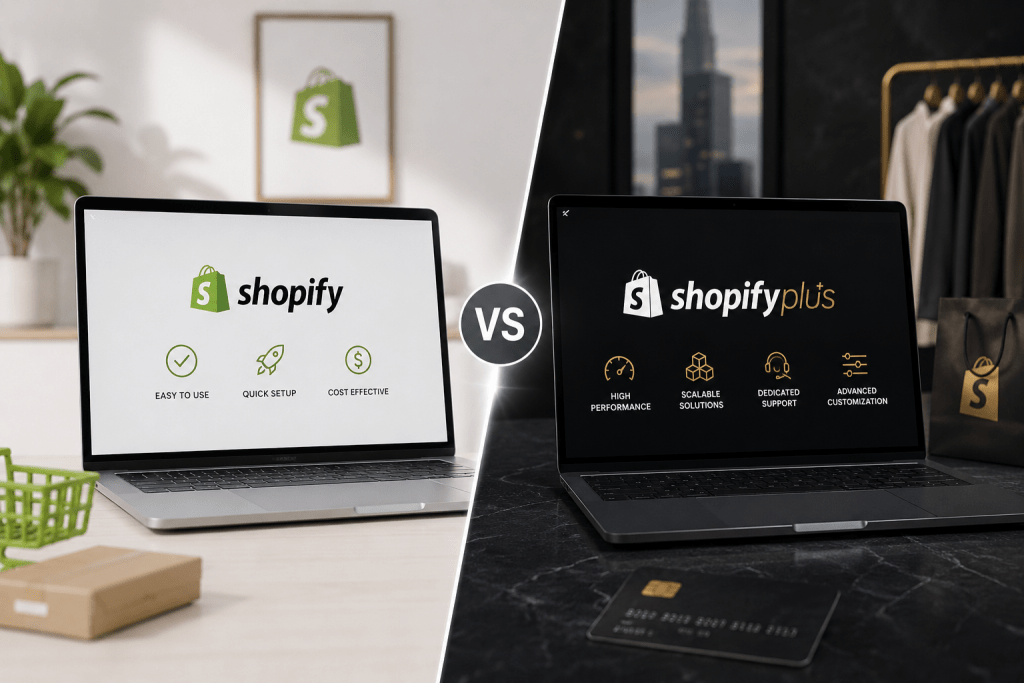

Choosing an ecommerce platform used to be the hard part. Now, for many growing businesses, the tougher question is whether it’s time to move beyond standard Shopify and invest in Shopify Plus.
I hear this question often:
“We’re growing fast. Should we upgrade to Shopify Plus now, or are we paying for features we’ll never use?”
It’s a fair concern. Shopify Plus starts at thousands of dollars per month, so upgrading isn’t a casual decision. Making the wrong choice could mean spending a significant portion of your technology budget on capabilities your business doesn’t actually need.
At the same time, waiting too long can create operational bottlenecks. As your store expands, managing multiple markets, handling B2B customers, coordinating large teams, or supporting complex checkout experiences becomes increasingly difficult on a standard setup.
The confusing part? Much of the content online is outdated.
For example, many articles still claim that Shopify Plus is the only option for B2B selling or that Shopify Flow is exclusive to Plus. Neither statement reflects Shopify’s current platform. Shopify has expanded several enterprise capabilities across paid plans, changing where the real differences lie.
So instead of repeating old comparisons, let’s look at what actually matters in Shopify Plus vs Shopify in 2026. We’ll compare features, pricing, automation, scalability, enterprise tools, and real business scenarios so you can decide whether upgrading is a smart investment or an unnecessary expense.
Quick Comparison Table
| Feature | Shopify | Shopify Plus |
| Best For | Small to mid-sized businesses | High-growth and enterprise businesses |
| Monthly Pricing | Starts with standard Shopify subscription plans | Starts around $2,300 to $2,500/month, depending on contract and business requirements |
| Checkout Customization | Standard checkout customization using Checkout Extensibility where supported | Advanced checkout customization with greater flexibility, branding, APIs, and custom experiences |
| B2B Selling | Core B2B features available on paid plans | Advanced B2B capabilities, unlimited catalogs, deposit payments, payment requests, and enterprise workflows |
| Shopify Flow | Available | Available with greater enterprise-scale implementation possibilities |
| Expansion Stores | Single primary store | Up to 9 expansion stores plus unlimited development stores |
| API Capacity | Standard | Higher API capacity designed for enterprise integrations |
| Team Management | Standard staff permissions | Advanced organization management and permission controls |
| Dedicated Support | Standard support | Priority support and access to Shopify’s Merchant Success resources |
Shopify is an excellent platform for most businesses. Shopify Plus becomes valuable when operational complexity, international expansion, or enterprise-level workflows begin limiting growth.
What Is Shopify?
Shopify is one of the world’s leading hosted ecommerce platforms, allowing businesses to build, manage, and grow online stores without maintaining their own infrastructure.
Whether you’re launching your first product or managing thousands of SKUs, Shopify provides the essential tools needed to sell online, including:
- Product management
- Secure checkout
- Inventory tracking
- Payment processing
- Order management
- Mobile commerce
- Marketing integrations
- App ecosystem with thousands of extensions
One reason Shopify has become so popular is its balance between simplicity and scalability. A startup can launch quickly, while an established brand can continue growing without migrating to an entirely different platform.
For most ecommerce businesses, standard Shopify offers everything required to build a successful online store at a predictable cost.
If you’re planning a new store or optimizing an existing one, investing in professional Shopify Services can help you build a faster, conversion-focused storefront while avoiding costly development mistakes.
What Is Shopify Plus?
Shopify Plus is not a separate ecommerce platform. It’s Shopify’s enterprise plan, built for businesses with more complex operational needs.
Instead of changing how Shopify works, Plus expands what the platform can do.
Businesses typically consider Shopify Plus when they need greater control over checkout, manage multiple international storefronts, support large B2B operations, automate repetitive workflows, or integrate deeply with ERP, CRM, and other enterprise systems.
One common misconception is that Shopify Plus exists simply for businesses with high revenue. In reality, capability requirements matter more than revenue alone. A fast-growing company with complex operations may benefit from Plus earlier than a larger business with relatively simple ecommerce needs.
Shopify Plus also includes organizational features that make it easier to manage multiple stores, larger teams, and international commerce from a centralized environment. These enterprise capabilities become increasingly valuable as operational complexity grows, not just sales volume.
Shopify Plus vs Shopify: Feature Comparison
When businesses compare Shopify Plus vs Shopify, they often focus on pricing first. That’s understandable, but it can also lead to the wrong decision.
A better question is this:
Which platform solves the problems your business has today and the ones you’ll face in the next two to three years?
If your current Shopify store runs smoothly, processes orders efficiently, and supports your growth plans, upgrading to Shopify Plus may not deliver enough value to justify the additional cost. On the other hand, if your team spends hours on manual processes, struggles with international storefronts, or needs deeper checkout customization, Shopify Plus starts looking less like an expense and more like an investment.
Here’s how the two plans compare where it matters most.
| Feature | Shopify | Shopify Plus |
| Online Store | ✔ | ✔ |
| Secure Hosting | ✔ | ✔ |
| Unlimited Products | ✔ | ✔ |
| Checkout Customization | Limited | Advanced customization with Checkout Extensibility, Branding API, and UI Extensions |
| Shopify Flow | ✔ | ✔ |
| Shopify Functions | ✔ | ✔ |
| B2B Selling | Core B2B features | Advanced enterprise B2B capabilities |
| Multiple Stores | One primary store | Up to 9 expansion stores included |
| API Capacity | Standard | Higher API limits for enterprise integrations |
| User Permissions | Standard roles | Advanced organization and user management |
| Priority Support | Standard support | Priority support and Merchant Success resources |
The biggest takeaway
The gap between Shopify and Shopify Plus has become smaller than it was a few years ago.
Shopify has expanded several advanced capabilities, including Shopify Flow and foundational B2B features, to paid plans. That means the decision is no longer about unlocking a handful of exclusive tools. It’s about whether your business has reached a level of operational complexity where enterprise capabilities create measurable value.
Shopify Pricing Comparison
Price is usually the first thing decision-makers ask about.
It shouldn’t be the only factor, but it certainly deserves attention.
Shopify Plans
Shopify offers multiple subscription tiers designed for businesses at different growth stages. These plans provide everything needed to launch and operate an online store, including secure hosting, inventory management, payment processing, and access to Shopify’s extensive app ecosystem.
For many startups and small to medium-sized businesses, these plans are more than sufficient.
Shopify Plus Pricing
Shopify Plus pricing in 2026 starts at approximately $2,300 per month with a three-year contract or around $2,500 per month with a one-year contract. Final pricing can vary depending on contract terms, region, and business requirements.
That difference is substantial.
Paying over $27,000 annually only makes sense if the additional capabilities help your business save time, reduce operational costs, or generate more revenue through improved customer experiences.
If your store generates a few hundred orders per month, Shopify Plus is unlikely to provide a strong return on investment.
If you’re managing thousands of daily orders across multiple regions with separate operational teams, the equation changes dramatically.
Cost isn’t just the subscription
Businesses should also consider:
- Development costs
- Third-party apps
- Operational efficiency
- Staff productivity
- International expansion requirements
- System integrations
A cheaper platform that creates operational bottlenecks can become more expensive over time.
Automation Features
Automation has become one of Shopify’s strongest advantages, regardless of plan.
Many articles still claim that Shopify Flow is exclusive to Shopify Plus.
That information is outdated.
Today, Shopify Flow is available across paid Shopify plans, allowing merchants to automate repetitive tasks without writing code.
Examples include:
- Automatically tagging high-value customers
- Sending fraud alerts
- Managing inventory workflows
- Organizing orders
- Triggering marketing actions
- Updating customer records
These automations can save hours every week.
So why choose Shopify Plus?
The difference isn’t simply having Shopify Flow.
It’s about the scale at which automation operates.
Enterprise businesses typically manage:
- Multiple storefronts
- Thousands of products
- Large customer databases
- ERP integrations
- Warehouse systems
- Regional fulfillment operations
Shopify Plus provides the infrastructure and integration capacity to support these more sophisticated workflows without creating unnecessary complexity.
B2B Features
This is where many comparison articles become inaccurate.
One of the biggest changes to Shopify in recent years is its approach to B2B commerce.
What standard Shopify now includes
Paid Shopify plans now support several core B2B capabilities, including:
- Company profiles
- Customer-specific catalogs with plan-based limits
- Net payment terms
- Purchase orders
- Self-service customer accounts
- Shopify Flow automation
For many wholesalers, these features may be enough.
What Shopify Plus adds
Businesses with larger wholesale operations gain additional enterprise capabilities such as:
- Unlimited product catalogs
- Direct company catalog assignments
- Deposit payments
- Partial payment options
- Payment requests for fulfilled orders
- More advanced B2B purchasing experiences
- Better support for complex account structures
If your wholesale business serves a limited number of customers, standard Shopify may be perfectly adequate.
If you manage hundreds or thousands of B2B buyers across multiple markets with different pricing agreements, Shopify Plus offers significantly greater flexibility.
Enterprise Scalability
Growth isn’t only about selling more.
It’s about managing growth without creating operational chaos.
That’s where enterprise Shopify capabilities become valuable.
Consider a fashion brand expanding from one domestic store to operations across the United States, Canada, Europe, and Australia.
The business now needs:
- Multiple currencies
- Regional storefronts
- Local inventory
- Separate marketing teams
- Country-specific promotions
- Different tax configurations
- ERP synchronization
- Centralized reporting
Trying to manage all of that through a single standard setup quickly becomes challenging.
Shopify Plus addresses these issues with features such as:
- Up to nine expansion stores included with the plan
- Higher API capacity for enterprise integrations
- Advanced organizational controls
- Better multi-store management
- Flexible checkout experiences
- Infrastructure built for high transaction volumes
This level of scalability Shopify offers isn’t something every business needs.
But for brands experiencing rapid growth, expanding internationally, or managing multiple business models, these capabilities can simplify operations and create room for continued expansion.
Which Businesses Should Upgrade to Shopify Plus?
One of the biggest mistakes I see businesses make is treating Shopify Plus as a milestone instead of a business decision.
I’ve spoken with merchants who wanted to upgrade simply because their competitors were on Shopify Plus. Others assumed that crossing a certain revenue figure automatically justified the move.
Neither is a good reason.
The real question is much simpler:
Has your business become too complex for your current Shopify plan?
If the answer is yes, Shopify Plus can remove operational friction. If not, you’ll likely achieve a better return by investing in SEO, paid advertising, conversion rate optimization, or customer retention.
Shopify Is the Right Choice If…
Standard Shopify remains the ideal solution if your business:
- Is a startup or small to medium-sized ecommerce brand
- Sells primarily through one online store
- Has a relatively straightforward product catalog
- Doesn’t require extensive checkout customization
- Has a small team managing operations
- Is still validating products or expanding its customer base
- Wants predictable monthly operating costs
These businesses rarely need enterprise-level infrastructure.
Instead, they’re better served by focusing on growth strategies and customer acquisition.
If you’re launching or improving your online store, working with experienced Shopify Services professionals can often deliver a much higher ROI than upgrading your subscription plan.
Shopify Plus Is Worth Considering If…
Shopify Plus becomes a smart investment when your business starts facing operational challenges such as:
- Selling across multiple countries
- Managing several storefronts or brands
- Processing thousands of orders every day
- Running large B2B and DTC operations simultaneously
- Needing highly customized checkout experiences
- Integrating ERP, CRM, OMS, or warehouse management systems
- Managing large internal teams with complex user permissions
- Requiring enterprise-level automation
At this stage, Shopify Plus isn’t simply adding features.
It’s helping your business scale without increasing operational complexity.
Real Business Use Cases
Looking at real scenarios makes the decision much easier.
Scenario 1: A Fast-Growing Fashion Brand
A clothing retailer sells exclusively within the United States and receives around 500 orders per month.
Its goals include improving SEO, launching email campaigns, and increasing conversion rates.
Would Shopify Plus help?
Probably not.
The business would likely see stronger returns by investing in marketing, better product pages, and conversion optimization rather than paying enterprise subscription fees.
Recommendation: Stay on Shopify.
Scenario 2: A Multi-Country Beauty Brand
A cosmetics company now serves customers across North America, Europe, and Australia.
Each market has different pricing, promotions, taxes, and fulfillment requirements.
The operations team spends hours coordinating multiple systems manually.
Here, Shopify Plus begins solving real business problems through expansion stores, advanced organizational controls, and greater integration capacity.
Recommendation: Shopify Plus makes business sense.
Scenario 3: A B2B Manufacturer
A manufacturer sells to hundreds of wholesale customers, each with unique pricing agreements, payment terms, and purchasing workflows.
The company also operates a direct-to-consumer website.
Managing both business models from a single platform becomes increasingly difficult.
Shopify Plus provides advanced B2B capabilities that simplify wholesale management while maintaining a seamless retail experience.
Recommendation: Shopify Plus is a strong long-term investment.
Scenario 4: A High-Volume Enterprise Retailer
An established ecommerce brand processes tens of thousands of orders during peak sales events like Black Friday and Cyber Monday.
It integrates Shopify with enterprise systems for inventory, accounting, fulfillment, and customer service.
In this environment, operational efficiency matters just as much as sales.
Features such as higher API capacity, expansion stores, advanced checkout customization, and enterprise management tools justify the investment.
Recommendation: Shopify Plus is the better fit.
So, Is Shopify Plus Actually Worth Your Money?
Here’s my honest assessment after comparing both platforms.
For most ecommerce businesses, standard Shopify remains one of the best ecommerce platforms available. It offers an excellent balance of affordability, reliability, and scalability without overwhelming merchants with unnecessary enterprise features.
Shopify Plus isn’t designed to replace Shopify.
It’s designed to remove the operational barriers that growing enterprises eventually face.
If your team is struggling with international expansion, multiple storefronts, sophisticated B2B operations, enterprise integrations, or highly customized checkout requirements, the investment can pay for itself through greater efficiency and improved customer experiences.
If those challenges aren’t part of your business today, there’s no urgency to upgrade.
Instead of asking, “Can I afford Shopify Plus?”, ask yourself:
“Will Shopify Plus solve problems that are already slowing down my business?”
That’s the question that leads to the right decision.
As your business grows, partnering with experts in Enterprise Ecommerce Solutions can also help you evaluate whether upgrading your platform aligns with your long-term growth strategy, ensuring technology supports your business goals rather than driving unnecessary costs.
FAQs
1. What extra features does Shopify Plus include?
Shopify Plus includes advanced checkout customization, up to nine expansion stores, higher API capacity, advanced organization management, priority support, and enterprise-focused B2B capabilities such as unlimited catalogs, deposit payments, and more flexible purchasing workflows.
2. Is Shopify Plus faster?
No. Shopify Plus does not automatically make your website faster. Store speed depends on factors such as theme quality, image optimization, app usage, and custom code. Shopify Plus focuses on scalability, operational efficiency, and enterprise functionality rather than improving page load speed.
3. Can I downgrade from Shopify Plus later?
Yes. Businesses can move from Shopify Plus to another Shopify plan, although the process depends on contract terms and operational requirements. Before downgrading, it’s important to review any enterprise features your business relies on to avoid disrupting day-to-day operations.
4. How much does Shopify Plus cost in 2026?
Shopify Plus pricing starts at approximately $2,300 per month with a three-year agreement or around $2,500 per month with a one-year agreement. Final pricing may vary based on contract terms, region, and business requirements.
5. Does Shopify Plus increase sales?
Not automatically. Shopify Plus doesn’t generate sales on its own. However, its advanced checkout capabilities, automation tools, international commerce features, and enterprise workflows can improve customer experience and operational efficiency, creating better opportunities for long-term revenue growth.
Talk To Shopify Experts
Choosing between Shopify and Shopify Plus isn’t about selecting the most expensive plan. It’s about selecting the platform that matches your business’s current needs and future ambitions.
At Webiators, we help businesses make that decision with confidence. Whether you’re launching a new Shopify store, optimizing an existing one, migrating from another platform, or planning an enterprise-scale ecommerce strategy, our experienced team can guide you every step of the way.
Talk to Shopify Experts today and discover the solution that will deliver the greatest value for your business, both now and as you continue to grow.
