
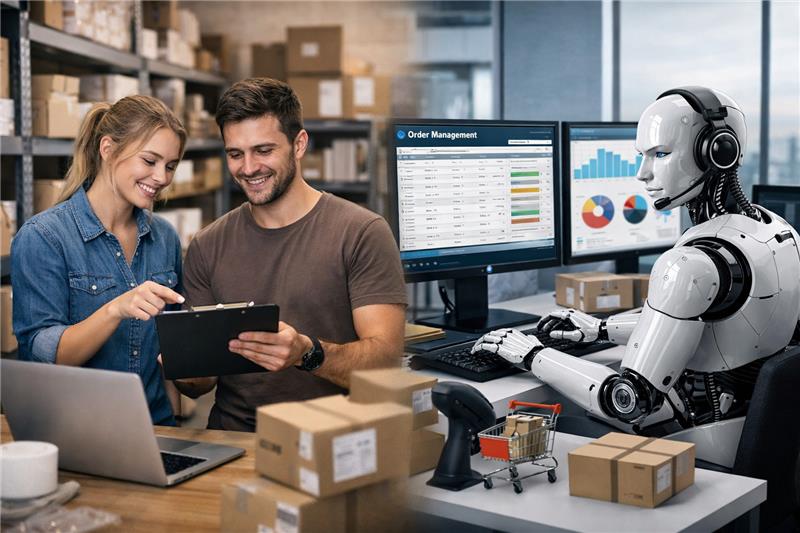

If you are running an ecommerce brand right now, your operations team probably feels stretched. Orders, returns, inventory sync, customer emails at 2 a.m., fraud checks, catalog updates. It never really stops.
Here is the reality. According to the World Economic Forum Future of Jobs Report 2023, employers estimate that 44% of workers’ core skills will change by 2027 due to automation and AI adoption.
That shift is already visible inside ecommerce.
This is where ecommerce automation moves from buzzword to business necessity.
The Quiet Takeover of AI in Ecommerce
AI in ecommerce is not futuristic anymore. It is operational.
Inventory forecasting powered by machine learning. Automated customer service through AI chat systems. Smart fraud detection analyzing thousands of transactions in seconds. Dynamic pricing engines adjusting margins in real time.
What used to require five people and three spreadsheets now runs through AI ecommerce operations tools.
And yes, some operational roles will shrink. Not because businesses are ruthless. Because systems are getting smarter.
Which Roles Are Most Affected?
Let’s be specific.
1. Order Processing and Manual Data Entry
Repetitive tasks are the first to go. Automated workflows can now process orders, trigger fulfillment, update inventory, and send confirmation emails without human intervention.
If you still have someone copying order details into multiple systems, you are paying for inefficiency.
2. Basic Customer Support
AI tools for ecommerce can handle order tracking, return policies, refund status, and FAQs instantly. Human agents now focus on escalations and complex cases. That is smarter allocation of talent.
3. Inventory Forecasting
AI ecommerce operations platforms analyze seasonality, buying patterns, and regional trends with more precision than manual forecasting. Less overstock. Fewer stockouts. Better cash flow.
That is not theory. That is measurable margin improvement.
Why Founders Should Welcome Ecommerce Automation
You might wonder, is this bad for company culture?
Not if handled correctly.
Automation does not eliminate ambition. It eliminates friction.
When you automate ecommerce operations, your team shifts from repetitive execution to strategic thinking. Marketing experiments. Conversion optimization. Partnership growth. Product expansion.
One DTC founder recently told us his operations team went from “firefighting mode” to “growth mode” after AI implementation. Same people. Different focus. Revenue increased because attention moved upstream.
That is the difference between survival and scale.
AI for Ecommerce Business: Competitive Pressure Is Real
Your competitors are not waiting.
According to McKinsey research on AI adoption in retail, companies integrating AI into operations report cost reductions of up to 20% and revenue uplift from personalization strategies.
If your margins are tight, a 10 to 20% operational efficiency gain is massive.
Magento stores, Shopify brands, B2B E-commerce platforms, all of them are integrating AI into workflows. The question is not whether automation is coming. It is whether you will lead or lag.
The Smart Way to Automate Ecommerce Operations
Blind automation is dangerous. Strategic automation is powerful.
You need:
- Clean data architecture
- Platform compatibility
- Workflow mapping
- API integrations
- Performance testing
That is where professional Ecommerce development services matter. Whether you are on Shopify or Magento, implementation must align with your infrastructure.
For Shopify stores, combining AI with structured Shopify Development Services ensures automation enhances UX rather than breaking it.
For enterprise brands on Magento, integrating AI through experienced Magento Development Services avoids operational disruption.
AI should plug into your ecosystem seamlessly.
The Human Layer Still Matters
Here is something important.
AI does not replace leadership. It replaces low leverage tasks.
Creative direction, brand storytelling, strategic partnerships, customer empathy. Those remain deeply human.
What ecommerce automation really does is buy you time. Time to think. Time to innovate. Time to build brand equity.
And in ecommerce, time is profit.
Final Thoughts
AI in ecommerce is not about replacing people. It is about replacing inefficiency.
Yes, certain operational roles will shrink or evolve. But founders who embrace automation early will build leaner, more scalable businesses.
If you are serious about growth, now is the moment to assess where AI fits inside your infrastructure.
At Webiators, we help brands implement intelligent ecommerce automation strategies that reduce cost and unlock performance without compromising stability.
The future of ecommerce operations is not heavier teams. It is smarter systems.
The real question is simple.
Are you building for today’s workload, or tomorrow’s scale?
FAQs
1. What is ecommerce automation?
Ans. Ecommerce automation uses AI and software tools to manage repetitive tasks such as order processing, inventory updates, customer support, and marketing workflows.
2. Will AI completely replace ecommerce jobs?
Ans. No. AI replaces repetitive operational tasks. Strategic, creative, and leadership roles remain essential.
3. How can AI improve profit margins?
Ans. AI reduces manual errors, lowers operational costs, improves forecasting accuracy, and enhances personalization, leading to higher conversions and lower waste.
4. Is ecommerce automation suitable for small businesses?
Ans. Yes. Even startups can use AI tools for ecommerce to streamline operations and scale efficiently without hiring large teams.
5. How do I start automating my ecommerce business?
Ans. Begin with an operational audit. Identify repetitive processes, evaluate AI tools compatible with your platform, and work with experienced Ecommerce development services providers for proper implementation.
